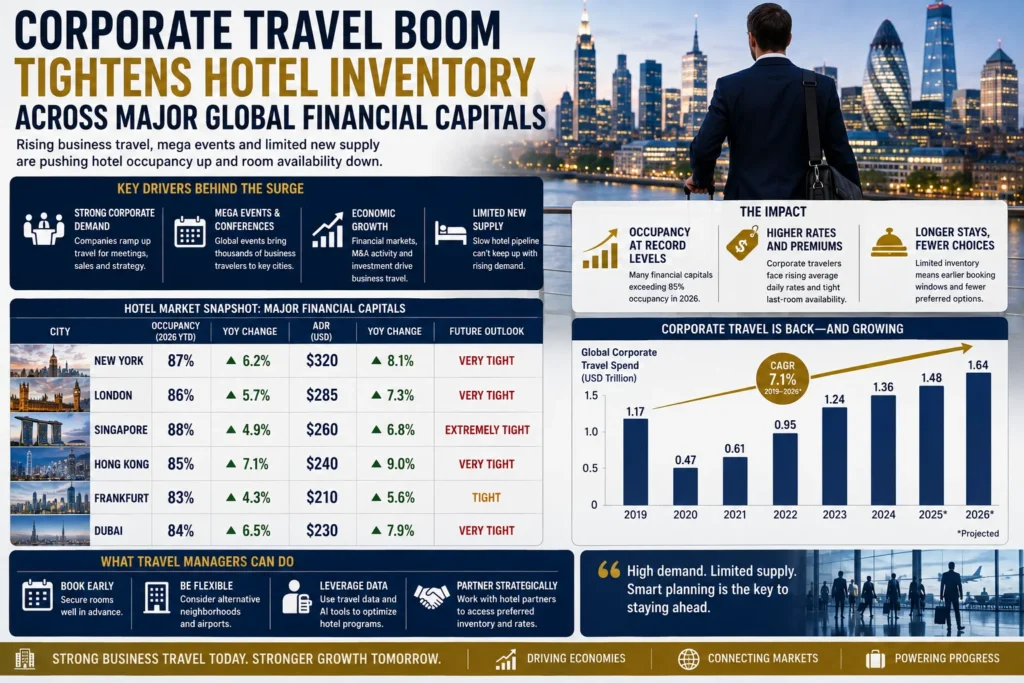
A major compression in lodging inventory has taken hold across the world’s leading commercial hubs as a surge in global business travel collides with sustained leisure demand. Managed under municipal development frameworks and official tourism board initiatives, cities such as Bogotá, New York, Singapore, London, Paris, and Tokyo are experiencing historically high hotel occupancy rates and rising daily room costs.
This expansion of corporate travel and corporate events is driving record performance metrics across key hospitality markets. As global executives and event delegates compete with leisure visitors for prime accommodations, municipal planning departments are accelerating hotel development projects to expand room capacity along primary transit corridors.
Bogotá Expands Business Travel and MICE Infrastructure
Bogotá stands out as a primary corporate travel node in Latin America. Official figures indicate that the capital expects to welcome over 15.3 million total visitors in 2026, representing a 4.5 percent increase over the previous year. This rapid growth has created severe lodging compression in central corporate districts like Chapinero and Usaquén.
According to official tourism statistics, Bogotá recorded a 55.0 percent hotel occupancy rate in early 2026, outperforming Colombia’s national average by 8.7 percentage points. Municipal programs like RVMBO 2026 have directly driven event demand, connecting hundreds of hospitality providers with international buyers from Mexico, Spain, Brazil, and the United States. Furthermore, international air passenger traffic through El Dorado International Airport reached an 80.3 percent seat load factor, supporting over 110,000 monthly hospitality jobs across the capital.
Record Demand Across North American and Asian Commercial Hubs
The impact of corporate travel growth is equally pronounced across North America and Asia:
New York City (United States): New York City Tourism + Conventions projects total visitation to reach 66.3 million visitors, with business travel accounting for 12.8 million arrivals. The city’s average hotel occupancy reached 84.2 percent, leading the top 25 U.S. hotel markets. Average daily room rates reached $334, while over 5,700 new hotel rooms remain under active development through 2028.
Singapore: Named the Asia-Pacific region’s top convention destination by international rankings, Singapore generated record tourism receipts. To manage delegate demand, the Singapore Tourism Board launched the SHINE hotel incentive framework, linking 22 major properties representing up to 25 percent of central room inventory to offer preferential rates for business events.
Tokyo (Japan): Tokyo Metropolitan Government data confirms that international visitor numbers climbed to 28.65 million, with overall foreign spending reaching ¥4.55 trillion. Lodging expenses represented the largest visitor expenditure category, climbing 12.9 percent year-on-year to reach ¥65,199 per traveler, concentrated around commercial districts like Marunouchi, Ginza, and Shibuya.
European Event Districts Experience Extended Occupancy Pressure
In Western Europe, major corporate gatherings, trade fairs, and sporting events have tightened room supply across key urban centers:
London (United Kingdom): London City Hall updated long-term lodging requirements following data indicating over 36 million overnight visitors. Forecasts identify a structural need for tens of thousands of additional serviced rooms to accommodate corporate travel alongside major annual events like Wimbledon and international trade conventions.
Paris (France): Greater Paris recorded overall hotel occupancy of 76 percent, with specialized event zones reaching 77 percent. Districts surrounding major convention halls, such as Porte de Versailles, reported a 20.5 percent surge in overnight stays, prompting the development of 60 new hotel projects across the region.
| Global City Hub | Projected Annual Visitors | Key Hotel Occupancy Rate | Dominant Business & Travel Corridors |
| Bogotá | 15.3 Million | 55.0% (Capitals Lead) | Chapinero, Usaquén, El Dorado Transit |
| New York City | 66.3 Million | 84.2% (U.S. Leader) | Midtown, Financial District, Hudson Yards |
| Singapore | High-Volume MICE Hub | S$2.3B MICE Receipts | Marina Bay, Orchard Road, City Hall |
| London | 36.0+ Million | High Central Density | City of London, Canary Wharf, West End |
| Paris | High-Density Region | 76.0% Regional Average | Porte de Versailles, La Défense, Central Seine |
| Tokyo | 28.65 Million | Record Visitor Spend | Marunouchi, Ginza, Shibuya District |
Practical Guidelines for Navigating Corporate Lodging Shortages
To secure competitive accommodations amidst widespread capacity constraints, destination specialists recommend several key operational strategies:
Pre-Book Midweek Stays: In major financial districts like Usaquén in Bogotá or Marunouchi in Tokyo, secure midweek business accommodations at least four to six weeks prior to departure to avoid price volatility.
Leverage Official Event Incentives: Delegates attending international conventions should check if host properties qualify for official incentive networks, such as Singapore’s SHINE program, to access guaranteed group rates.
Utilize Mass Transit Links: In high-density cities like London and Paris, select eco-certified properties located slightly outside central business cores but directly connected to primary underground metro lines.
Consult Official Tourism Registrations: Reference verified municipal tourism registries to source newly accredited boutique hotels and certified alternative accommodations.
As global corporate travel continues to expand, public tourism boards and private hospitality developers are aligning investments in transit infrastructure and sustainable hotel construction to maintain long-term urban accessibility.
For more travel news like this, keep reading Global Travel Wire