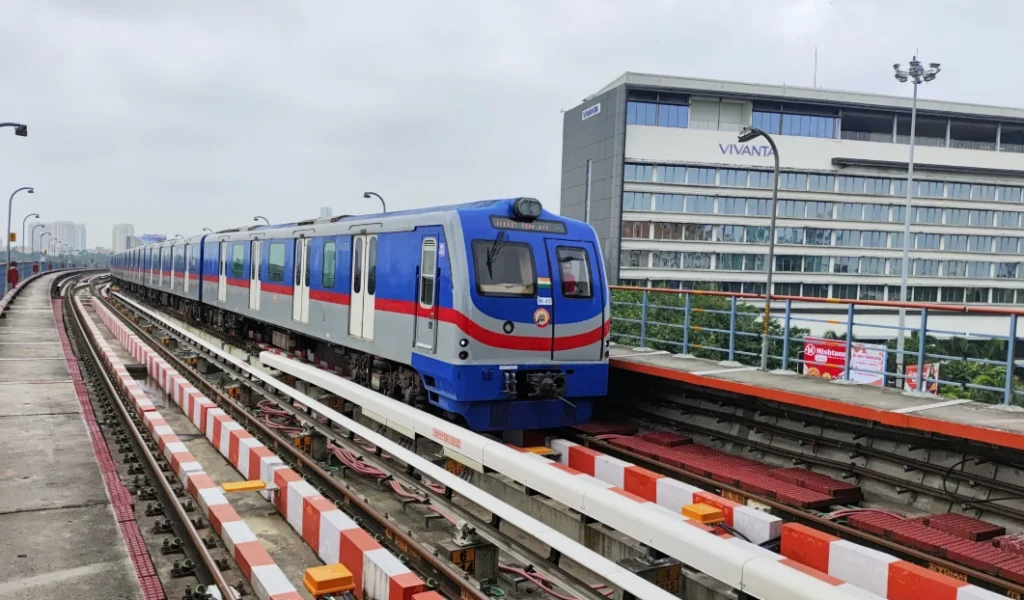
Kolkata Metro Railway is preparing for another major phase of growth, with its network expected to expand to around 130 kilometres in the coming years as new corridors and extensions strengthen rapid transit across the city and surrounding urban areas.
Metro Railway General Manager Prem Sagar Gupta outlined the expansion vision during his Independence Day address at Metro Rail Bhavan on August 15, 2026. The target represents the future overall network length, rather than construction of 130 kilometres of entirely new lines.
Government information has previously outlined a 130 km network objective, while the Ministry of Railways confirmed in March 2026 that four Kolkata Metro corridors covering about 52 kilometres were under construction.
For residents, business travellers and visitors, the expansion could create faster connections between residential districts, employment centres, railway stations, shopping areas and major visitor destinations while reducing dependence on congested road travel.
Metro becomes a major Kolkata transport backbone
Passenger numbers demonstrate the growing importance of rapid transit in Kolkata.
According to figures presented by Gupta, Metro Railway carried 23.60 crore passengers during the 2025–26 financial year. The scale of usage reinforces the system’s position as an increasingly important part of everyday mobility in the metropolitan region.
As additional corridors become operational, the network can potentially serve communities that currently depend heavily on buses, suburban rail, taxis and private vehicles.
A broader system also creates advantages for tourists. Easier connections between transport hubs, commercial areas and attractions can reduce travel uncertainty for visitors unfamiliar with Kolkata’s busy road network.
The city already gained international attention for infrastructure innovation when India’s first underwater metro section beneath the Hooghly River entered service, adding another distinctive element to Kolkata’s transport system.
Revenue rises sharply as passenger demand strengthens
Metro Railway is also recording stronger financial performance.
Gupta reported earnings of ₹166 crore between April and July 2026, representing a 34% increase compared with the corresponding period a year earlier.
The increase comes as Metro services become more deeply embedded in Kolkata’s daily transport patterns.
Higher utilisation can support the broader case for continued investment in passenger amenities, operational reliability and infrastructure capacity as the network expands.
For the visitor economy, dependable public transport is particularly important. Hotels, restaurants, entertainment districts and attractions benefit when travellers can move around a city efficiently without relying entirely on private transport.
Four major corridors remain under development
The 130 km vision is being supported by several ongoing projects.
The Ministry of Railways said in March that four Metro corridors with a combined length of about 52 kilometres were under construction in and around Kolkata. These include remaining sections of the Joka–Esplanade corridor and other projects intended to extend rapid transit into areas not previously served by Metro.
Construction has continued to progress during 2026.
In July, Kolkata Metro achieved another milestone on the Purple Line when Tunnel Boring Machine “Durga” completed a breakthrough as part of underground construction activity.
Such projects are gradually transforming Kolkata from a city centred on one historic Metro corridor into a multi-line rapid transit network.
Digital ticketing changes the passenger experience
Infrastructure expansion is being accompanied by digital modernisation.
Metro passengers are increasingly using electronic methods to purchase QR-based tickets and recharge smart cards, reducing dependence on traditional ticket counters.
The official Aamar Kolkata Metro application, developed by the Centre for Railway Information Systems, enables passengers to book QR tickets and top up Stored Value Smart Cards through their mobile devices.
Passengers can present the generated QR ticket at Automatic Fare Collection gates for entry and exit.
For visitors, mobile ticketing can make Metro travel easier by reducing queues and simplifying access to public transport.
Digital services will become increasingly important as the network grows and passenger volumes rise.
Faster connectivity could strengthen Kolkata tourism
A larger Metro network could have benefits extending beyond everyday commuting.
Kolkata attracts travellers for heritage tourism, festivals, food, culture, healthcare, education and business. Better rapid-transit coverage can improve connections between accommodation districts, railway terminals, commercial centres and attractions.
Reduced road dependency can also make visitor itineraries more predictable in a city where congestion can significantly affect journey times.
Public transport expansion therefore contributes not only to urban mobility but also to the overall destination experience.
Kolkata prepares for a new mobility era
Kolkata Metro’s planned growth toward approximately 130 kilometres represents a significant transformation of the city’s transport landscape.
Strong passenger volumes, rising revenue, ongoing corridor construction and expanding digital ticketing demonstrate that development is taking place across both physical and technological infrastructure.
Metro Railway is also focusing on safety, passenger amenities and operational reliability as the system grows.
For Kolkata, the long-term result could be a more connected urban region where residents and visitors can move between neighbourhoods faster and more efficiently.
As new sections are completed, the Metro is positioned to become an even stronger backbone for Kolkata’s economy, tourism industry and everyday urban life.
For more travel news like this, keep reading Global Travel Wire