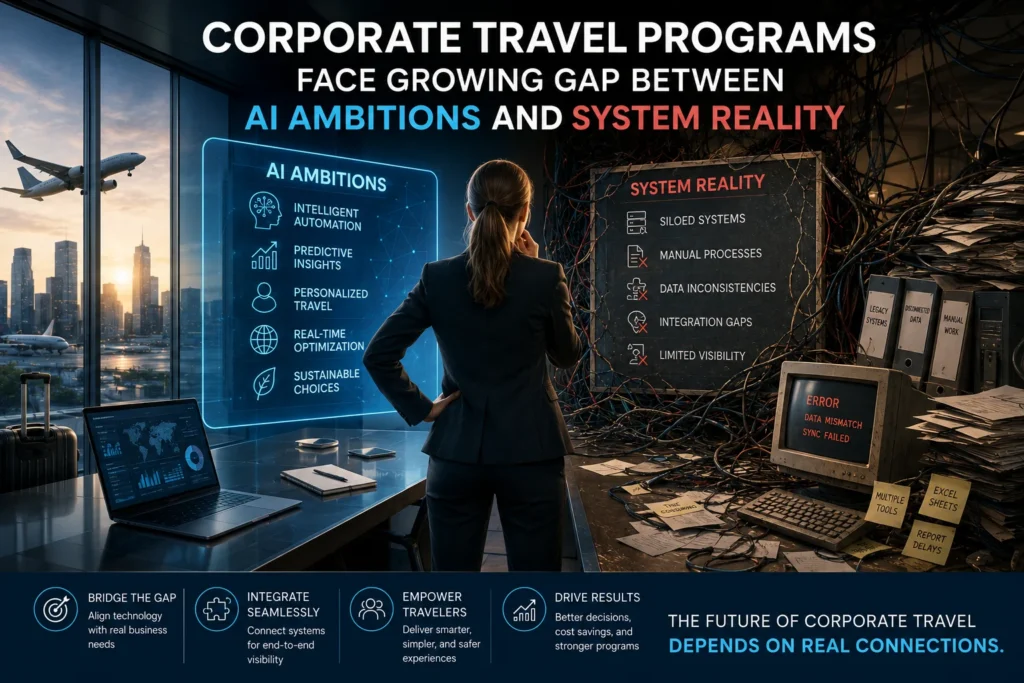
The corporate travel sector is undergoing a major technological transformation, yet a significant divide has emerged between software expectations and operational reality. Official public survey metrics released during major industry assemblies confirm that while travel decision-makers expect high-level technology to lead corporate travel developments, real-world deployment continues to lag behind commercial needs.
According to survey data compiled from more than 200 corporate travel managers across North and South America, nearly one in five travel buyers cites slow artificial intelligence integration as a primary technology frustration. Despite these implementation delays, digital transformation is projected to be the single most influential factor shaping corporate travel management over the next fifteen months, moving ahead of broader global economic pressures and general inflation metrics.
Shifting Priorities Across Corporate Travel Program Operations
Official public survey benchmarks track how operational priorities have shifted significantly compared to previous review cycles. Travel decision-makers were asked to evaluate the primary factors expected to impact corporate travel programs over the coming fifteen months:
Artificial Intelligence: Identified by 22 percent of buyers in 2026, up from 19 percent in 2025.
Advances in Technology and Data Analytics: Selected by 17 percent of travel managers, up from 15 percent previously.
Global Economic Pressures and Inflation: Selected by 16 percent of respondents, representing a sharp drop from 26 percent last year.
Dynamic Pricing and Rate Negotiations: Cited by 16 percent of corporate travel buyers, doubling from 8 percent in the previous survey.
Geopolitical Tensions and Conflict: Identified by 11 percent of program managers, down slightly from 13 percent.
These shifts illustrate that while macroeconomic volatility remains a background concern, corporate program leaders are turning their focus toward digital management tools, automated rate structures, and advanced data analytics to control travel expenditures.
Customization and System Flexibility Emerge as Main Technical Barriers
Beyond implementation delays, corporate travel buyers report widespread frustration with rigid software architectures and limited platform customization. When identifying their primary technical pain points, respondents highlighted systemic barriers that slow operational workflows:
Excessive Implementation Timelines: 44 percent of buyers report that software updates and custom configurations take too long to execute.
Lack of Customization Options: 41 percent state that standard corporate booking environments lack the flexibility required for tailored travel policies.
Additional Financial Costs for Custom Features: 37 percent cite high add-on costs for software modifications as a major barrier.
Poor Interoperability Between Tools: 31 percent report significant friction when attempting to sync booking engines, expense platforms, and security tools.
Insufficient Access to Raw Program Data: 26 percent indicate that limited data extraction restricts comprehensive reporting and auditing.
Official industry feedback emphasizes that travel managers are not seeking standalone tools or complex software layers. Instead, corporate programs require flexible platforms that integrate smoothly with existing enterprise infrastructure, streamline administrative tasks, and deliver actionable data for duty-of-care compliance.
Overall Satisfaction with Current Travel Technology Stacks Remains Moderate
The disconnect between technology capabilities and program requirements is reflected in overall software satisfaction scores across the business travel sector. Official survey results reveal that only 7 percent of corporate travel decision-makers rate their current technology stack as highly satisfactory with a maximum rating.
Nearly half of all surveyed buyers—49 percent—evaluate their digital tools at a mid-level rating of three out of five, while approximately 14 percent assign low ratings of one or two.
When asked to specify the single most important change needed in their travel ecosystem, corporate program leaders consistently emphasize five key operational priorities:
Flexible Architecture: Booking engines that adapt quickly to updated corporate travel policies.
Advanced Analytics: Robust reporting tools capable of processing real-time spend and carbon metrics.
Connected Platforms: Seamless data sharing across travel management, expense tracking, and corporate card systems.
Simplified Administration: Automated workflows that reduce manual oversight for routine approvals and travel audits.
Controlled Testing Environments: Opportunities to pilot digital features and automated workflows before full enterprise rollout.
Data Integrity as the Foundation for Advanced Travel Intelligence
Public sector announcements and transport administration guidelines emphasize that digital tools rely on robust, high-quality data. Without clean administrative input, advanced tools can exacerbate booking errors or generate inaccurate reporting.
As corporate travel managers look toward future software updates, the emphasis is shifting from theoretical promises to practical, value-driven execution. Enterprise buyers are demanding tools that deliver verified administrative efficiencies, reduce friction for traveling employees, and maintain rigorous data accuracy across all financial compliance channels.
For more travel news like this, keep reading Global Travel Wire