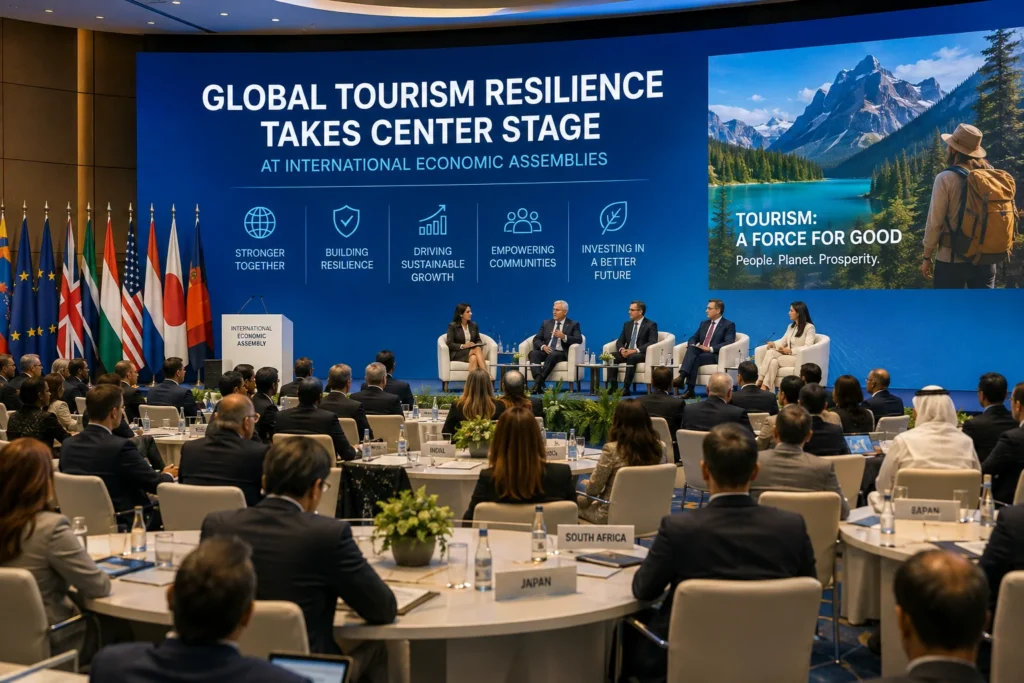
Global tourism policy is undergoing a structural shift as economic decision-makers prioritize crisis preparedness, risk mitigation, and systemic adaptability over simple volume expansion. Official public disclosures confirm that Jamaica’s Minister of Tourism, Edmund Bartlett, has accepted an invitation to co-chair the upcoming Beyond Tourism Day 2026 initiative, scheduled to take place at the World Economic Forum headquarters in Geneva.
Operating under the thematic framework of resilient growth and renewed impact, the high-level meeting brings together senior government ministers, institutional investors, infrastructure experts, and civil society leaders. The session focuses on addressing structural fragmentation within the travel ecosystem, persistent labor shortages, rapid technological shifts, climate vulnerabilities, and capacity constraints across international destinations.
Transitioning Crisis Preparedness into Mainstream Economic Policy
The co-chair appointment reflects Jamaica’s long-standing effort to transition destination resilience from specialized crisis management into mainstream international economic policy. Official Jamaican tourism ministry statements highlight that building structural adaptability is essential for protecting national balance sheets, maintaining foreign currency inflows, and safeguarding employment.
Public sector reporting framework updates from international economic forums demonstrate a broader evolution in how travel and tourism are analyzed. Rather than evaluating hotel accommodations, aviation networks, and destination marketing as isolated industries, international framework models adopt an interconnected ecosystem approach. Under this model, public infrastructure, digital networks, financial systems, local communities, and regulatory bodies operate as a unified value chain where disruptions in one node rapidly cascade across the sector.
To strengthen cross-sector alignment, international research frameworks identify five core enabling conditions that must be developed systematically: human capital development, targeted capital allocation, physical infrastructure, technology integration, and public governance models. For island nations and climate-exposed coastal destinations, embedding risk management directly into long-term infrastructure planning has become a foundational requirement for sustained economic competitiveness.
The Role of International Frameworks and Institutional Infrastructure
Jamaica’s prominent role in global resilience discussions builds upon years of institutional development designed to assist destinations in preparing for, managing, and recovering from systemic shocks.
Official program documentation confirms that the Global Tourism Resilience and Crisis Management Centre, established in Jamaica in 2018, serves as a primary international research platform. The center conducts data analytics, risk management modeling, and public policy formulation focused on diverse disruption vectors—ranging from extreme weather events and health emergencies to cybersecurity threats and market volatility.
This institutional work has achieved formal recognition across international bodies:
Global Tourism Resilience Day: On February 6, 2023, the United Nations General Assembly officially adopted Resolution A/RES/77/269, designating February 17 as Global Tourism Resilience Day. Maintained as an annual international observance, the resolution urges member states to establish national recovery strategies, enhance public-private partnerships, and diversify tourism offerings.
International Year of Sustainable and Resilient Tourism 2027: Following Jamaica’s sustained advocacy, the UN General Assembly adopted Resolution A/RES/78/260, officially declaring 2027 as the International Year of Sustainable and Resilient Tourism. This global initiative calls on international financial institutions, national governments, and regional bodies to align tourism investments with climate adaptation, environmental conservation, and social inclusion frameworks.
Addressing Climate Risk, Workforce Shortages, and Digital Systems
Official documentation prepared for international policy discussions highlights three central challenges requiring coordinated public and private intervention:
Climate Exposure and Infrastructure Adaptation
Climate-related disruptions extend far beyond immediate storm events. Changing weather patterns impact freshwater security, cause coastal erosion, increase asset insurance costs, and disrupt transport networks. National tourism boards emphasize that adapting coastal and natural infrastructure is vital to maintaining asset values and ensuring visitor safety.
Human Capital and Workforce Stabilization
Post-pandemic operational challenges revealed significant workforce shortages across international hospitality networks. Sustainable sector growth requires comprehensive education programs, skill certification frameworks, and improved labor retention strategies to support increasingly complex digital and operational environments.
Technological Transformation and Cybersecurity
The rapid deployment of automated booking systems, artificial intelligence platforms, and digital credentialing offers operational efficiencies but exposes travel networks to system interruptions. Building digital resilience requires stringent data protection protocols, robust cyber infrastructure, and coordinated emergency response frameworks across public transit hubs and private accommodation systems.
Future Outlook for Global Destination Management
The high-level discussions in Geneva reflect a broader movement toward establishing standardized resilience metrics within international tourism development. As global travel volumes expand alongside environmental and economic complexities, destinations that build proactive management frameworks, secure adaptive capital, and invest in resilient infrastructure will lead the global travel economy into its next era of growth.
For more travel news like this, keep reading Global Travel Wire