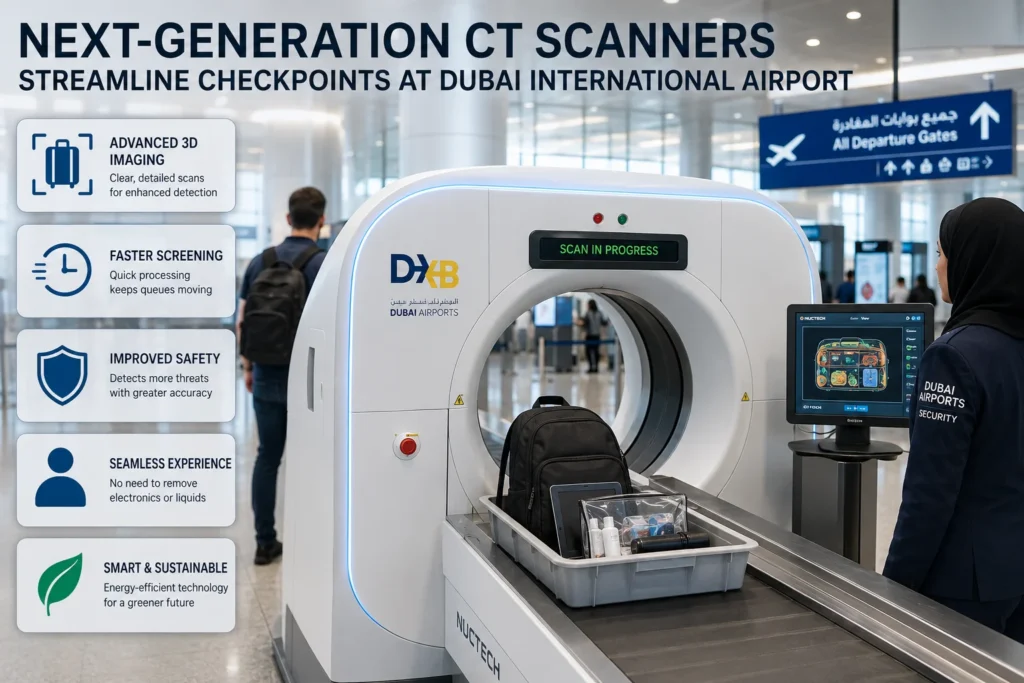
A major operational modernization is underway at Dubai International Airport (DXB) as aviation authorities roll out advanced computed tomography (CT) screening technology across security checkpoints. The next-generation systems eliminate the longstanding requirement for passengers to unpack laptops, personal electronics, and liquids from their hand luggage during security screening.
The initiative, managed under Dubai Aviation Engineering Projects and Dubai Airports, replaces legacy X-ray equipment with high-resolution 3D imaging suites. These systems generate multi-dimensional volumetric views of bag contents, enabling security personnel to inspect carry-on items accurately without manual separation.
According to official statements from Dubai Airports, the airport-wide deployment follows successful trial phases aimed at increasing throughput, reducing queue times, and elevating passenger convenience across all operational terminals.
Enhanced Processing Capacity Supports Global Aviation Growth
As one of the world’s primary international transit hubs, Dubai International Airport manages millions of passengers annually across peak flight banks. Implementing automated screening technology accelerates processing speeds per passenger lane, significantly reducing physical bottlenecks at departure checkpoints.
Official announcements confirm that the CT screening units feature automated tray return systems, smart lane management software, and integrated object recognition algorithms. These automated features streamline physical tray movement, permitting security officers to focus on threat detection rather than manual tray handling.
The technology complies with international aviation safety certifications, including standards established by the U.S. Transportation Security Administration and the European Civil Aviation Conference. By aligning with global regulatory benchmarks, DXB reinforces its position as an international leader in airport operational efficiency.
Physical Refurbishments Optimize Passenger Flow in Terminal 1 and Concourse B
The rollout of advanced security hardware is accompanied by targeted physical infrastructure upgrades across key operational zones. Major refurbishment works are underway in Terminal 1 and Concourse B to expand checkpoint corridors and optimize passenger flow.
Structural changes include laying new durable flooring, reconfiguring queue lines, and building additional security processing lanes. Aligning terminal architecture with automated CT screening capabilities ensures that physical layout constraints do not impede the increased processing capacity enabled by the new technology.
These spatial enhancements provide passengers with direct access to central departure concourses, increasing dwell time in retail, dining, and relaxation zones. By reducing time spent at security checkpoints, the airport authority improves overall terminal capacity without requiring expansive physical floor extensions.
Transitional Operational Guidelines for International Passengers
Because hardware replacement is proceeding through a phased installation schedule across Terminals 1, 2, and 3, screening protocols may vary depending on specific departure gates and concourses. While upgraded lanes permit electronics and liquids to remain packed, selected processing points using legacy equipment will temporarily maintain standard unpacking rules.
Airport authorities advise travelers to review terminal signage and follow on-site directions provided by security officers at each checkpoint. To ensure a seamless transit experience, passengers are encouraged to observe the following travel recommendations:
Follow clear lane signage indicating whether screening equipment requires unpacking personal belongings.
Utilize automated biometric Smart Gates for immigration clearance to complement faster security processing.
Prepare passports and travel documents ahead of time to maintain steady movement through immigration queues.
Take advantage of expanded off-peak transit windows when navigating central terminal concourses.
Long-Term Airport Transformation and Sustainable Transit Infrastructure
The security modernization strategy aligns with broader government directives aimed at building intelligent, high-capacity transport infrastructure. Upgrading security screening protocols supports the United Arab Emirates’ wider aviation strategy, ensuring existing hubs operate efficiently while long-term master plans progress for Al Maktoum International Airport.
Modern CT scanners also contribute to airport sustainability targets by optimizing energy consumption per passenger processed and reducing reliance on single-use plastic bags traditionally required for liquid segregation.
By merging technological innovation, physical infrastructure upgrades, and passenger-centric operational design, Dubai International Airport continues to establish new benchmarks for international air travel, safety compliance, and terminal efficiency.
For more travel news like this, keep reading Global Travel Wire