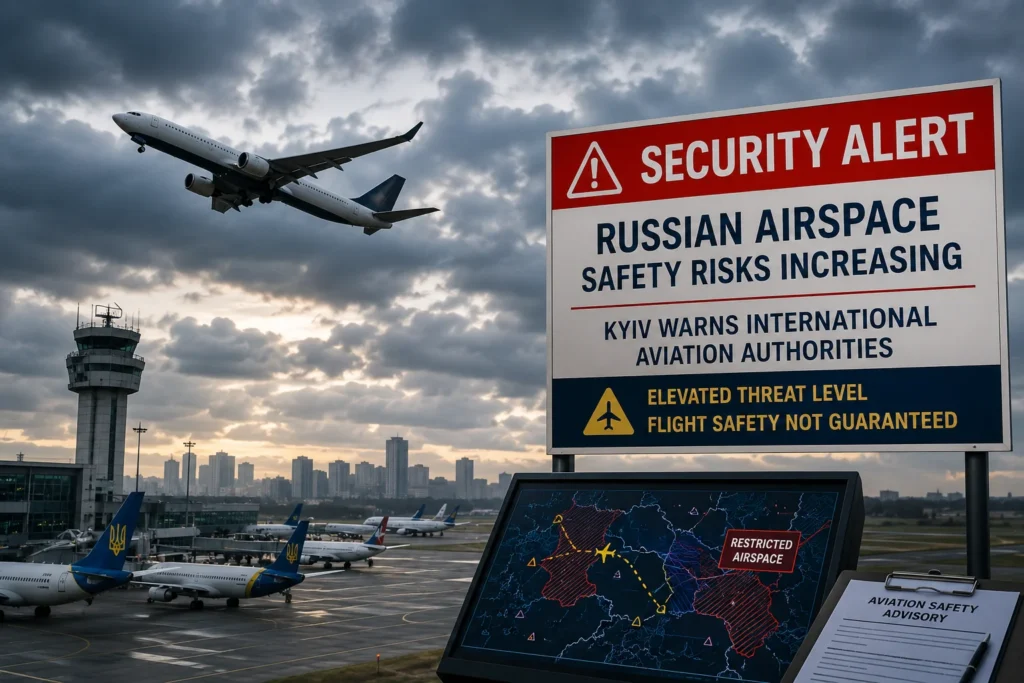
Ukrainian authorities have formally issued an official notification to the International Civil Aviation Organization, advising global aviation regulators, international carriers, and insurance providers that operating within Russian airspace now carries severe security risks. The advisory urges global commercial airlines to carefully evaluate transit routes crossing Russian territory as long-range aerial drone activity continues to expand across major regional flight corridors.
The formal notification to the global aviation governing body emphasizes that escalating military activity and anti-aircraft defensive operations across key Russian flight information regions present heightened operational hazards for civil aircraft. Officials stressed that while commercial airliners are not targets, the operational environment surrounding active transit sectors requires immediate risk re-evaluation by flight planning departments worldwide.
Official Safety Alerts and Escalating Verbal Sparring
The official alert submitted to global aviation authorities follows a series of public statements regarding flight safety over regional transit hubs. Ukrainian leadership issued explicit notices directed toward international air carriers and marine underwriters operating within the regional airspace, emphasizing that ongoing long-range operations could create persistent hazards for commercial flight operations traversing the region.
State communications affirmed that defense forces maintain no intention of targeting civilian airliners. However, officials pointed out that the presence of defensive counter-measures, low-altitude air defense activity, and frequent operational disruptions near major transport hubs make navigating Russian skies inherently unpredictable for civil aviation.
In response, government officials in Moscow vehemently rejected the warning, characterizing public statements regarding airspace closures as aggressive rhetoric aimed at intimidating international commercial operators. Russian state representatives argued that issuing broad advisories against transit through sovereign airspace constitutes an unwarranted effort to disrupt global civil aviation logistics and inflict economic strain.
Flight Disruptions, Airport Suspensions, and Logistics Challenges
Despite official assurances from transport authorities claiming operational security remains intact, persistent aerial alerts have repeatedly impacted commercial schedules across primary aviation hubs. Major metropolitan facilities—including Moscow’s primary international airports—have experienced temporary flight holds, reroutings, and cancellation spikes following regional defensive activations.
Aviation safety experts highlight that the primary concern for long-haul carriers involves the risk of navigational misidentification, signal jamming, or collateral exposure during rapid air defense deployments. While many European and North American air carriers already avoid transiting the area due to existing regulatory bans, several major operators across Asia, the Middle East, and Latin America continue to utilize transpacific and Eurasian corridors through Russian skies.
Despite the escalating friction surrounding airspace security, state officials signaled that diplomatic exceptions could be established. Specified air corridors may remain available for sanctioned diplomatic flights and international missions aimed at facilitating peace discussions or humanitarian efforts.
Operational Overview: Aviation Advisory Metrics
| Advisory Metric | Official Status & Details |
| Primary Regulatory Recipient | International Civil Aviation Organization (ICAO) |
| Designated High-Risk Regions | Moscow, St. Petersburg, Rostov-on-Don, Samara, Yekatenrinburg |
| Principal Aviation Risk Factors | Active air-defense systems, GPS signal disruptions, operational delays |
| Impacted Operational Hubs | Selected municipal and regional airports in western and central Russia |
| Exemption Protocols | Diplomatic corridors for designated peace and negotiation missions |
Frequently Asked Questions
Why was an official warning issued regarding Russian airspace safety?
Official notifications were submitted to international regulatory bodies to warn commercial airlines, flight underwriters, and civil aviation authorities about potential operational hazards arising from active defense systems and aerial operations across regional flight corridors.
How are major international flight routes currently affected?
While numerous Western airlines already avoid regional airspace under previous regulatory directives, carriers from other international regions continuing Eurasian transit routes face potential schedule delays, route adjustments, or increased insurance assessment requirements.
What measures are transport authorities taking to safeguard civil aviation?
Regional transport authorities maintain that safety protocols are continually updated in coordination with security agencies to manage flight corridors, minimize airport disruptions, and maintain international civil aviation operations safely.
For more travel news like this, keep reading Global Travel Wire