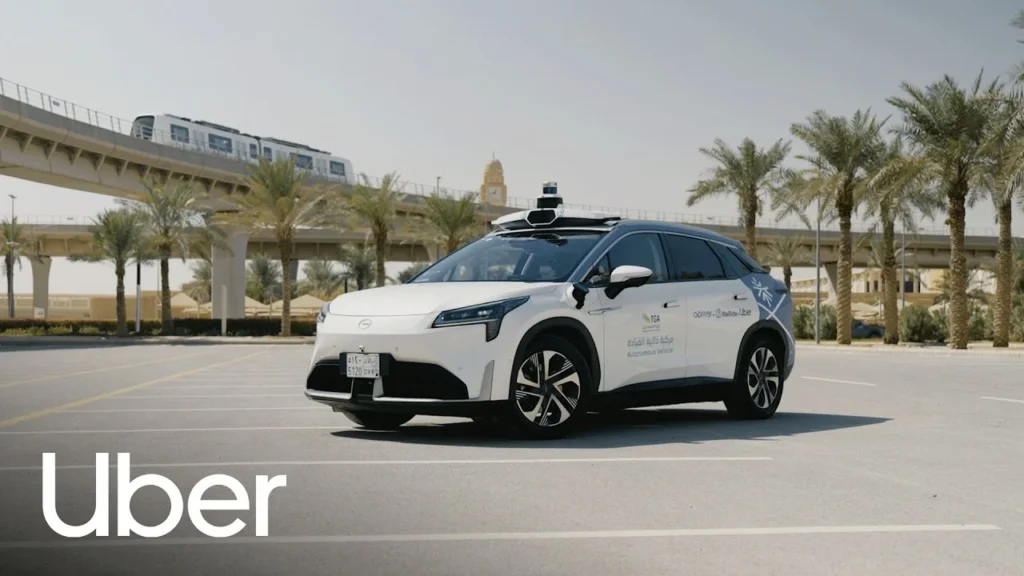
Uber and British autonomous-driving specialist Wayve have introduced a supervised self-driving ride service in London, allowing passengers to experience artificial intelligence-powered mobility through the existing Uber application.
Launched on September 3, 2026, the service uses electric Ford Mustang Mach-E vehicles equipped with Wayve’s AI Driver technology. The initial operation covers parts of central London but excludes airport journeys.
Passengers booking UberX, Uber Electric or Uber Comfort may be matched with a Wayve vehicle when one is available. The autonomous experience carries no additional charge, and customers continue to see their estimated fare before confirming the journey.
However, the vehicles are not operating without human supervision. A private hire driver licensed by Transport for London remains behind the wheel to monitor the technology and take control when required.
The controlled rollout gives Uber and Wayve an opportunity to study passenger demand and system performance on some of Britain’s most complex roads.
Existing Uber app provides access
Travellers request a ride through the same Uber booking process they already use. When an eligible Wayve vehicle is operating nearby, the platform may assign it to an UberX, Uber Electric or Uber Comfort request.
Users can also activate an autonomous-vehicle preference within the Uber app to increase their chances of being matched with one. More than 140,000 users have already enabled the preference, indicating significant public interest in experiencing the technology.
Receiving a match does not remove passenger choice. Customers can accept the Wayve vehicle or select another available option before beginning the trip.
Once confirmed, passengers can unlock the electric vehicle through the application. In-car displays then provide information about the journey and planned route.
Availability will initially depend on the number of participating vehicles, their operating locations and passenger demand. Therefore, selecting the preference does not guarantee that every booking will receive an autonomous car.
Safety drivers remain behind the wheel
The new operation represents supervised autonomous transport rather than a fully driverless taxi service.
Each vehicle carries a properly licensed safety driver who remains responsible for monitoring the journey. The driver can intervene whenever road conditions or operational requirements make manual control necessary.
This distinction is especially important for visitors unfamiliar with autonomous technology. Passengers will experience AI-controlled driving functions, but a trained person remains in the vehicle throughout the current phase.
Uber and Wayve have not announced a timetable for removing safety drivers. Any progression towards unsupervised operation will depend on technology readiness, infrastructure and regulatory approval.
The companies plan to increase the fleet gradually rather than beginning with large-scale deployment. This measured approach allows them to evaluate operations while gathering practical experience from London’s streets.
London creates a demanding AI test
London presents an unusually challenging setting for autonomous vehicles. Its road network combines dense traffic, cyclists, pedestrians, buses, taxis, delivery vehicles and complex junctions.
Temporary roadworks and changing traffic patterns add further difficulty. Successfully operating in this environment requires technology capable of responding to circumstances that may vary significantly between journeys.
Founded in the United Kingdom in 2017, Wayve has been developing an AI-based driving system designed to learn from experience and adapt across different environments.
Its approach seeks to reduce dependence on extensive high-definition mapping and costly specialised hardware. The aim is to create flexible technology capable of operating in multiple cities without rebuilding an entire driving system for every location.
The Ford Mustang Mach-E vehicles combine Wayve’s AI Driver with surrounding sensors and passenger-facing technology. Their fully electric powertrains also connect autonomous development with efforts to reduce emissions from urban road transport.
Visitors gain a new mobility experience
For travellers, the service introduces a technology-focused option within London’s established transport network. Tourists may encounter a Wayve vehicle while booking an eligible ride between hotels, attractions, meeting venues and central neighbourhoods.
The experience could appeal particularly to visitors interested in artificial intelligence, electric mobility and the future of city transportation.
Nevertheless, travellers should plan around the service’s current limitations. Wayve vehicles are not available for airport transfers, and fleet size will restrict availability during the early rollout.
London’s Underground, buses, licensed taxis and conventional ride-hailing vehicles remain the primary options for most journeys. The autonomous service currently supplements these choices rather than replacing them.
Launch opens a new urban transport chapter
The partnership gives Wayve access to Uber’s established booking platform and passenger network. Meanwhile, Uber gains a practical route for introducing autonomous vehicles without requiring customers to learn a separate booking system.
For London tourism, future expansion could influence how visitors move between hotels, attractions and commercial districts. Autonomous electric fleets may eventually improve transport availability while creating more consistent technology-led services.
However, passenger trust and safe performance will determine the speed of wider adoption. Clear information will also remain essential so riders understand when technology is controlling the vehicle and how human supervision works.
The September launch marks an early but significant step. By placing supervised AI-powered electric vehicles inside a familiar ride-hailing platform, Uber and Wayve are giving London travellers a controlled glimpse of how autonomous urban transport could develop.
For more travel news like this, keep reading Global Travel Wire