Air travel safety and passenger conduct remain top priorities for aviation authorities and commercial airlines across the United States. Following a recent inflight disturbance on a domestic flight bound for Miami International Airport, official airport procedures, airline safety protocols, and passenger conduct regulations have come into sharp focus for travelers planning upcoming trips.
Inflight Disturbance Handled En Route to Miami International Airport
Official aviation tracking records and airport authority reports confirm an incident involving passenger misconduct on a domestic flight traveling from Baltimore/Washington International Thurgood Marshall Airport to Miami International Airport.
During the journey, cabin crew members identified disruptive and indecent behavior from an individual seated in the forward section of the aircraft. In accordance with standard civil aviation safety procedures, flight attendants immediately notified the flight deck to manage the situation and ensure the overall safety and comfort of the remaining passengers on board.
Flight crew members utilized standard Aircraft Communications Addressing and Reporting System (ACARS) channels to notify airline operations control and local ground authorities of the situation in real time. The official communications requested immediate law enforcement support upon arrival at the gate, detailing the nature of the disturbance so local officers could prepare prior to landing.
Strategic Decision to Continue to Destination Gate
Despite the disruptive behavior in the cabin, the flight crew evaluated the overall security status of the aircraft and determined that an unscheduled emergency diversion was unnecessary. The aircraft maintained its original flight path toward South Florida, allowing air traffic control and airport operations teams ample time to coordinate a structured ground response.
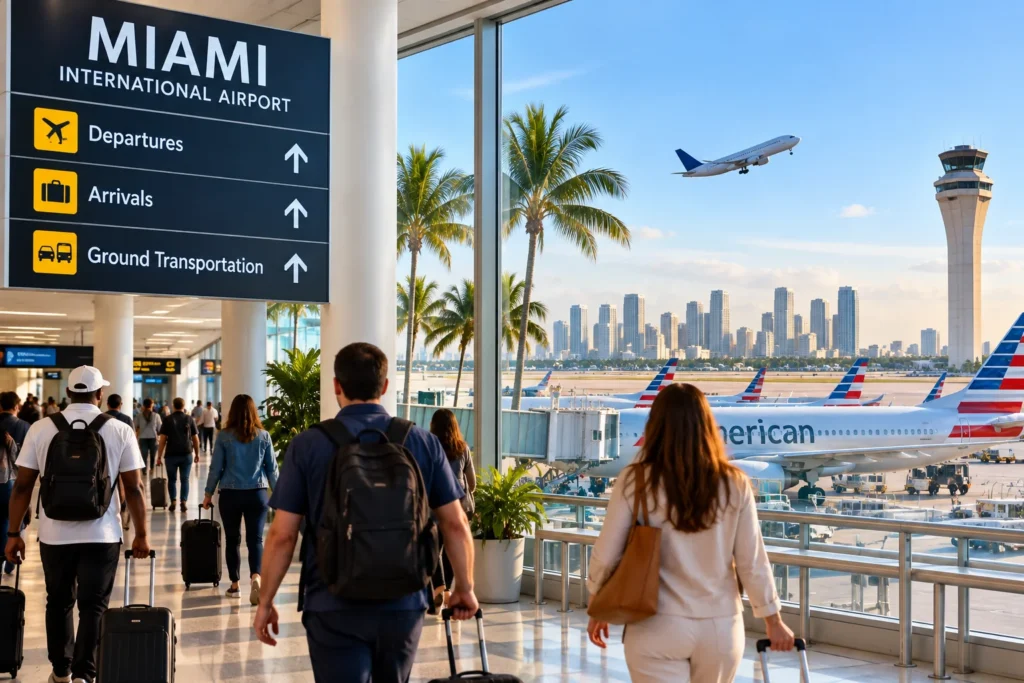
Upon landing at Miami International Airport, the aircraft taxiing to the North Terminal was met directly at the arrival gate by officers from local law enforcement agencies. Ground personnel and responding officers safely met the aircraft, boarded after engine shutdown, and took the individual into custody without further disruption to airport operations or surrounding flights.
Official statements from local law enforcement confirm that an investigation into the incident remains active under applicable federal and local civil aviation regulations governing passenger decorum and onboard safety.
Understanding Civil Aviation Rules on Passenger Conduct
Maintaining order inside an aircraft cabin is essential for public safety, flight crew focus, and passenger comfort. Federal aviation guidelines and official airline policies strictly enforce passenger behavior standards from pushback to gate arrival.
Compliance with Crew Instructions: Federal regulations require all passengers to obey instructions provided by flight crew members immediately. Disregarding safety commands or engaging in disruptive behavior can lead to severe civil penalties, mandatory removal from the aircraft, and potential flight bans.
Indecent Conduct and Interference: Engaging in indecent exposure, physical interference, or inappropriate public conduct on board an commercial aircraft violates federal aviation law. Incidents of this nature prompt immediate law enforcement intervention upon landing and can result in criminal charges.
Flight Operations Integrity: Flight crews are trained to assess whether a disturbance warrants an immediate unscheduled landing or continued progress to the destination. Maintaining flight continuity minimizes broader air traffic delays while ensuring ground authorities are positioned for immediate action upon arrival.
Practical Advice for Passengers Traveling Through Miami
As one of the busiest international and domestic travel hubs in the region, Miami International Airport maintains strict safety and security protocols across all terminals to protect millions of annual visitors. Travelers can ensure a smooth journey by keeping key travel practices in mind.
First, passengers should familiarize themselves with individual airline codes of conduct prior to boarding. Airlines hold the legal right to deny transportation to any individual demonstrating disruptive, unsafe, or inappropriate behavior prior to departure or during flight.
Second, if an inflight disturbance occurs, passengers are advised to remain seated, keep their seatbelts fastened, and allow trained cabin crew members to handle the situation. Flight attendants undergo rigorous training to de-escalate disruptions, coordinate with the cockpit, and communicate directly with ground-based law enforcement.
Finally, travelers experiencing flight delays or unexpected gate holds due to law enforcement responses should monitor official airport announcements and airline mobile applications for updated baggage claim and connecting flight information. Through strict enforcement of safety regulations and rapid ground coordination, aviation authorities continue to ensure secure and comfortable travel conditions for all passengers.
For more travel news like this, keep reading Global Travel Wire