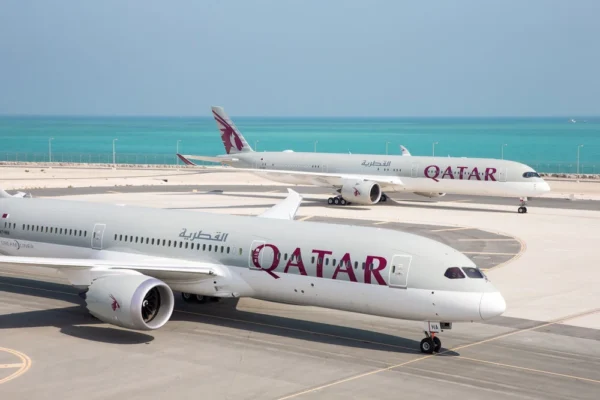
Qatar Airways is reshaping connected travel through artificial intelligence, immersive airport previews, flexible premium cabins and high-speed inflight internet.
The strategy connects several stages of an international journey. Travellers can receive digital booking assistance, preview Doha’s airport environment and remain online aboard long-haul flights. Expanded services and destination partnerships also strengthen access to tourism markets, including the Maldives.
The airline presented major elements of this vision at Arabian Travel Market 2025 in Dubai. The event focused on developing tourism through enhanced connectivity. It brought together more than 2,800 exhibitors and over 55,000 travel professionals from 166 countries.
For passengers, the developments reflect a wider change in aviation. Airlines increasingly compete on the complete journey rather than the seat and route alone.
Arabic-speaking AI supports trip planning
One of the most distinctive products presented in Dubai was the Arabic-speaking version of Sama, Qatar Airways’ AI-powered digital human cabin crew.
Sama can communicate through Modern Standard Arabic and different Arabic dialects. The technology assists passengers with flight bookings, destination recommendations and questions about airline products and services.
Travellers can interact with the digital assistant through Qatar Airways platforms, including its mobile application and QVerse.
This approach could make complicated international journeys easier to plan. Airline websites contain extensive information covering schedules, baggage allowances, fares, cabins and destinations. A conversational interface can help passengers navigate those choices more naturally.
The Arabic capability also makes digital travel planning more accessible across important regional markets. It combines automation with language support tailored to passenger needs.
Virtual reality brings Doha closer
Qatar Airways also used immersive technology to recreate The ORCHARD at Hamad International Airport. Visitors at ATM could explore a virtual version of the airport’s indoor tropical garden before travelling through Doha.
The experience promotes more than an airport attraction. It introduces passengers to Doha as a destination and international transit hub before departure.
Hamad International Airport’s completed expansion raised annual capacity beyond 65 million passengers. The project added two concourses and 17 boarding gates, strengthening passenger movement and international connectivity.
That capacity is important because many Qatar Airways customers travel through Doha rather than ending their journeys there. A smoother transfer can influence route selection, particularly for long-distance passengers connecting between Europe, Asia, Africa and the Middle East.
Qsuite Next Gen adds cabin flexibility
Qsuite Next Gen formed the centrepiece of the airline’s premium passenger display. Its design responds to the different ways people use business-class cabins.
Quad Suites accommodate groups of four, while Companion Suites serve two passengers travelling together. Features include movable 4K OLED entertainment screens, digitally controlled privacy dividers and additional dining space.
Ambient lighting and a “Make My Bed” function further support comfort on long-distance journeys.
The flexible configuration can serve executives seeking privacy, couples travelling together or families wanting a shared space. Consequently, the cabin becomes adaptable to both individual and group travel requirements.
Such flexibility could become increasingly important as premium passengers expect workspaces, privacy and social areas within the same journey.
Maldives partnership supports visitor growth
The airline’s technology showcase also carried a direct tourism message. Qatar Airways signed a memorandum of understanding with Visit Maldives to support destination promotion and international arrivals.
The cooperation combined Qatar Airways’ global network with the Maldives’ destination-marketing activities. Planned areas included consumer campaigns, travel-trade engagement, media initiatives and tourism education.
A renewed cooperation framework announced in September 2026 is set to expand joint promotion as the airline prepares to increase Maldives capacity. This gives the destination greater access to established and emerging source markets across six continents.
Qatar Airways also established tourism cooperation with Indonesia’s Ministry of Tourism, reinforcing aviation’s role in connecting global travellers with leisure destinations.
For island economies, airline capacity directly supports resorts, guesthouses, tour operators, restaurants and local employment. Stronger promotion can also spread demand across more traveller segments and source markets.
More flights improve international choices
Network growth remains another pillar of the strategy. Qatar Airways announced increased services across destinations including Tokyo Narita, Manchester, Madrid, Lisbon and London Heathrow.
During the 2026–27 winter season, the airline plans to serve more than 170 destinations. Additional services are expected across markets including Zanzibar, Seychelles, Johannesburg, Kuala Lumpur, Canberra and London Heathrow.
Nearly 1,800 weekly frequencies are planned for December 2026. More departures can provide passengers with better connection choices and greater flexibility when organising holidays or business trips.
Starlink transforms time in the air
High-speed connectivity may deliver the most noticeable passenger change. By August 2026, Qatar Airways had reached 150 Starlink-equipped widebody aircraft, with more than 23 million passengers connecting since the onboard launch in October 2024.
The service can deliver speeds of up to 500 Mbps. The airline was operating as many as 323 Starlink-enabled flights daily, with that figure expected to reach 340 during the winter schedule.
Passengers can increasingly work, communicate and stream entertainment throughout long-haul flights. Therefore, the aircraft becomes a connected part of the journey instead of an offline interval between destinations.
From Dubai’s tourism marketplace and Doha’s expanding hub to Maldives resorts, Qatar Airways is building a travel model around continuous connectivity. The journey itself is becoming as strategically important as the destination.
For more travel news like this, keep reading Global Travel Wire