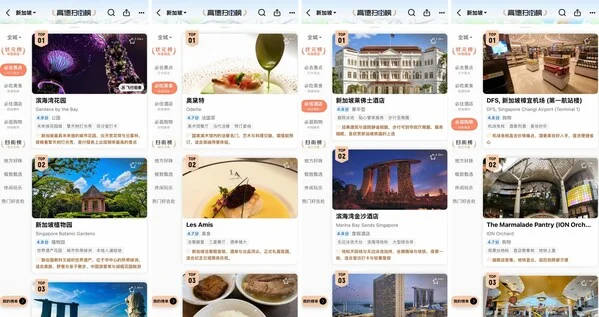
Singapore has launched an AI-supported destination guide designed to help independent Chinese travelers discover attractions, neighborhoods, businesses, and local experiences.
Singapore Street Stars features 104 places across seven themed rankings within Amap, Alibaba’s location-based services platform. The guide launched in September 2026 through cooperation with the Singapore Tourism Board.
The service combines destination recommendations with Chinese-language searches, panoramic previews, transportation support, driver translation, and familiar payment options.
It represents the first overseas edition of Amap Street Stars developed alongside a national tourism authority. The project followed an agreement signed in Beijing on June 2, 2026.
The guide primarily targets free and independent travelers who plan their journeys without fixed group itineraries. It could simplify trip preparation while directing visitors toward different areas of Singapore.
Seven Rankings Showcase 104 Places
Singapore Street Stars organizes its recommendations across seven themes covering family activities, nightlife, nature, photography, emerging favorites, curated experiences, and authentic local life.
The selections combine established attractions with neighborhood destinations and community-focused experiences.
Gardens by the Bay, Sentosa Island, and Merlion Park appear alongside Haji Lane, Joo Chiat Road, Maxwell Food Centre, and Tiong Bahru Market.
This mixture could encourage visitors to explore beyond Singapore’s most recognizable landmarks. It also gives hotels, restaurants, retailers, and smaller businesses greater visibility among Chinese users.
Travelers can compare attractions, food centers, shopping streets, hotels, and lifestyle venues while preparing their itineraries.
However, inclusion within the guide does not guarantee increased bookings or visitor spending. No dedicated economic assessment has yet measured its commercial impact.
Virtual Previews
SEO Headline: Singapore Launches Amap AI Travel Guide to Unlock 104 Attractions and Local Adventures
Meta Description: Singapore and Amap launch an AI travel guide featuring 104 places, panoramic previews and planning tools for Chinese visitors.
Focus Keyword: Singapore AI travel guide
Additional Keywords: Amap Singapore Street Stars, Singapore travel planning, Chinese tourists Singapore
WordPress Category: Travel Technology
WordPress Tags: Singapore, Amap, Artificial Intelligence, Chinese Travelers, Tourism Technology
News Article:
Singapore AI Guide Expands Local Discovery
Singapore has launched an AI-supported destination guide designed to help independent Chinese travelers discover attractions, neighborhoods, restaurants, hotels, and shops.
Singapore Street Stars features 104 places across seven themed rankings within Amap, Alibaba’s location-services platform. The service launched on September 18, 2026.
It represents the first international edition of Amap Street Stars developed with a national tourism authority. The project follows an agreement signed with the Singapore Tourism Board in Beijing on June 2.
The guide combines prominent landmarks with local neighborhoods and community experiences. Gardens by the Bay, Sentosa Island, and Merlion Park appear alongside Haji Lane and Joo Chiat Road.
Maxwell Food Centre and Tiong Bahru Market also feature, giving visitors more opportunities to explore Singapore’s culinary and residential districts.
The Singapore AI travel guide targets free and independent travelers who create personal itineraries instead of joining fixed group tours.
Seven Rankings Simplify Travel Planning
The guide organizes its 104 recommendations around family experiences, nightlife, nature, photography, emerging favorites, curated discoveries, and authentic local life.
This structure could help travelers identify activities that match their interests. It also places established tourism icons beside less familiar local destinations.
First-time visitors can compare attractions, hotels, restaurants, shopping areas, and neighborhoods while developing their itineraries.
Chinese-language search functions further reduce planning difficulties for the guide’s principal audience. Travelers can explore options using familiar digital tools before and during their visit.
However, inclusion within the rankings does not guarantee availability, pricing, or admission. Visitors should confirm operating hours and reservation requirements through authoritative channels.
The initiative primarily supports destination discovery and tourism marketing. It does not guarantee that searches will become confirmed bookings or produce higher visitor spending.
Panoramic Previews Offer Digital Exploration
Amap and the Singapore Tourism Board are also testing Flying Street View at selected locations.
This feature uses panoramic imaging to show travelers how an attraction or neighborhood appears before they arrive. Singapore marks its first deployment outside China.
Families and first-time visitors may use the previews to compare destinations and prioritize limited vacation time.
The visual experience could also encourage travelers to consider neighborhoods beyond Singapore’s best-known tourism precincts.
Nevertheless, panoramic previews do not provide live information. They cannot confirm crowd levels, weather, temporary closures, ticket availability, current prices, or accessibility conditions.
Travelers should treat the images as planning support rather than a substitute for updated operational information.
Transport Tools Support Independent Travelers
The Amap platform connects destination discovery with several practical travel functions.
Available features include airport transfers, pre-arranged vehicles, local ride services, driver translation, and familiar payment methods.
A traveler could discover a neighborhood, preview its surroundings, and examine transport options within the same digital environment.
This integration may reduce practical difficulties for Chinese visitors navigating Singapore independently. Driver translation could prove especially useful when confirming destinations or discussing collection points.
However, users remain responsible for checking fares, payment conditions, cancellation rules, and pickup locations before confirming services.
The guide may give listed restaurants, retailers, hotels, and attractions greater visibility among Chinese users. Any resulting revenue growth remains unconfirmed.
Chinese Visitors Drive Tourism Demand
Singapore welcomed 16.9 million international visitors in 2025, representing growth of 2.3% from the previous year.
Mainland China led all source markets with 3.1 million arrivals. Indonesia contributed 2.4 million visitors, while Malaysia and Australia each generated 1.3 million.
India supplied approximately 1.2 million arrivals. China’s leading position explains the strong focus on independent Chinese travelers.
Singapore also recorded S$32.8 billion in tourism receipts during 2025. Mainland Chinese visitors generated S$3.68 billion during the first nine months.
Their food and beverage spending increased by 19% compared with the corresponding 2024 period.
These figures demonstrate China’s importance to Singapore tourism. However, they predate the completed guide and cannot measure its impact.
Singapore Entry Rules Remain Unchanged
The launch creates no new visa entitlement and changes none of Singapore’s immigration requirements.
Foreign travelers generally need passports with at least six months of remaining validity. Visitors from visa-required countries must obtain the appropriate visa before departure.
Holding a visa does not guarantee admission. Immigration officers make the final entry decision at the checkpoint.
Travelers must generally submit the SG Arrival Card within three days before arrival, including the arrival date. The electronic declaration is not a visa.
The approved stay period depends on the electronic Visit Pass issued during immigration clearance.
Tourism 2040 Provides Long-Term Direction
Singapore Street Stars supports broader efforts to build a more innovative and diverse visitor economy.
Under Tourism 2040, Singapore aims to become a world-class destination with distinctive experiences and productive tourism enterprises.
The roadmap projects annual tourism receipts between S$47 billion and S$50 billion by 2040. A S$740 million Tourism Development Fund supports new experiences, technology, and industry development.
For 2026, Singapore expects between 17 million and 18 million visitors and S$31 billion to S$32.5 billion in receipts.
The Amap guide could strengthen local discovery and distribute visitor attention more widely. Its eventual value will depend on measurable bookings, neighborhood visits, and traveler spending.
For more travel news like this, keep reading Global Travel Wire