The European rail sector reached another major milestone at the InnoTrans international transport exhibition in Berlin as rail startup Nox Mobility officially presented its first prototype night train coach. The company announced the launch of a new long-distance overnight passenger route connecting Hamburg and Munich starting in March 2027. Engineered specifically around private single- and double-occupancy spaces, the service introduces an innovative, hospitality-focused travel model intended to replace short-haul domestic flights with sustainable, high-comfort rail journeys.
Founded in 2025, the mobility venture was established to address persistent consumer concerns regarding privacy, reliability, and price in traditional overnight rail services. Backed by capital investments—including a pre-seed funding round led by regional investment venture funds—the company is moving from initial vehicle development into commercial operations within an accelerated timeframe, setting a rapid precedent for new open-access rail operations across Europe.
Private Suites and Modern Accommodation Designs
Unlike traditional night trains that rely heavily on shared multi-berth couchettes or public compartments, the company’s operational framework mandates individual private quarters for every traveler. The physical rolling stock unveiled in Berlin consists of converted inter-city passenger coaches leased from regional rolling stock asset providers.
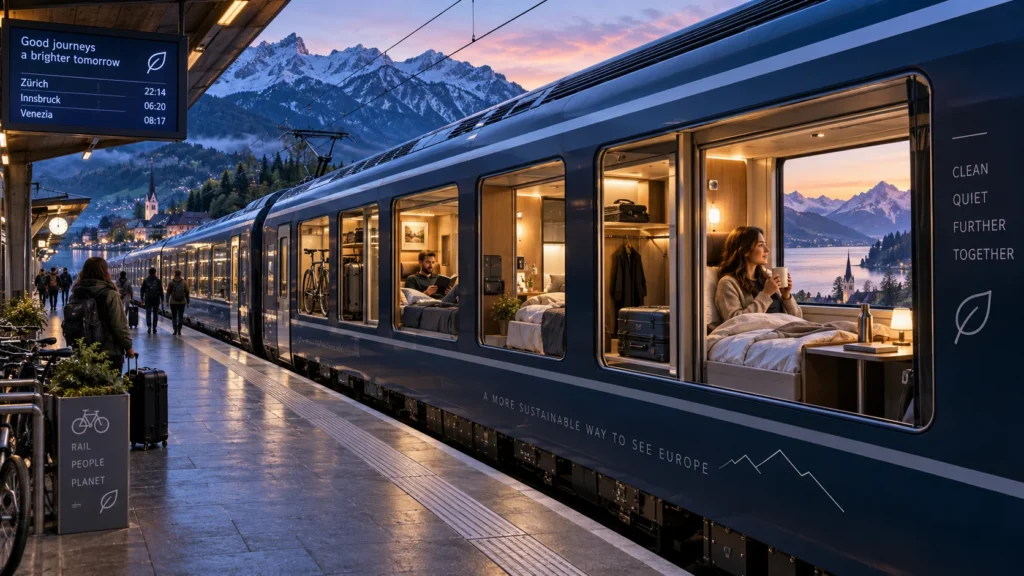
Inside the modernized coaches, every passenger gains access to a private compartment known as the Nox Suite. Designed for dual-purpose travel, the space functions as a private workstation during daytime and early evening hours before unfolding into a full two-meter flat sleeping berth along the window.
Looking toward future fleet expansion, designers also introduced additional cabin layout concepts set to join active service:
Double Loft: A spacious multi-level cabin for two travelers featuring two seating chairs and an elevated 1,700-millimeter double bed accessible by private stairs.
Single Loft: A compact single-occupancy version utilizing the elevated loft concept to maximize ground-level workspace and personal storage.
Double Vista: A low-floor layout with twin berths oriented parallel to the direction of travel, allowing uninterrupted window views directly from the bed.
By replacing shared six-berth compartments with individual lockable suites, the private operator aims to eliminate common passenger pain points such as shared spaces, overnight noise, and lack of dedicated working amenities.
Strategic Route Network Targets Key Domestic Business Hubs
The initial line will link Germany’s northern and southern economic capitals, operating three return trips per week between Hamburg and Munich, with intermediate stops in Bremen and Augsburg. Service schedules are tailored specifically for corporate travelers and leisure tourists seeking to maximize daytime activities while traveling overnight.
Under official operating timetables, southbound trains depart Hamburg in the late evening, making intermediate stops before arriving in central Munich early the following morning. Northbound return journeys follow a matching overnight schedule, allowing passengers to commute without losing productive working hours or incurring additional hotel accommodation costs.
The selection of the Hamburg-Munich corridor directly addresses one of Central Europe’s heaviest domestic travel markets. Official business travel statistics confirm that over 1.2 million air passengers traveled between the two metropolitan areas annually, while national travel surveys indicate that rail has increasingly overtaken domestic flying for short-duration trips due to lower carbon footprints and city-center-to-city-center convenience.
Transport policy officials highlight that developing high-quality, comfortable night train connections provides a practical, low-carbon alternative to domestic aviation, significantly reducing greenhouse gas emissions per passenger-kilometer while optimizing overall transport capacity.
Integrated Hospitality Model Elevates the Passenger Journey
To streamline operations, the company operates an asset-light open-access model. While external railway partners manage locomotive traction, track access, and heavy fleet maintenance, the startup handles overall branding, digital ticketing, and onboard hospitality services.
The customer service strategy extends beyond the physical train journey. The company is building an integrated digital travel platform designed to unify the entire door-to-door trip experience into a single booking interface. Strategic partnerships with urban hospitality providers, co-working operators, and local fitness facilities will allow arriving passengers to reserve early hotel check-ins, luggage storage, morning shower facilities, and workspace access directly at their arrival destinations.
Ticket sales for the initial Hamburg-Munich service have officially opened, with introductory single fares starting at accessible price points. As fleet modifications continue, the startup plans to scale the service from three weekly departures to daily operations, eventually expanding its private sleeper network to connect major urban centers across Western and Central Europe.
Through a combination of modern cabin engineering, tailored business schedules, and an end-to-end hospitality framework, the launch marks a major shift in how European night train tourism is delivered to modern travelers.
For more travel news like this, keep reading Global Travel Wire