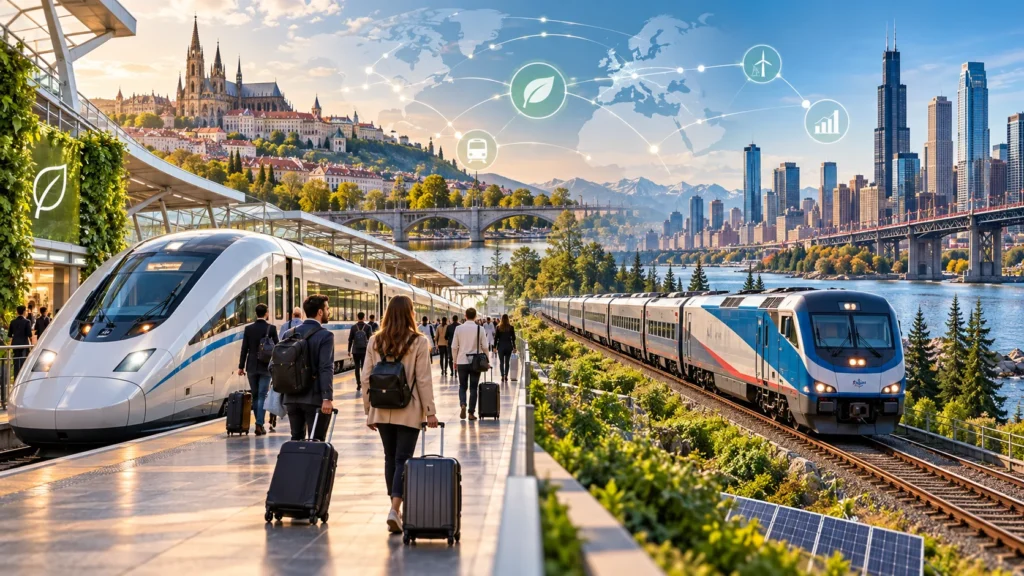
International passenger rail infrastructure across Europe is experiencing significant investment as regional transport networks expand cross-border services. European international financing institutions have finalized a twelve million euro, ten-year financial agreement with Serbia’s national passenger rail operator, Srbija Voz. The financing supports the acquisition of six advanced Siemens Vectron A17 multi-system electric locomotives designated for international routes operated under public service obligation commitments.
The modern multi-system electric locomotives are being certified for operation across Serbia, Hungary, Austria, and Germany. This fleet upgrade enables seamless, continuous rail journeys across central and southeastern Europe without the need for locomotive changes at national borders.
Official transport ministry policies and European rail initiatives emphasize that expanding electrified cross-border corridors provides eco-conscious travelers with efficient, low-emission alternatives to short-haul regional flights. By strengthening rail links between major urban centers, national operators are advancing sustainable rail travel and supporting cross-border tourism throughout the continent.
Automated Mass Transit Investments Transform Urban European Travel
Major European metropolitan areas are deploying automated rail systems to increase public transit capacity, improve passenger comfort, and optimize urban mobility. In Denmark, municipal transit investments are advancing the modernization of Copenhagen’s S-bane urban rail network.
As part of a landmark agreement, train manufacturer Siemens Mobility has contracted specialized onboard system provider Teleste to deliver complete passenger information, public address, closed-circuit television security, and passenger communication architecture for 226 fully automated four-car electric multiple units.
Key highlights of the Copenhagen automated transit project include:
Automated Operations: Fully automated four-car trainsets designed to expand network passenger capacity and enhance departure frequency.
Integrated Passenger Systems: Advanced onboard audio, visual guidance, and security technology managed through centralized software platforms.
Multi-Year Rollout: Initial equipment deliveries beginning in 2028, with full passenger revenue service scheduled to commence in 2032.
Official tourism board releases and urban planning strategies highlight that modernizing mass transit networks plays a vital role in destination accessibility. High-frequency, automated urban rail systems allow domestic and international visitors to navigate metropolitan regions safely, efficiently, and with minimal environmental impact.
High-Speed Rail Expansion and Advanced Onboard Digital Infrastructure
High-speed rail operators are expanding open-access services across international borders while upgrading digital passenger amenities to meet evolving traveler expectations. Italian high-speed rail operator Italo has selected connectivity specialist Nomad Digital to equip 26 Siemens Velaro high-speed trainsets for its upcoming expansion into the German passenger rail market starting in 2028.
The high-speed fleet will feature 5G connectivity and specialized passenger portals using hybrid aggregation tools that combine terrestrial cellular networks with low-Earth orbit satellite infrastructure. This technological configuration ensures continuous, high-speed internet access for passengers traveling at high velocity across international rail corridors.
Simultaneously, safety technology developers are adapting automotive sensor systems to enhance rail safety. Engineering teams at major technology providers are deploying automated collision warning systems for urban light rail and tram networks, leveraging mass-production platforms to protect pedestrians and transit vehicles in dense urban travel environments.
Strengthening Passenger Rail Leadership and Industry Governance
In North America, passenger rail advocacy organizations and transit industry associations are reinforcing executive leadership to address infrastructure delivery and operational reliability. Canadian transit association TRACCS Transit & Rail has appointed former Toronto City Councillor and Toronto Transit Commission Chair Karen Stintz as Managing Director.
The leadership appointment is tasked with advancing national mandates to improve the safety, efficiency, and delivery value of passenger rail systems across Canada. Industry leadership initiatives focus on aligning government policy, public transit authorities, and equipment manufacturers to resolve infrastructure bottlenecks and accelerate capital project delivery.
Official public transport data demonstrates that reliable, high-frequency passenger rail services remain fundamental to national tourism strategies, regional economic development, and carbon reduction targets. Through coordinated investments in electric rolling stock, digital connectivity, and automated transit infrastructure, transportation agencies are building a resilient foundation for the future of global passenger travel.
For more travel news like this, keep reading Global Travel Wire