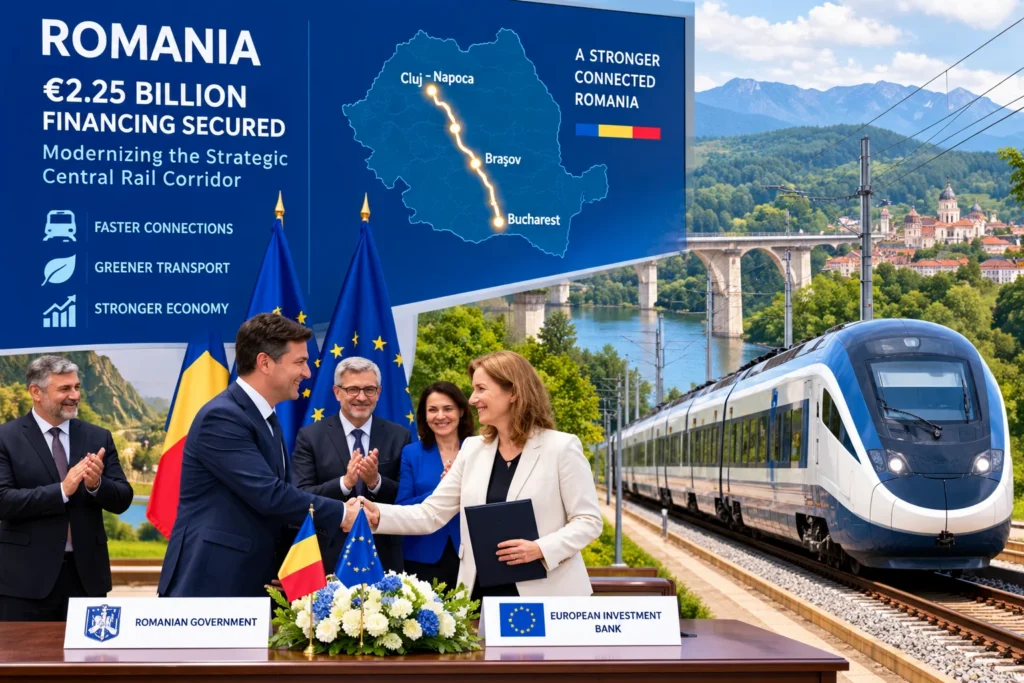
The European Investment Bank has signed a co-financing agreement with national authorities to fund a major modernizing initiative across the transport infrastructure of central Romania. Totaling an estimated investment of 2.25 billion euros, the project integrates direct European Investment Bank funding alongside European Union structural contributions and national budget allocations. The primary operational objective focuses on modernizing a strategic 113-kilometer double-track electrified railway section connecting the historic cities of Brașov and Sighișoara.
Through comprehensive physical track overhauls, signaling updates, and structural reinforcement, the upgraded route will permit passenger express services to reach operational speeds of up to 160 kilometers per hour, while freight transit speeds will increase to 120 kilometers per hour. The modernized infrastructure is engineered to handle significantly higher daily traffic volumes, accommodating up to 29 passenger trains and 22 freight services per day. Annually, the corridor is projected to move around four million passengers and six million tonnes of freight, creating a faster and more reliable transportation artery through the heart of Transylvania.
Removing Bottlenecks Across European Transit Corridors
The Brașov-Sighișoara line represents a vital component within the broader Trans-European Transport Network, forming an essential link along both the Rhine-Danube corridor and the Baltic Sea-Black Sea-Aegean Sea transit routes. Prior to these capital improvements, structural limitations along this mountainous central section created operational bottlenecks that delayed international passenger connections and limited cross-border freight distribution.
By modernizing this central corridor, the project aligns national infrastructure with broader European Union mobility standards. The installation of advanced signaling infrastructure—specifically the European Rail Traffic Management System—will ensure full operational interoperability with international rail standards, allowing seamless cross-border travel. Furthermore, the upgraded line will accommodate longer, heavier freight trains, facilitating efficient trade flows between Eastern European agricultural and industrial centers and wider continental markets.
Environmental Benefits and Regional Mobility Enhancements
A central priority of the infrastructure initiative is driving modal shift from highway transport to sustainable rail travel. By expanding capacity and reducing travel times between major regional centers, the upgraded line offers a clean, efficient alternative to private vehicle and long-distance bus travel. Transportation authorities anticipate that shifting regional transit to electrified rail will significantly reduce highway congestion, lower vehicle emissions, diminish ambient noise pollution, and enhance overall public safety along major road corridors.
For everyday commuters and visiting travelers, the investment extends well beyond faster track speeds. Station facilities, platforms, and passenger stops along the 113-kilometer route are undergoing systematic modernizations designed to enhance accessibility. Upgraded infrastructure includes barrier-free boarding solutions, improved passenger information displays, and enhanced safety features tailored to assist individuals with reduced mobility or disabilities.
Strategic Economic Impacts and International Advisory Support
In addition to direct capital funding, the project benefits from specialized technical and advisory support provided by European Investment Bank experts. This collaborative framework assists national transportation authorities throughout the execution, procurement, and environmental management phases, ensuring that the long-term economic and operational benefits of the investment are fully realized.
Official statements from European Investment Bank leadership describe the railway modernization as a long-term investment in regional connectivity, community access, and economic resilience. By building high-capacity, low-emission infrastructure, the project strengthens Romania’s integration with European commercial networks while establishing a modern foundation for sustainable regional development. Romanian ministry representatives emphasize that investments of this magnitude are fundamental to enhancing national competitiveness, attracting business development, and improving public mobility standards across the region for decades to come.
For more travel news like this, keep reading Global Travel Wire