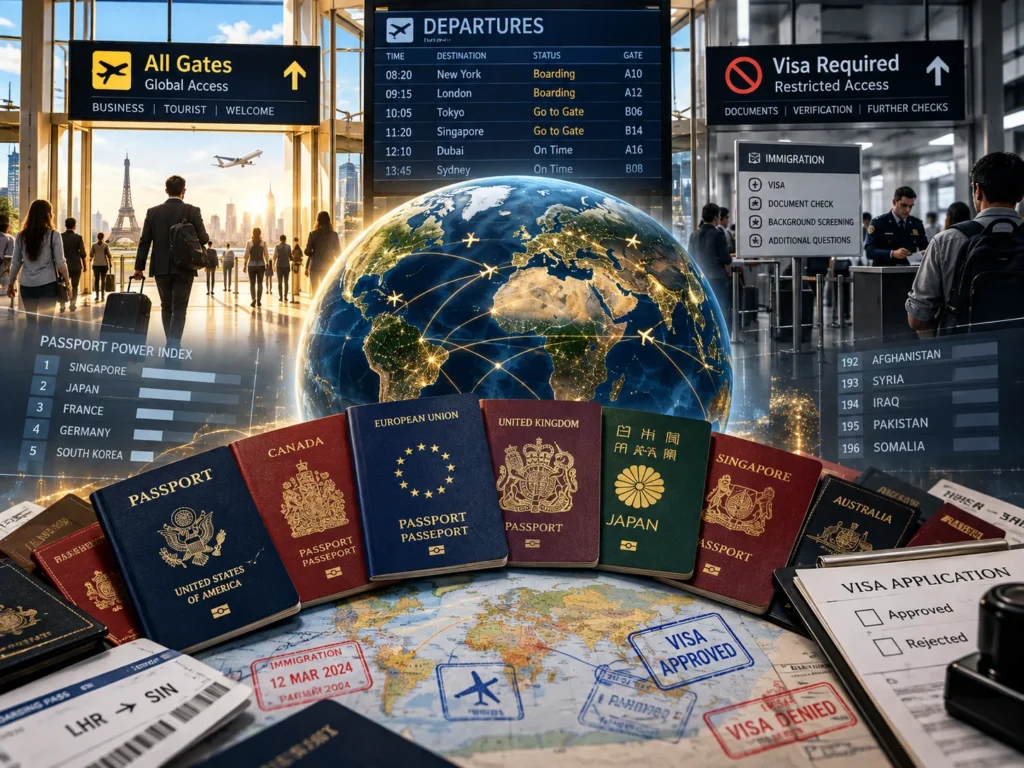
The ability to cross international borders easily remains a major indicator of global economic standing, diplomatic relations, and bilateral trust. Around the world, millions of aspiring international travelers seek to explore foreign destinations, pursue educational exchanges, or expand corporate footprints. However, the international travel landscape reveals that global movement is far from open to all. The concept of passport power—defined as the total number of foreign destinations a passport holder can enter without securing a prior visa—highlights an enduring disparity in international mobility between nations.
Official mobility indicators released by global travel research organizations confirm that sovereign passport strength directly shapes international access. Citizens holding high-ranking passports navigate international transit hubs with minimal friction, simplified border entry protocols, and reduced administrative burdens. Conversely, travelers holding weaker passports face rigorous screening, extensive documentation mandates, mandatory financial disclosures, and uncertain processing timelines before receiving permission to travel.
Regional Leaders Secure Top Positions in Global Travel Freedom
Global mobility rankings demonstrate the distinct advantage held by highly connected economies across Asia and Europe. Singapore holds the top position internationally, granting its citizens seamless, visa-free or visa-on-arrival entry to 193 destinations worldwide. Neighboring nations Japan and South Korea follow closely, offering their passport holders frictionless access to 190 destinations.
European countries continue to dominate the upper tiers of global travel indices. Nationals from France, Germany, and Italy maintain pre-approved access to nearly 189 global destinations, underscoring strong diplomatic networks and robust cross-border agreements. While traditional Western powers such as the United Kingdom and the United States maintain substantial global reach—ranking 6th and 10th respectively—their relative mobility growth has stabilized compared to rapidly expanding Asian diplomatic corridors.
Within Southeast Asia, significant mobility gaps remain evident across neighboring states. Malaysia holds an influential position in 11th place, while Brunei secures 18th place globally. At the opposite end of the spectrum, nations impacted by long-standing political instability, ongoing conflict, or limited international representation remain restricted. Afghanistan remains at the bottom of global mobility lists with access to approximately 25 destinations, illustrating how geopolitical conditions heavily influence travel rights.
Philippine Passport Trajectory Reflects Gradual Global Mobility Gains
The Philippine passport currently holds 72nd place globally, tied with Mongolia and Sierra Leone. This position offers Filipino travelers visa-free or visa-on-arrival entry to 65 destinations worldwide. While this figure represents an absolute majority of world territories requiring advance visas, it marks a steady upward trajectory in post-pandemic recovery efforts.
Historical data from official international mobility indexes illustrates the country’s gradual progress:
2006: Ranked 63rd globally during early index tracking.
2021: Dropped to 83rd place, representing a historic low amidst global border closures and pandemic travel restrictions.
2022: Rebounded to 77th position as regional transit corridors reopened.
2023: Held 78th place during ongoing diplomatic evaluations.
2024: Advanced to 73rd position through expanded bilateral agreements.
2026: Reached 72nd place, reflecting strengthened consular ties and modernized immigration frameworks.
Despite these incremental improvements, Filipino passport holders can access less than one-third of the world’s 227 tracked destinations without a prior visa. National authorities continue working to negotiate expanded travel agreements, modernize consular issuance procedures, and enhance bilateral diplomatic trust to expand travel options for citizens abroad.
Real-World Administrative and Financial Impacts on International Mobility
For citizens operating with moderate passport mobility, entry restrictions extend beyond holiday leisure planning. Securing entry visas for international business meetings, higher education, or personal visits involves significant economic and logisitical hurdles.
Primary operational challenges associated with visa-restricted travel include:
Financial Costs: Non-refundable processing fees, mandatory travel insurance policies, bank statements, and certified documentation create cumulative financial burdens for travelers.
Professional and Academic Delays: Strict appointment scheduling and variable embassy processing times can result in missed corporate conferences, delayed academic scholarships, or lost international employment opportunities.
Strict Airport Scrutiny: Travelers from countries with stricter visa requirements often undergo additional screening, secondary questioning, and extensive documentation checks at immigration checkpoints.
Family Reunification Barriers: Overseas workers and immigrant families experience prolonged delays when trying to arrange family visits or joint holiday travel due to complex visa requirements.
Diplomatic Strategy Essential for Expanding Cross-Border Access
Passport power is ultimately an outcome of strategic statecraft, economic stability, and international cooperation. As sovereign governments strengthen international trade ties, implement biometrics-based passport security, and negotiate reciprocal visa-waiver agreements, national travel freedom expands accordingly.
For developing nations, every step upward in global mobility rankings translates into enhanced international opportunities for students, business leaders, and tourists. Building long-term diplomatic trust and modernizing border management systems remain critical strategies for expanding global travel freedom and ensuring that international travel becomes increasingly accessible to all.
For more travel news like this, keep reading Global Travel Wire