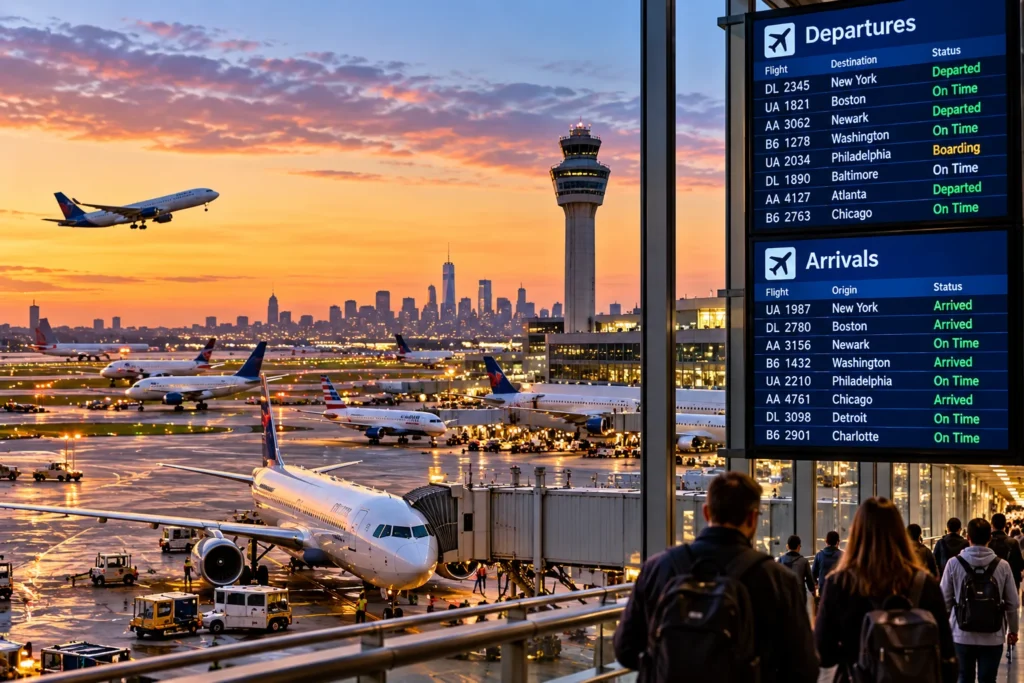
A massive Northeast air travel disruption caused widespread chaos across the United States transportation grid after sudden equipment failures severely impacted operations at key regional transit hubs. According to official Federal Aviation Administration statements, critical air traffic control infrastructure failures caused national flight cancellations to surpass 1,000 trips, while over 6,000 scheduled flights suffered significant delays nationwide.
The epicenter of the travel breakdown affected two major Mid-Atlantic aviation portals: Newark Liberty International Airport in New Jersey and Philadelphia International Airport in Pennsylvania. Ground stops and airspace restrictions rapidly expanded across neighboring air corridors, briefly bringing flight departures to a complete standstill across the entire Northeast corridor.
Dual Telecommunications Failures Ground Air Traffic Control Operations
Official public releases from transportation authorities confirmed that the operational breakdown originated from a primary circuit failure at a key regional air traffic control facility in Philadelphia. When automated safety protocols attempted to transition system operations to an established secondary system, technical crews discovered that the redundant backup line had been physically severed during regional infrastructure construction work in New Jersey.
The simultaneous loss of both primary and secondary data transmission circuits left air traffic controllers temporarily without essential radar coverage and primary communication links across busy regional sectors. To maintain passenger safety while technicians attempted to replace the damaged Philadelphia circuit, federal safety officials implemented emergency airspace closures. Ground stops were temporarily broadened to encompass John F. Kennedy International Airport and LaGuardia Airport in New York City before regional corridors could be safely stabilized.
Transportation Department Restores Essential Aviation Infrastructure
Following hours of urgent technical intervention by federal technicians and telecommunications providers, public updates from the U.S. Department of Transportation confirmed that primary communication circuits had been restored. Federal aviation authorities verified that telecommunication lines were successfully repaired, allowing air traffic control facilities to resume standard operational monitoring.
Department officials announced that regional airspace and airport operations across the Northeast had officially reopened for commercial and general aviation traffic. However, authorities emphasized that clearing the accumulated backlog of diverted, delayed, and rescheduled aircraft would require an extended recovery timeline across the global civil aviation network.
Passenger Travel Waivers and Airline Recovery Protocols
Major commercial air carriers operating out of affected hubs immediately enacted contingency plans to assist stranded passengers. Key hub operators at Newark Liberty International Airport confirmed the end of domestic flight cancellations for the day once radar and communication stability returned.
Airlines issued comprehensive travel flexibility waivers, allowing affected passengers to modify reservation dates, change flight paths, or rebook travel itineraries without incurring standard change penalties. Travel authorities continue to advise all passengers traveling through impacted regional airports to monitor real-time flight status boards and confirm departures with individual air carriers prior to arriving at airport terminals.
For more travel news like this, keep reading Global Travel Wire