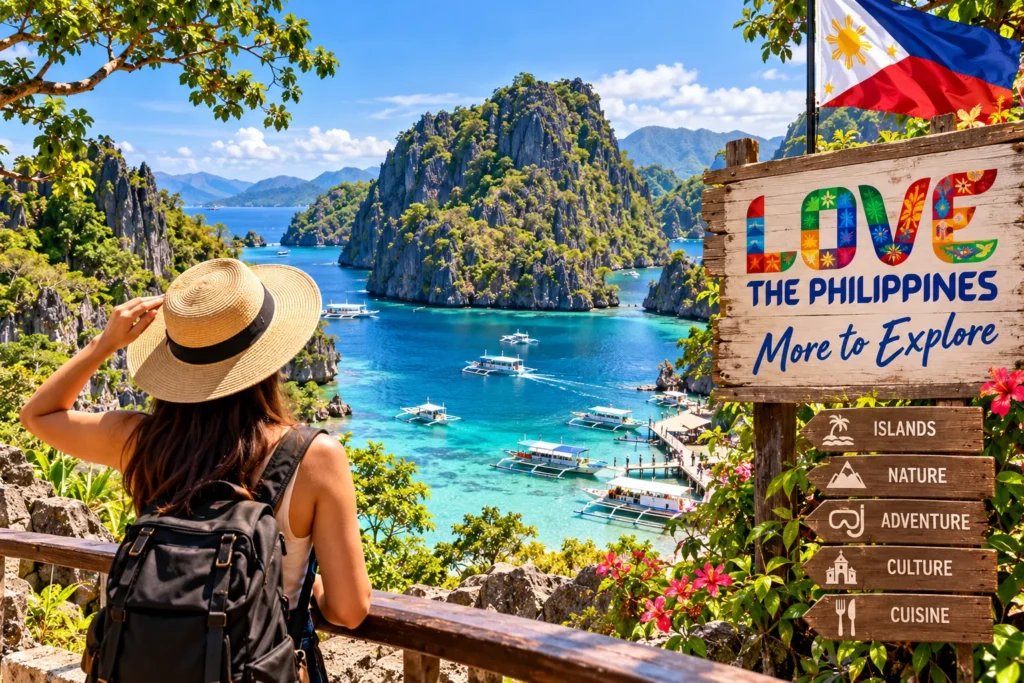
The Philippines has achieved a significant milestone in international travel performance, earning recognition as the seventh-fastest improving economy in global tourism development. Official figures from the 2026 Travel and Tourism Development Index reveal that the archipelago moved up eight positions to reach 57th place out of 110 evaluated nations. Recording an overall benchmark score of 4.08, the nation stands out among key non-high-income economies poised to drive future international leisure travel expansion.
The official evaluation metrics highlight substantial performance gains across key operational areas, including environmental sustainability, transport connectivity, public safety, and supportive government policy frameworks. The Department of Tourism confirmed that national efforts to strengthen visitor infrastructure, safeguard natural ecosystems, and improve local transport nodes contributed directly to the elevated international status.
Major Advances in Sustainable Tourism Development and Environmental Protection
A primary driver of the country’s upward trajectory is its notable advancement in environmental management. In the travel and tourism sustainability evaluation pillar, the Philippines experienced a major leap, rising to 29th place globally from its previous 64th position.
Official government releases attribute this achievement to expanded nature conservation programs, enhanced marine reef protection, and modernized municipal wastewater treatment systems across popular island destinations. Tourism Secretary Dita Angara-Mathay emphasized that preserving biodiversity remains central to the national tourism strategy. Official policy directives prioritize protecting fragile ecosystems, tropical reefs, rainforests, and historic cultural sites while managing visitor capacity to ensure long-term ecological balance.
By integrating responsible management into regional growth plans, public authorities aim to preserve natural attractions so that local host communities and future generations continue to derive economic benefit from sustainable travel.
Infrastructure Upgrades and Public Safety Improvements Drive Connectivity
Ground and maritime transit networks also registered marked structural improvement. The national rating for ground and port infrastructure climbed to 49th place worldwide, supported by higher efficiency ratings across public transport networks, railway systems, and major seaport terminals.
The Department of Tourism highlighted ongoing inter-agency coordination aimed at upgrading road bridges, expanding regional airports, and modernizing maritime sea hubs connecting primary island clusters. These targeted infrastructure investments facilitate seamless travel transfers for domestic and international visitors moving between primary entry portals and island destinations.
Furthermore, public safety metrics demonstrated measurable progress. The nation advanced twenty places in the safety and security assessment pillar, rising to 73rd position. Official statements credited this improvement to enhanced law enforcement coordination between regional tourism units and the Philippine National Police, resulting in lower crime incidents across primary tourist corridors.
Supportive Policy Frameworks Fuel Long-Term Sector Resilience
In the policy and enabling conditions dimension, the Philippines secured an impressive 12th position globally, marking a substantial progression from its 33rd rank in 2019. Government releases confirm that this progress was supported by a 5.8 percent increase in direct public budget allocations dedicated to tourism infrastructure and destination promotion.
The benchmarking framework assesses sustainability and operational resilience across five core dimensions and 17 individual analytical pillars. By securing a prominent position alongside other major developing tourism markets such as India, Indonesia, Malaysia, Thailand, and Vietnam, the Philippines continues to strengthen its economic role within the regional travel sector.
Government leaders reiterated their commitment to expanding community-based tourism programs, ensuring that ongoing sector growth generates stable employment, raises local household income, and improves the overall quality of life across Philippine municipalities.
For more travel news like this, keep reading Global Travel Wire