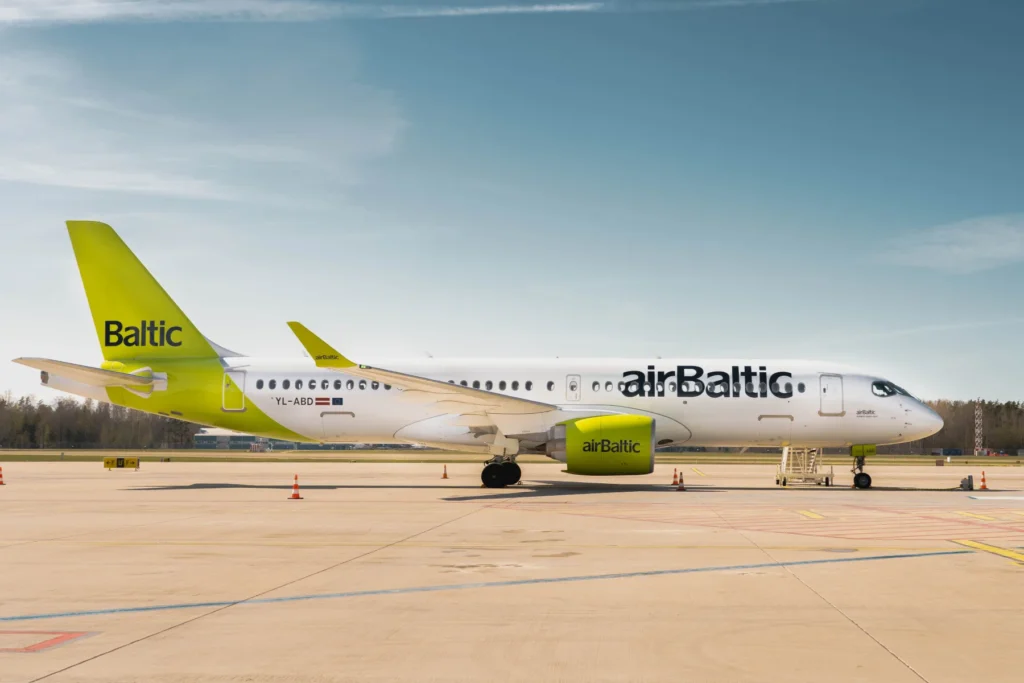
Latvia’s national carrier, airBaltic, is preparing organisational changes that could affect approximately 500 to 700 positions across its Baltic bases. The proposed adjustments cover Riga, Vilnius and Tallinn as the airline implements a new business plan.
The estimate remains preliminary, and decisions concerning individual employees have not been finalised. airBaltic currently employs around 3,000 people across the Baltic region.
For passengers, the immediate position remains clear: the organisational changes are not affecting the airline’s existing flight schedule. Operations continue normally under its current operating plan.
The wider strategy prioritises financial stability, operational efficiency and a more focused route network. It also envisages a smaller Airbus A220-300 fleet and a greater role for year-round aircraft partnerships.
Workforce Estimate Remains Subject to Consultation
The proposed workforce range reflects airBaltic’s current assumptions about its future operating scale and staffing requirements.
However, the figure could change as restructuring progresses. It should not be interpreted as a confirmed number of redundancies.
Consultations with trade unions include possible reduced workload arrangements for pilots and cabin crew. Those discussions form part of the estimated impact.
Meanwhile, the airline is developing a revised organisational structure for other business areas. It expects to define that structure by mid-October.
Employees should receive more comprehensive information throughout October as the company determines its next steps.
At this stage, airBaltic cannot establish how particular bases, functions or employee groups might be affected. That uncertainty limits any detailed assessment of local impacts.
Leadership Outlines Employee Communication Priorities
Erno Hildén, airBaltic’s President and Chief Executive Officer, acknowledged the importance and sensitivity of the process for employees.
He said the airline would prioritise transparency, respect and care while keeping staff informed as planning progresses.
Hildén also emphasised that the company has made no final decisions concerning individual employees. Direct engagement will follow as subsequent steps become clearer.
The airline has informed the State Employment Agency of its intention to begin a collective redundancy process.
It says the procedure will follow applicable legal requirements and relevant consultation processes.
For employees, the forthcoming organisational detail will matter more than the initial headline estimate. It should clarify the proposed structure and potential implications.
Smaller Fleet Features in the Business Plan
The airBaltic restructuring extends beyond staffing. Its business plan seeks to align costs and operations with the expected future size of the airline.
A smaller Airbus A220-300 fleet forms part of that approach, alongside a more focused route network.
The supplied plan does not specify the final fleet size or identify individual routes for changes. Consequently, it does not establish particular service withdrawals.
For tourism businesses, those details will be important when available. Airline capacity influences destination access and the practicality of international itineraries.
However, the current announcement provides a strategic direction rather than a complete future timetable.
Hotels, tour operators and event organisers can therefore distinguish ongoing scheduled operations from decisions still under development.
Year-Round Partnerships Gain a Larger Role
airBaltic also plans to expand year-round Aircraft, Crew, Maintenance and Insurance partnerships, commonly known as ACMI arrangements.
Under this model, an airline supplies aircraft and associated operating resources to another carrier through a commercial agreement.
The planned emphasis places these partnerships alongside airBaltic’s own scheduled network within its future operating model.
Their expansion represents a separate part of the transformation, rather than a direct announcement about passenger booking changes.
The available information does not identify new partners, contract volumes or deployment details. Those elements will determine how the strategy develops operationally.
For the wider Baltic aviation sector, the balance between scheduled services and partnership flying will be an important development to follow.
Existing Flights Maintain Baltic Travel Access
Despite the organisational changes, airBaltic intends to maintain dependable connectivity for Latvia and the wider Baltic region.
That commitment matters for leisure travel, business journeys and visits to friends and relatives. Air access also supports accommodation providers and other visitor-facing businesses.
The airline’s current schedule continues normally. The announcement therefore gives passengers no basis to assume their booked flights have changed.
Travellers can continue checking their individual booking details and airline notifications through the usual channels.
Future updates should provide greater clarity about workforce measures and business-plan implementation when significant developments occur.
For destinations served by airBaltic, the central tourism question concerns how its future network will support reliable access.
The next phase should clarify organisational decisions while showing how the carrier intends to balance financial stability with regional connectivity.
For more travel news like this, keep reading Global Travel Wire