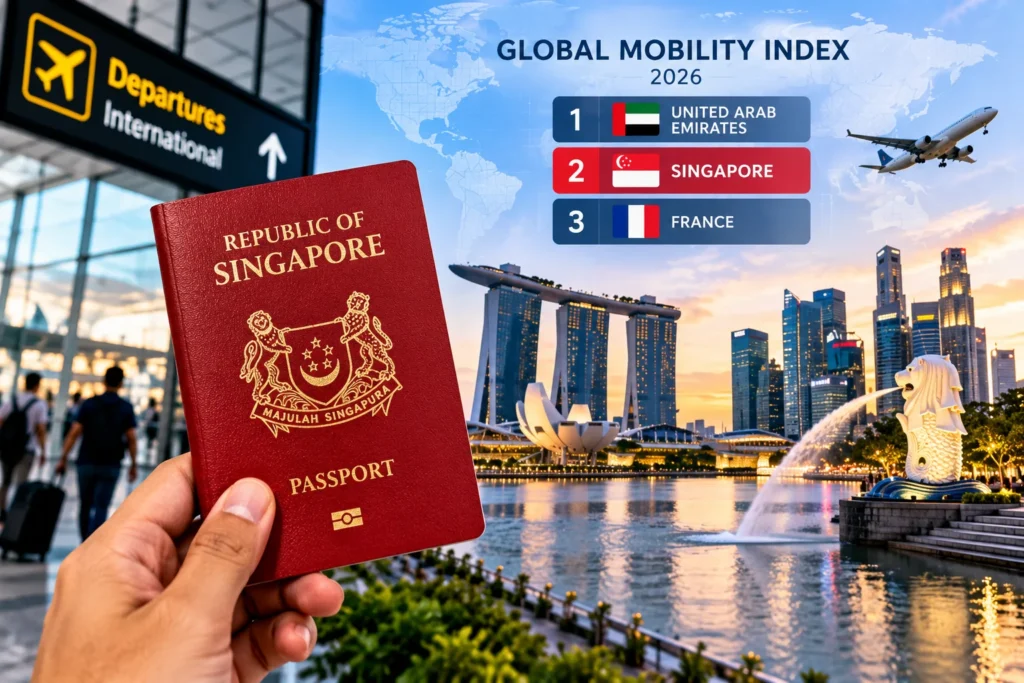
The global travel landscape continues to reflect the strength of diplomatic agreements, international cooperation, and strategic border management. In the official October 2026 global passport mobility assessment, Singapore’s travel document achieved a global ranking of second overall, recording an impressive Mobility Score of 175 and providing an 88.4% global access rate for its citizens.
This mobility evaluation measures outbound travel freedom by evaluating entry requirements across international destinations. Singapore passport holders currently enjoy direct visa-free entry to 129 destinations worldwide, along with streamlined entry arrangements—such as visa on arrival—for 35 destinations. Electronic Travel Authorisation is required for 11 destinations, while only 23 global territories necessitate a traditional visa secured prior to departure.
The score underscores the Southeast Asian nation’s established diplomatic standing, robust consular ties, and commitment to facilitating seamless international travel for business, tourism, and diplomatic exchanges.
Unmatched Regional Dominance Across Asia and Global Economic Blocs
Beyond its high international standing, Singapore passport mobility demonstrates exceptional strength across regional and multilateral economic groupings. Within Asia, Singapore ranks second among 50 evaluated passports, achieving an overall regional access rate of 83.7%.
Official statistical breakdowns highlight complete 100% border access across Europe, North America, the Caribbean, and Gulf Cooperation Council member states. High accessibility is maintained in other major travel corridors, with access rates standing at 92.9% in Oceania, 91.7% in South America, 82.4% in the Middle East, 80.0% in Central Asia, and 75.9% across Africa.
When benchmarked against international economic alliances, Singapore holds the primary position across several prominent multilateral blocs:
Ranked 1st among 21 Asia-Pacific Economic Cooperation economies.
Ranked 1st among 11 Association of Southeast Asian Nations member states.
Ranked 1st among 56 Commonwealth member nations.
Ranked 1st across parliamentary republics and official language groupings including English, Chinese, Malay, and Tamil groups.
Additionally, Singapore retains the second position globally among 159 World Trade Organization members and 132 Group of 77 nations, reinforcing its influence as a premier global business and travel hub.
Multi-Year Mobility Trends Highlight Sustained Global Access
Historical evaluation data highlights consistent performance in Singapore’s international mobility metrics over consecutive reporting periods. The country maintained a matching Mobility Score of 175 in both 2025 and 2026, holding its second-place position worldwide across both annual cycles.
This stability marks a significant upward movement from earlier reporting periods. In 2023, the national mobility score stood at 175 with a 13th-place global rank, while in 2024, a score of 174 placed the document 20th globally. The steady ascent to and retention of the second global spot reflects ongoing bilateral negotiations and newly implemented visa-exemption agreements over recent years.
The high mobility score directly benefits Singaporean citizens traveling internationally for leisure, higher education, and corporate investment. Unrestricted border access eliminates lengthy visa application processes, supporting fluid travel logistics and promoting international commerce.
Distinguishing Outbound Mobility from Inbound Openness
Official travel assessment protocols emphasize an important distinction between outbound mobility—measuring where a nation’s citizens can travel—and inbound border openness, which tracks entry requirements imposed on visiting foreign nationals.
In contrast to its second-place outbound mobility ranking, Singapore holds the 43rd position globally regarding inbound openness toward foreign passport holders. Border control authorities maintain tailored entry requirements, automated border screening systems, and electronic travel registration frameworks to balance international visitor access with national security protocols.
Separating outbound passport power from inbound entry regulations ensures a comprehensive evaluation of global travel dynamics. While outbound scores reflect the diplomatic strength and trust enjoyed by Singaporean travelers abroad, inbound policies remain calibrated to support domestic security, public health standards, and controlled migration management.
As international travel continues to expand, Singapore’s strong standing on global mobility indices reinforces its reputation as one of the world’s most connected and accessible nations, delivering exceptional travel freedom for its citizens across every continent.
For more travel news like this, keep reading Global Travel Wire