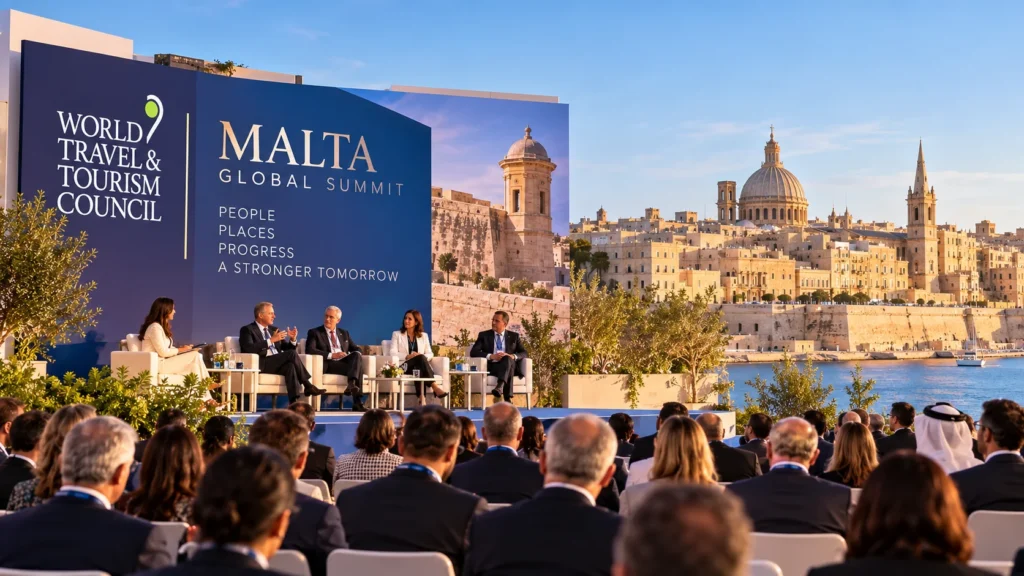
Government ministers and international business executives representing 24 nations gathered in Valletta, Malta, for the World Travel & Tourism Council (WTTC) Global Leaders Dialogue. Organized under the banner of “Rewriting the Rules of Global Competitiveness,” the summit addressed critical structural factors shaping the future of global travel, including automated visa processing, cross-border infrastructure, aviation capacity, and strategic public-private investment frameworks.
The high-level gathering highlighted the need for synchronized policy decisions between state authorities and private enterprise to strengthen national destination appeal while eliminating persistent operational bottlenecks.
Public-Private Dialogue Focuses on Seamless Borders and AI Innovation
The inaugural plenary session, titled “Seamless Travel: Where Government and Industry Meet,” concentrated on the end-to-end journey of international travelers. Key discussion points included modernizing entry clearance systems, refining biometrics, and expanding artificial intelligence applications within visa workflows.
Participating delegates underscored that security protocol enhancements must be paired with efficient passenger management systems. As destination choices widen globally, minimizing friction at international ports of entry has become a fundamental benchmark of national tourism competitiveness.
Discussions spanned several key industry themes:
Border Operations: Integration of digital identity management and automated passenger verification to maintain strict border integrity while reducing transit friction.
Aviation & Logistics: Strategic alignment on bilateral air transport capacity, route development, and airport infrastructure scaling.
Capital Flows: Establishing host-country regulatory frameworks that encourage long-term foreign direct investment in hospitality and travel services.
Policy Coordination: Bridging ministerial regulations with private-sector operations to ensure sustained infrastructure delivery.
Delegates emphasized that modern traveler expectations demand continuous technological upgrades across immigration checks, airport logistics, and digital documentation.
Ministerial and Executive Representation
The summit brought together key government figures responsible for national tourism strategies alongside chief executives from global mobility, technology, hospitality, and travel service organizations.
High-level public sector officials in attendance included:
Egypt: Sherif Fathy, Minister of Tourism and Antiquities
Spain: Rosario Sánchez Grau, Secretary of State for Tourism
Bahrain: Fatima bint Jaafar Al Sairafi, Minister of Tourism
Malta: Jo Etienne Abela, Minister for Tourism
United States: Robert O’Leary, Department of Commerce
India: Gajendra Singh Shekhawat, Tourism Minister
Private sector participation featured leaders across real estate, technology, global distribution, and event management, including:
Minor International: William Heinecke, Founder and Chairman
JTB Corp: Eijiro Yamakita, Chairperson
VFS Global: Zubin Karkaria, Founder and CEO
Amadeus: Maher Koubaa, President EMEA
Arsenale: Paolo Barletta, CEO
ICCA: Senthil Gopinath, CEO
Pernod Ricard: Laura Sileo Pavat, Global Brand Homes Director
The assembly underscored the role of public-private collaboration in shaping destination strategies, aligning legal frameworks with commercial expansion needs.
Strengthening International Investment and Infrastructure
A central outcome of the Valletta dialogue was the shared consensus on capital attraction. As market conditions evolve, national tourism authorities face increased pressure to build transparent regulatory environments, establish clear investment incentives, and implement modern digital border platforms.
Official statements from leadership highlighted the core takeaways of the session:
“Competitiveness is built through partnership. When governments and industry work hand in hand, they create the conditions for investment, innovation, connectivity and growth.” — Gloria Guevara, WTTC President & CEO
The Valletta summit affirmed that international destination leadership will increasingly depend on swift public sector adaptation, deployment of border technologies, and continuous cross-sector investment in transit infrastructure.
For more travel news like this, keep reading Global Travel Wire