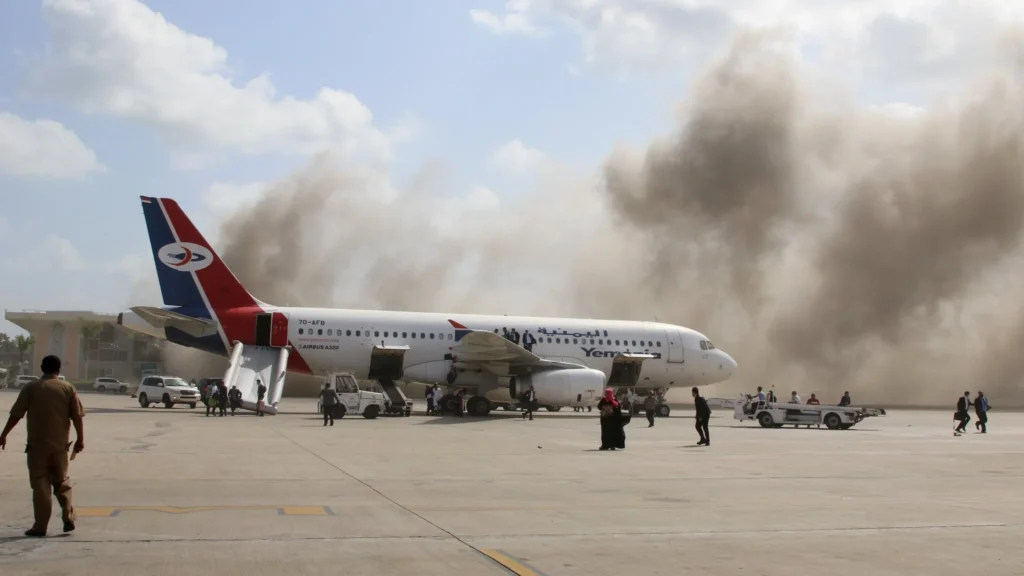
The Aden airport attack has raised fresh aviation concerns after Yemeni authorities reported missiles and explosive-laden drones near civilian operations. The October 7, 2026 incident threatened an important international gateway and disrupted an incoming passenger flight from Cairo.
Yemeni transport authorities said two ballistic missiles and several drones endangered the runway and passenger terminal. They reported cancelling the incoming aircraft’s landing and redirecting it towards Jeddah, Saudi Arabia.
The immediate consequences centre on Yemen’s international connectivity. However, the incident also highlights how airport security threats can affect journeys involving several countries.
Wider disruption across Middle Eastern tourism destinations remains unconfirmed. The situation requires distinctions between direct airport threats, individual flight disruptions and possible regional consequences.
Cairo Flight Faces Sudden Diversion
According to Yemeni transport authorities, a missile landed near Aden’s runway shortly before Yemenia Flight 603 was expected to arrive.
Authorities said they redirected the Cairo-origin service towards Jeddah to protect passengers. The reported decision connected Egypt, Yemen and Saudi Arabia through one disrupted journey.
For travellers, such diversions can complicate onward transport, accommodation arrangements and arrival plans. Nevertheless, the supplied information does not establish passengers’ subsequent movements or the flight’s final operational outcome.
The episode illustrates the importance of conditions at the destination airport. An aircraft can leave its departure city while circumstances change before arrival.
Consequently, passengers travelling through affected routes need current operational updates when organising airport transfers or connecting journeys.
Passengers and Aircraft Moved From Exposed Areas
The incident also affected people already inside Aden International Airport.
Passengers were reportedly awaiting a Jeddah-bound departure around 3am, while airport employees and aviation crews remained on duty. Authorities moved people away from potentially exposed areas.
Two aircraft were reportedly on the ground, associated with Yemenia and Aden Airways. Authorities repositioned them as concerns continued over further aerial activity.
No airport casualties were initially reported in the supplied account. However, that initial assessment does not establish the full extent of damage or subsequent operational restrictions.
For passengers, even a precautionary interruption can create uncertainty. Airport safety measures may affect boarding, baggage handling and departure timing while authorities assess conditions.
Yemen’s Essential Connections Face Pressure
Aden serves communities with limited international aviation alternatives after years of conflict.
Its connections support family visits, employment journeys, medical travel and other essential movement. Therefore, disruption carries consequences beyond conventional holiday demand.
If interruptions continue, travellers could face fewer practical routing options or additional journey stages. These remain possible outcomes, rather than confirmed changes following this incident.
Reliable flights also support accommodation providers, ground transport businesses and services connected with passenger arrivals. Prolonged uncertainty could complicate staffing and bookings for those operators.
However, the information provided contains no measured tourism losses, hotel cancellations or sustained passenger-demand decline.
The immediate story concerns aviation access and passenger safety. Any assessment of wider economic damage requires additional confirmed information.
Regional Tourism Exposure Varies
Saudi Arabia became directly connected with the incident through the reported diversion towards Jeddah.
The city supports international, business and religious travel. Its role as an alternative destination demonstrates how neighbouring aviation networks can absorb disruption elsewhere.
However, the Aden incident alone does not establish disruption at Jeddah’s airport.
Similarly, it provides no evidence that Dubai, Abu Dhabi, Muscat or Cairo faced equivalent airport conditions. Those destinations have different operational environments and security exposure.
For the UAE’s international hubs, broader escalation could create routing or connection pressures. Such effects remain potential consequences unless airlines or authorities confirm changes.
Egypt’s immediate connection concerns the Cairo-origin flight. That does not establish a comparable threat to Cairo’s own airport operations.
Red Sea Connectivity Adds Wider Context
Yemen’s position near Bab al-Mandab gives its security environment broader transport significance.
The strait connects the Gulf of Aden with the Red Sea and maritime routes towards the Suez Canal. Consequently, prolonged instability could affect shipping and cruise planning.
However, the airport incident does not itself demonstrate a maritime closure or cruise cancellation. Aviation disruption and shipping restrictions require separate operational confirmation.
For tourism businesses, the distinction matters when assessing itineraries and communicating with customers. Regional geography explains potential exposure, but cannot establish actual disruption.
Operational Updates Will Shape Travel Decisions
The next developments at Aden will determine whether disruption remains temporary or affects additional services.
Travellers should monitor confirmed departure times, arrival arrangements and airport access before proceeding with affected journeys.
Airline schedule changes and public authority announcements will provide the clearest indication of practical consequences.
For the wider tourism sector, the central issue is whether essential connectivity continues while authorities manage the security threat.
For more travel news like this, keep reading Global Travel Wire