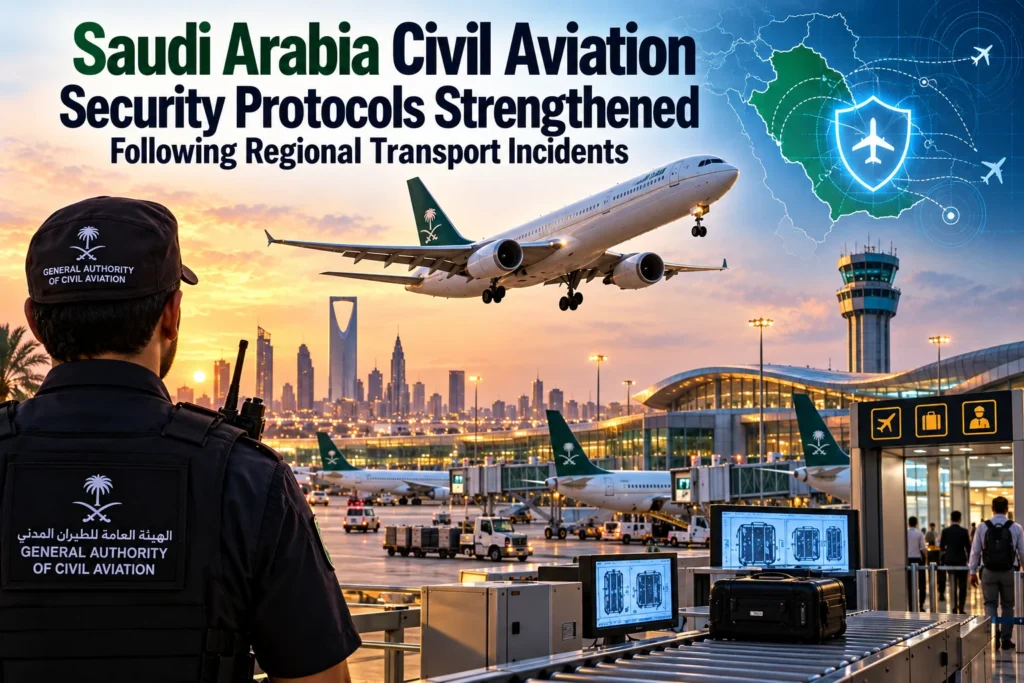
Security protocols across the Kingdom of Saudi Arabia have been heightened following verified safety incidents targeting major civilian transportation hubs. Officials confirmed that civil aviation authorities, emergency response teams, and security agencies activated comprehensive containment measures in response to disruptions in proximity to critical transport facilities.
The General Authority of Civil Aviation (GACA) announced in official statements that emergency response protocols were triggered across civilian air transport facilities, including King Khalid International Airport in Riyadh and Abha International Airport. Official government releases verified that security events resulted in casualties and injuries among airport personnel, foreign residents, and international passengers.
In the national capital of Riyadh, precautionary measures were temporarily initiated across diplomatic quarters, corporate offices, and educational institutions as security agencies verified airspace conditions. International embassies issued safety advisories instructing personnel and residents to follow local authority directives, while administrative teams at local and international schools implemented standard emergency sheltering procedures to ensure student safety.
Operational Assessment and Civil Aviation Safety Benchmarks
King Khalid International Airport functions as a primary air transit hub for the Middle East, serving millions of business travelers, government delegates, and international tourists annually. Maintaining uncompromised civil aviation security remains a central operational imperative for the Kingdom’s transport sector, which underpins broader economic initiatives aimed at expanding international tourism and trade.
According to official updates from GACA, civil aviation regulators maintain full integration with national security agencies to conduct comprehensive physical damage assessments, evaluate flight path safety, and maintain strict monitoring over national airspace. Ground handling facilities, passenger terminals, and air traffic control centers operate under continuous surveillance to preserve operational integrity.
International civil aviation standards mandate immediate activation of air space management protocols, route diversions, and temporary flight schedule adjustments whenever potential threats to civil aviation emerge. While short-term schedule realignments and temporary flight pauses were implemented across select regional routes to prioritize passenger welfare, civil aviation authorities confirmed that primary transport infrastructure remains under controlled monitoring.
International Cooperation and Defense Alignment for Travel Resilience
Governments and international travel bodies worldwide have issued official statements addressing civil transport security in the region. Foreign ministries across the Gulf Cooperation Council (GCC) and global diplomatic partners strongly condemned targeted actions against civilian transit facilities, reaffirming full support for Saudi Arabia’s measures to safeguard its national borders, airspace, and transportation systems.
Diplomatic releases underscored that the safety of international civil aviation, non-combatant travelers, and commercial transit corridors is protected under international law. Enhanced air defense integration and real-time monitoring mechanisms continue to intercept airborne threats before they reach critical civilian infrastructure.
Despite regional operational complexities, Saudi Arabian tourism and civil aviation authorities remain committed to upholding rigorous safety standards. Continued coordination between civil aviation regulators, defense agencies, and international airlines aims to reinforce traveler confidence, protect commercial transit lines, and sustain long-term regional connectivity.
For more travel news like this, keep reading Global Travel Wire