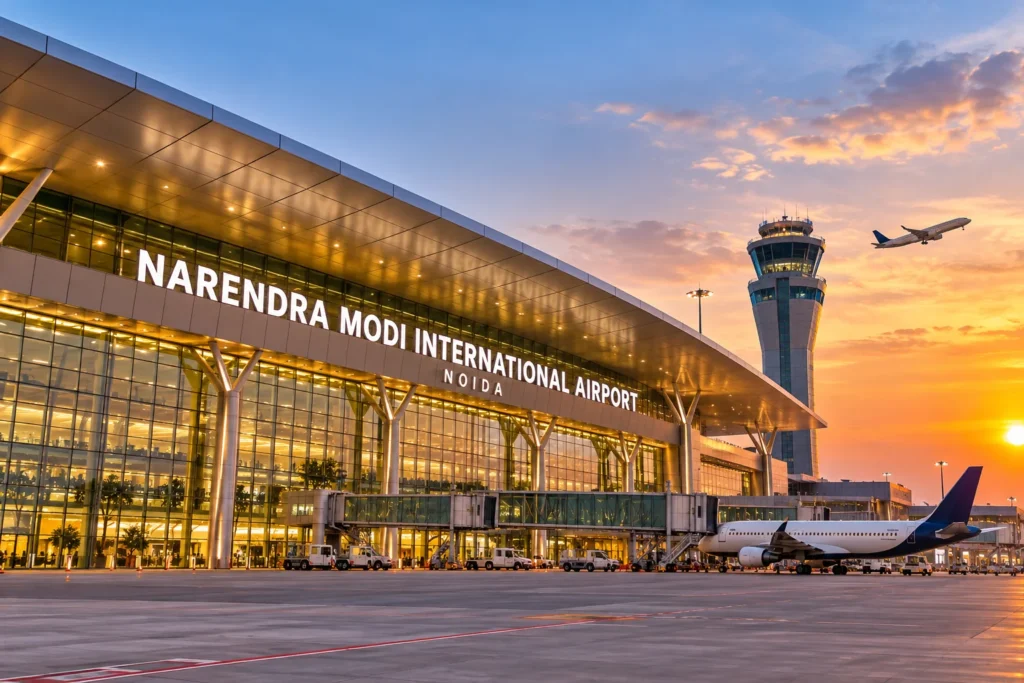
Uttar Pradesh has marked a pivotal moment in its infrastructure expansion following an official announcement regarding the strategic aviation hub at Jewar. The Council of Ministers of Uttar Pradesh, led by Chief Minister Yogi Adityanath, has formally approved a landmark proposal to rename the upcoming Noida International Airport as the Narendra Modi International Airport, Noida-Jewar.
Addressing the media following the state cabinet meeting, Chief Minister Yogi Adityanath confirmed that the state government expressed its sincere gratitude to the Prime Minister for granting this transformative project to Uttar Pradesh. The naming reflects the significant role that federal and state government collaboration plays in developing large-scale mega-projects capable of reshaping regional transport and travel networks.
Set to become the largest airport in Uttar Pradesh, the venue is engineered to act as a primary catalyst for civil aviation and commercial connectivity across Northern India. Built to alleviate passenger traffic congestion at existing national capital hubs, the development forms part of a multi-modal transit network integrating major expressways and high-speed rail corridors.
Strategic Significance for Regional Tourism and Aviation
The transformation of the Jewar mega-project into a major international gateway holds immense promise for the tourism economy of Uttar Pradesh and neighboring region. For years, the state has been one of India’s foremost destinations for domestic and international visitors, driven by world-renowned cultural, spiritual, and heritage circuits.
With the launch of operations at the newly designated Narendra Modi International Airport, seamless access will be provided to key tourist centers including the Taj Mahal circuit in Agra, the historical corridors of Mathura and Vrindavan, and the broader capital region. Direct long-haul air capacity is expected to significantly shorten ground travel times for international visitors arriving in Northern India.
Official tourism board projections indicate that seamless air entry points directly spur local employment, boost hospitality sector investments, and drive demand across traditional arts, crafts, and eco-tourism initiatives throughout the regional belt.
Key Operational Milestones and Progress
The project has achieved significant operational milestones leading up to this latest governance milestone. Prime Minister Narendra Modi officially inaugurated the facility on March 28 earlier this year, signaling the completion of critical airside and landside civil infrastructure necessary for flight safety and passenger processing.
Following its official inauguration, the airport successfully tested its commercial aviation logistics on June 15, when it welcomed its inaugural flight landing. The inaugural domestic service, operated by an IndiGo aircraft arriving directly from the state capital of Lucknow, verified runway capabilities, air traffic management operations, and ground handling services under real-world conditions.
The development and ongoing expansion of the facility are managed by Yamuna International Airport Private Limited (YIAPL), a special-purpose vehicle established to build and operate the airport under a public-private partnership framework. Designed with modern green building standards, smart passenger processing technologies, and flexible terminal designs, the site is prepared to handle multi-phase passenger growth over the coming decades.
Economic Expansion and Infrastructure Integration
Beyond serving as a vital transportation node, the establishment of the airport is driving extensive socio-economic growth across the Yamuna Expressway Industrial Development Authority (YEIDA) zone. State urban planning and industrial development departments have aligned zoning regulations to foster aviation logistics parks, commercial centers, hospitality zones, and manufacturing clusters in the immediate vicinity of the airport.
According to official planning statements, the integration of dedicated freight terminals and cargo facilities at the site will streamline export supply chains for regional industries, including textiles, electronics, and agricultural products from Western Uttar Pradesh.
As construction and phase-wise expansion proceed on schedule, the renamed Narendra Modi International Airport stands as a cornerstone of Uttar Pradesh’s broader economic objective to build world-class transportation networks, establish strategic tourism gateways, and reinforce the state’s position on the international aviation map.
For more travel news like this, keep reading Global Travel Wire