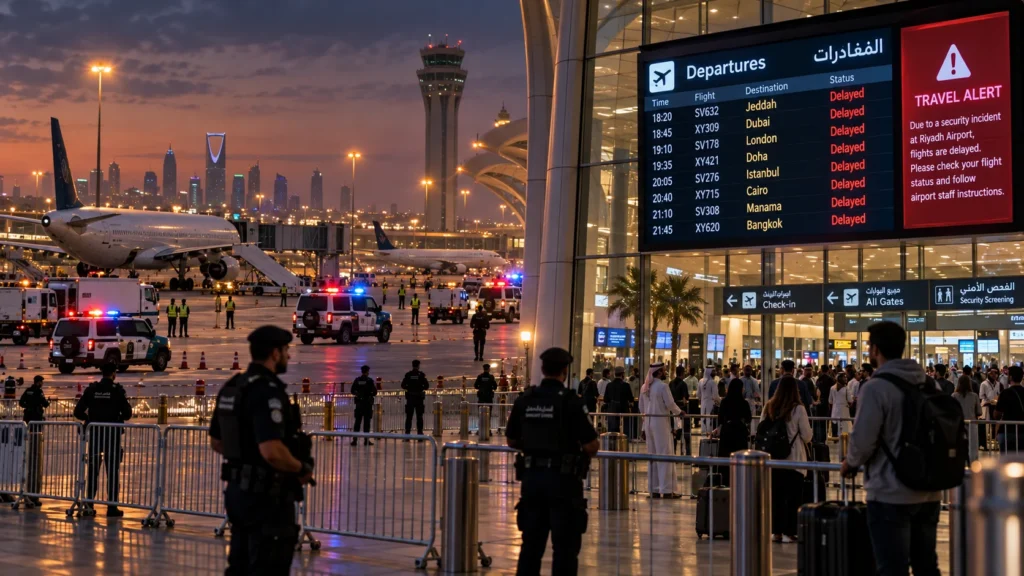
The United States diplomatic mission in Saudi Arabia has published an urgent safety notification advising international travelers and foreign citizens of widespread operational disruptions across key aviation hubs. Official statements released by government representatives confirm heightened risks of flight cancellations, sudden airspace restrictions, and ground movement delays following hostile security events targeting King Khalid International Airport in the capital city of Riyadh.
Travelers planning transit through or destinations within the Middle Eastern region are being advised to maintain strict personal safety protocols and prepare for sudden schedule changes. Civil aviation authorities and international embassy offices urge all inbound and outbound passengers to confirm departure schedules directly with commercial air carriers prior to arriving at airport terminals.
Official Security Alerts and Regional Aviation Disruptions
According to official bulletins released by the United States Department of State, formal security notifications were issued following targeted hostility events at King Khalid International Airport. Government reports explicitly highlight safety concerns tied to cross-border hostility mechanisms involving unmanned aerial vehicles and missile projectiles, which pose documented risks to civil aviation hubs, transportation networks, and public infrastructure.
The broader travel stance for the Kingdom of Saudi Arabia remains categorized under an official Level 3 Travel Advisory. Under standard diplomatic protocols, Level 3 directives explicitly urge citizens to reconsider all non-essential international travel due to volatile regional security environments, civil security risks, and potential escalation across surrounding air transit corridors.
Diplomatic notices emphasize that commercial aviation schedules across major urban hubs including Riyadh, Jeddah, and Dhahran remain vulnerable to sudden disruption. Civil aviation management groups advise passengers to continuously monitor live flight boards via primary airport digital portals to adjust transit arrangements swiftly.
Enhanced Administrative Restrictions for Diplomatic Personnel
In parallel with public passenger advisories, government entities have implemented strict operational mandates limiting the movements of official personnel operating within the region. U.S. government employees stationed in Saudi Arabia are required to secure specialized administrative authorization prior to scheduling transit or departure routes through King Khalid International Airport.
Furthermore, mandatory territorial restrictions prohibit official personnel from traveling within a 20-mile buffer zone along the southern border separating Saudi Arabia and Yemen due to heightened tactical risks. Pre-clearance requirements have also been expanded to cover specified administrative districts and regional municipalities, including the provinces of Jizan, Asir, and Najran, alongside urban centers such as Qatif, Yanbu, and Taif.
Official spokespersons clarified that while these internal travel rules govern diplomatic employees, private international travelers should review these restricted regions as vital safety indicators when mapping local itineraries.
Safety Protocols and Emergency Recommendations for International Visitors
To mitigate personal risks during unexpected regional incidents, official government guidance outlines key protective actions for civilian travelers. In the event of aerial security alerts or active regional defense counter-measures, individuals are instructed to seek immediate interior shelter, remaining clear of exterior glass doors, window structures, and unverified fallen debris.
Public civil defense notifications advise all visitors to maintain low profiles, exercise heightened awareness in publicly accessible areas, and completely avoid political demonstrations, unsanctioned public gatherings, or sites displaying heavy law enforcement presence.
To maintain continuous connectivity, travelers are encouraged to register their travel details through the Department of State’s Smart Traveler Enrollment Program. Enrollment allows automated delivery of real-time security alerts and facilitates immediate contact with consular officials during local emergencies, while routine consular and emergency assistance functions remain fully operational at official embassy and consulate locations.
For more travel news like this, keep reading Global Travel Wire