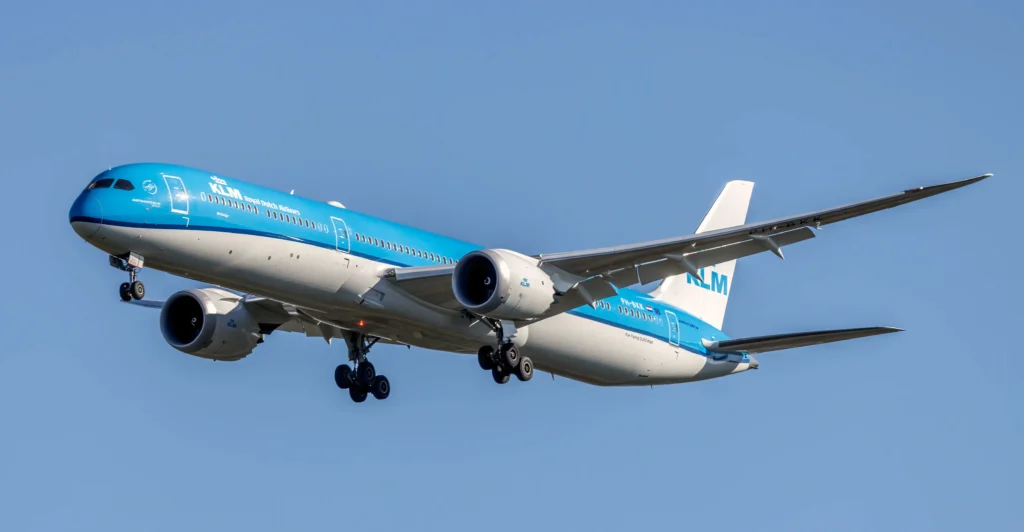
KLM flight KL642 reportedly completed its New York–Amsterdam crossing in five hours and 43 minutes after departing on October 8, 2026.
The supplied flight history records the Boeing 787-10 Dreamliner leaving New York JFK at 21:26 UTC. It landed at Amsterdam Schiphol at 03:09 UTC on October 9.
The elapsed time highlights an unusually swift eastbound transatlantic journey. However, the available information does not establish an all-time route record.
For holidaymakers and connecting passengers, the flight illustrates how actual journey times can differ considerably from published schedules.
Flight Timing Requires a Careful Comparison
The reported crossing compares with a published scheduled duration of approximately seven hours and 20 minutes.
Subtracting those figures produces a difference of one hour and 37 minutes. However, that calculation requires an important qualification.
Takeoff-to-landing measurements and airline schedules may cover different parts of a journey. Scheduled durations generally account for airport operations alongside flying time.
Consequently, the reported difference does not automatically establish that passengers reached their arrival gate 97 minutes ahead of schedule.
The supplied timestamps establish an elapsed interval. They do not provide every operational milestone needed for an exact comparison.
Travellers should therefore distinguish flight duration, landing time and arrival at the gate when assessing the journey.
Strong Winds Can Shorten Atlantic Journeys
High-altitude winds can significantly influence eastbound flights across the North Atlantic.
Jet streams form relatively narrow bands of powerful winds in the upper atmosphere. Their location and strength change with atmospheric conditions.
A favourable tailwind increases an aircraft’s speed over the ground without requiring an equivalent increase through the surrounding air.
This helps explain why journeys along the same route can take different amounts of time.
Nevertheless, favourable winds remain a plausible explanation for KL642’s performance rather than an established cause.
The supplied information does not include historical wind measurements or detailed operational records for the flight.
Routing decisions and air traffic conditions can also influence duration. Weather and turbulence may affect which path an aircraft follows.
Dreamliner Operates the Long-Haul Service
The supplied flight history identifies the aircraft as PH-BKD, a KLM Boeing 787-10 Dreamliner.
The wide-body aircraft serves long-haul routes and offers several seating options within KLM’s network.
The supplied aircraft specifications list a cruising speed of 903 kilometres per hour and a maximum passenger capacity of 344.
However, cruising speed alone cannot explain the reported crossing. Ground speed also depends on winds encountered during the journey.
For passengers, cabin arrangements may matter more when choosing their flight. The aircraft offers Economy, Premium Comfort and World Business Class seating.
Travellers should check their specific booking for cabin features and the planned aircraft. Operational changes can alter aircraft assignments.
Earlier Arrivals Can Improve Travel Flexibility
A shorter crossing can reduce time spent in transit, particularly for passengers travelling overnight between North America and Europe.
For visitors beginning a Netherlands holiday, an earlier arrival may create additional flexibility for transfers, luggage storage or sightseeing.
However, hotel access still depends on the property’s check-in arrangements. Landing early does not guarantee immediate access to a room.
Business travellers may similarly gain flexibility before appointments, although their practical benefit depends on the complete arrival process.
Passengers must still account for airport formalities, baggage delivery and transport into their destination.
These steps determine how much usable time an earlier landing actually provides.
Schiphol Connections Depend on the Complete Itinerary
Amsterdam Schiphol also serves passengers continuing beyond the Netherlands. Transatlantic arrival performance therefore matters to a wider range of journeys.
An earlier landing could provide additional time before an onward departure. Nevertheless, connection requirements remain specific to each itinerary.
Passengers may need to complete immigration, security checks or transfers between gates. Baggage arrangements can also influence the connection process.
Travellers continuing by rail should review departure times and ticket conditions before committing to a tightly timed journey.
The airline’s timetable remains the appropriate basis for planning. One exceptional crossing does not justify reducing a necessary transfer buffer.
Fast Crossing Does Not Establish a Tourism Surge
The reported flight offers an interesting example of aviation performance and its potential effect on passenger experience.
However, it does not demonstrate increased visitor arrivals, stronger hotel demand or higher tourism spending.
Those outcomes require separate evidence. Similarly, the available information does not establish a permanent reduction in KLM’s scheduled journey time.
An all-time record claim would require comparable historical flight data and consistent measurement methods.
For future passengers, dependable planning remains more useful than assuming another unusually fast crossing.
Travellers should check their booking and current flight updates while allowing sufficient time for the journey beyond Schiphol.
For more travel news like this, keep reading Global Travel Wire