Seven Japanese railway operators plan to introduce paper QR tickets from spring 2027, changing how passengers enter and leave stations. A joint announcement on 13 October 2026 confirms that printed codes will replace magnetic tickets across participating networks.
Passengers will scan their tickets when entering and exiting, then deposit used tickets in collection boxes. The system preserves a physical ticket option, allowing visitors to travel without presenting a smartphone or using a mobile application.
For international travellers, the change affects everyday station procedures rather than train routes or timetables. Individual launch dates, detailed handling arrangements and connections between networks still require further announcements.
How the New Train Tickets Will Work
Travellers choosing paper tickets will purchase them from ticket machines and present the printed code to a compatible reader. They will scan the same ticket again when leaving.
After completing the exit procedure, passengers will place used tickets in collection boxes. They should therefore retain their ticket throughout the journey.
This differs from the familiar process of inserting a magnetic ticket into a gate. Visitors accustomed to that method will need to recognise the scanning equipment and follow local instructions.
Where compatible gates are unavailable, passengers will use staffed counters. Although the programme covers all lines and stations of seven operators, station equipment and handling will vary.
Airport Connections Give the Change Tourism Relevance
Participating networks serve rail connections associated with Haneda and Narita airports, making the transition relevant to international visitors. Travellers may encounter the new format during airport transfers as well as sightseeing journeys.
However, the announcement concerns ground transport ticketing. It introduces no changes to flights, airport processing or permission to enter Japan.
For visitors travelling across several railway networks, connection arrangements deserve particular attention. Coordination continues with connecting operators, including services running across network boundaries.
The joint notice does not establish one final conversion date for every affected journey. Travellers should check instructions for their specific route as local implementation details emerge.
Simpler Equipment and Recycling Drive Transition
The programme aims to support sustainable railway operations by changing ticket handling and the paper used.
Earlier programme material identifies the complexity of magnetic-ticket machinery and the possibility of tickets becoming jammed inside equipment. Scanning printed codes aims to simplify that interaction.
Magnetic tickets also contain metal, requiring separation of the magnetic layer during recycling. The planned paper format aims to make recycling easier.
These are the stated reasons behind the transition. The announcement does not provide measured reductions in equipment failures, maintenance costs or environmental impacts.
Similarly, it does not establish that passengers will experience shorter queues. Such outcomes will depend on implementation and subsequent operating performance.
Larger Tickets Preserve a Paper Option
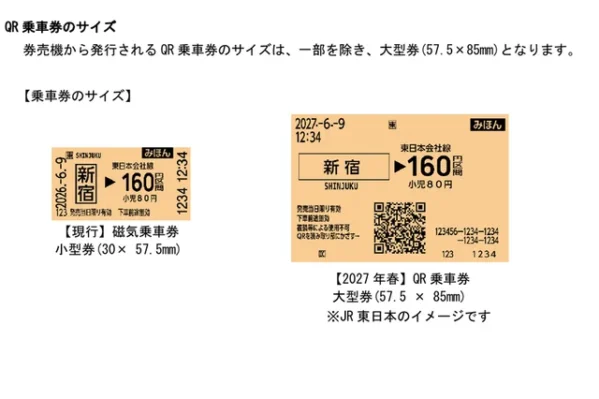
Most machine-issued QR tickets will measure 57.5 by 85 millimetres, although exceptions will apply. The illustrated existing small ticket measures 30 by 57.5 millimetres.
The larger format aims to make the code easier to present to a reader. However, ticket size alone does not demonstrate faster scanning or greater passenger capacity.
Contactless transport cards and mobile services remain part of wider ticketing plans. The new paper option will operate alongside those alternatives.
For travellers who prefer physical tickets, the important feature is continued access without a smartphone display. They will still need to carry the printed ticket until completing the required exit process.
Rollout Builds on Earlier Railway Plans
The October announcement follows a programme first outlined on 29 May 2024. That earlier plan addressed replacing machine-issued ordinary short-distance magnetic tickets through a gradual introduction.
A further station-service announcement on 9 June 2026 identified spring 2027 for the short-distance change on one network.
The latest joint notice provides shared passenger procedures and a common starting window. However, operators beginning services during the 2027 financial year or later will announce schedules separately.
Discounted and promotional products also require local checks. Travellers should avoid assuming that every ticket product will change simultaneously.
What Visitors and Tourism Businesses Should Prepare
Hotels, tour organisers and visitor information teams may need to update directions explaining station entry and exit. Clear guidance could help guests recognise readers, retain tickets and locate collection boxes.
Travellers planning journeys from spring 2027 should check local start dates before departure. They should also review instructions for connecting services and any changes affecting magnetic tickets.
The announcement creates no immediate need to alter existing travel plans. Its practical significance will become clearer as individual operators publish implementation details.
For visitors, preparation centres on one new routine: scan at entry, scan at exit and deposit the used ticket afterwards.
For more travel news like this, keep reading Global Travel Wire