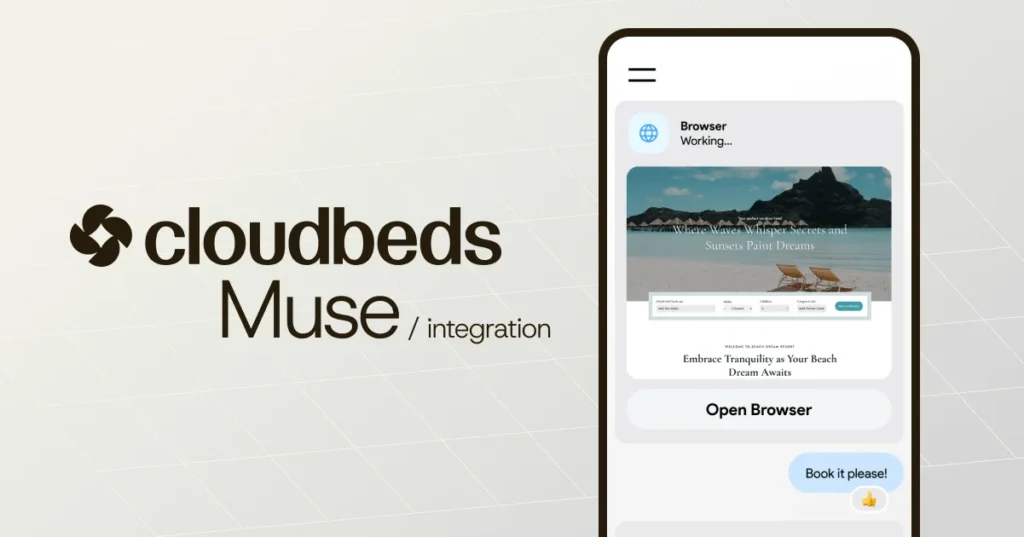
Cloudbeds plans to connect participating hotels with Meta’s personal AI agent, Muse, creating another route for travellers to discover accommodation and book directly. The rollout is scheduled to begin in the United States during the first quarter of 2027.
The integration will make live room rates, availability and booking policies accessible during AI-assisted travel planning. Reservations will pass through participating properties’ Cloudbeds Booking Engine before entering their property management system.
For travellers, the initiative could simplify accommodation searches. For hotels, it offers a potential distribution channel that preserves the direct booking relationship.
The announcement concerns a commercial technology partnership. It does not represent a United States government initiative or establish nationwide hotel participation.
Connecting Travel Discovery With Reservations
The proposed arrangement links two stages of the holiday journey: finding suitable accommodation and completing a reservation.
Travellers using Muse could explore properties using current hotel information rather than relying solely on general descriptions. Access to availability and prices could help narrow choices around travel dates and accommodation preferences.
The final reservation would use the participating hotel’s existing Cloudbeds booking infrastructure. Confirmed bookings would then enter its operational system.
This approach allows hotels to participate without establishing an entirely separate reservation platform. However, the announcement does not identify how many properties will join initially.
Direct Bookings Offer Hotels Another Channel
Hotel operators balance broad market exposure against the cost of securing reservations. Different booking channels can deliver different audiences, expenses and customer relationships.
The Cloudbeds integration aims to introduce participating properties to travellers using AI for accommodation planning. Routing reservations through the property’s booking engine maintains a direct transaction with the hotel.
That could interest independent hotels and boutique accommodation providers seeking more control over distribution.
However, direct reservations do not automatically produce higher profits. Technology costs, marketing expenditure, cancellation levels and booking conversion all affect the revenue a property ultimately retains.
The commercial test will involve whether the channel brings additional guests at an acceptable acquisition cost.
Independent Properties Face a Visibility Test
Smaller accommodation businesses often have limited resources for maintaining visibility across multiple digital platforms.
An additional discovery channel could help these hotels reach prospective guests whose preferences match their facilities, location or room availability.
Nevertheless, participation alone does not guarantee prominent placement within AI recommendations. The announcement does not establish how Muse will rank accommodation or distribute visibility between competing properties.
Hotels will therefore need to understand both the technical connection and the traveller-facing experience.
Competitive offers, clear descriptions and dependable reservation processes will remain relevant. An AI recommendation still needs to lead to a booking experience that customers trust.
Accurate Information Will Shape Traveller Confidence
Live rates and availability form the practical foundation of the integration. Travellers need displayed information to match the conditions presented before payment.
Cancellation terms, room details and booking restrictions also influence whether an offer suits a particular journey.
For example, a flexible holiday itinerary may require different cancellation conditions from a fixed-date stay. Clear information helps travellers make that distinction.
Connecting discovery with hotel management infrastructure could reduce some information gaps. However, it does not establish that every pricing discrepancy or availability change will disappear.
Guests should still review the final reservation details before confirming accommodation.
US Rollout Will Test Practical Benefits
The planned first-quarter 2027 introduction provides an initial opportunity to assess the integration’s usefulness.
For travellers, relevant measures include search convenience, accurate recommendations and successful booking completion. For hotels, the priorities include reservation volume, acquisition costs and operational reliability.
Properties will also need to distinguish additional demand from bookings redirected away from their existing channels.
A reservation arriving through Muse may represent a new customer. Alternatively, it may come from someone who would otherwise have visited the hotel’s website.
Understanding that difference will help operators judge the integration’s contribution to their business.
Tourism Impact Depends on Adoption
More accessible accommodation information could support travel planning by helping visitors identify suitable places to stay.
For destinations, independent hotels form part of a wider visitor economy involving restaurants, attractions, transport providers and local experiences. Better hotel discovery could create opportunities across that network.
However, the announcement provides no measured increase in visitor arrivals, overnight stays or tourism spending.
Its significance currently lies in the proposed booking model rather than proven destination growth.
As the rollout approaches, participating hotels will need accurate inventory and clear policies. Travellers will need confidence that AI-assisted choices translate into dependable reservations.
The integration’s longer-term role will depend on adoption, booking performance and the quality of the guest experience.
For more travel news like this, keep reading Global Travel Wire