Official figures released by the Ministry of Tourism and Wildlife and the Kenya National Bureau of Statistics confirm substantial growth in the nation’s tourism sector, driven primarily by protected game parks, community conservancies, and world-class wildlife reserves. Annual international arrivals have climbed past the 2 million visitor mark, underscoring Kenya’s standing as East Africa’s premier travel hub while generating vital foreign exchange revenue for the national economy.
While Kenya continues to develop coastal and cultural circuits, traditional wildlife encounters remain the foundation of its global appeal. State agencies and conservation authorities highlight that sustainable management, habitat protection, and community empowerment are transforming the visitor experience across the country’s most celebrated wildlife corridors.
Masai Mara and the Great Migration Anchor Safari Inflows
The iconic Masai Mara National Reserve continues to lead visitor demand, celebrated internationally for its thriving predator populations and the annual Great Wildebeest Migration. Co-managed with regional authorities, the reserve offers regular sightings of Africa’s Big Five: lion, leopard, African elephant, Cape buffalo, and rhinoceros.
Government records indicate that the Mara ecosystem serves as a model for private-public conservation partnerships. Surrounding community-owned conservancies lease land from local Maasai landowners, creating contiguous corridors that allow migratory herds to disperse safely during seasonal movements. Revenue generated through regulated gate fees and conservancy leases provides direct household dividends, supports health clinics, and finances primary education.
To safeguard the delicate savannah habitat, tourism officials have introduced stringent ecological guidelines. These measures limit vehicle density around key river crossings, curb off-road driving, and encourage low-impact, solar-powered eco-camps, ensuring the Mara’s world-famous spectacle remains preserved for future generations.
Samburu and Northern Conservancies Offer Rare Biodiversity
Beyond the southern savannahs, the northern wilderness of Samburu National Reserve and the wider Laikipia-Samburu ecosystem have established a distinct safari presence. The Ewaso Ng’iro River serves as the primary water source for this arid region, drawing substantial elephant herds, wild dog packs, and high concentrations of big cats.
The northern circuit is distinguished by the “Samburu Special Five,” rare species adapted to dryland environments:
Grevy’s zebra, an endangered equid monitored through national wildlife censuses
Reticulated giraffe, notable for its geometric coat patterns
Beisa oryx, built for arid terrain
Gerenuk, a long-necked antelope adapted to stand upright on hind legs
Somali ostrich, recognised by its distinct slate-grey neck and legs
Official data from the Wildlife Research and Training Institute confirms that community-led conservancies across Samburu and Isiolo have substantially curbed illegal grazing and human-wildlife conflict. These regional initiatives preserve vital wildlife corridors connecting the central highlands to the northern rangelands.
Circuit Diversification Across Amboseli, Tsavo, and the Rift Valley
To alleviate pressure on seasonal migration hubs, the Kenya Wildlife Service (KWS) and the Ministry of Tourism actively promote alternative destinations within the national park network.
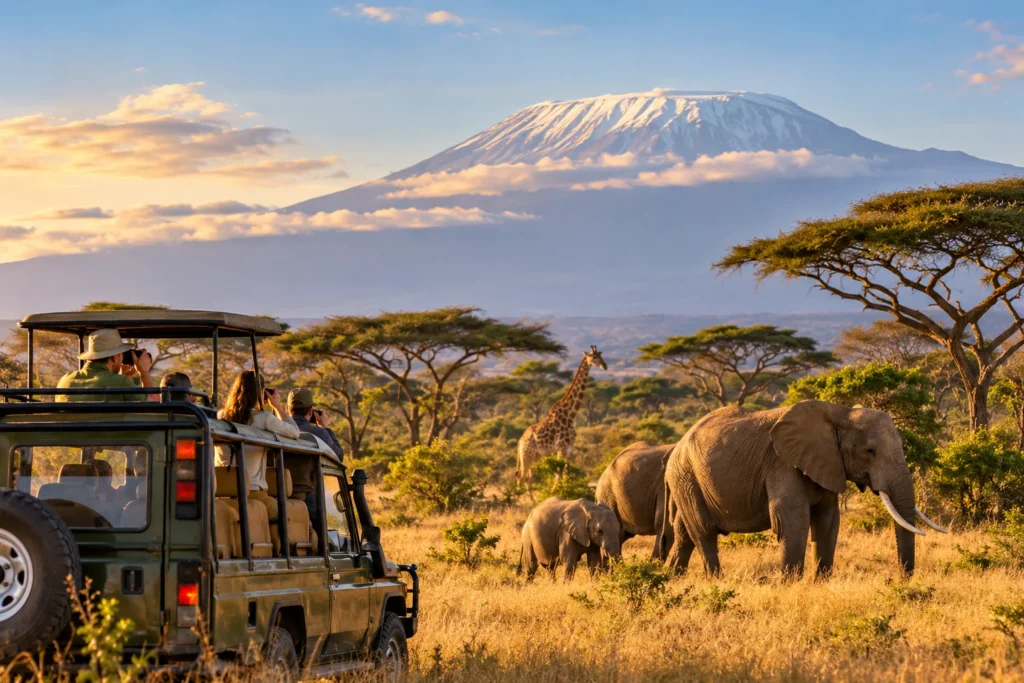
Amboseli National Park remains an anchor of the southern circuit, internationally recognised for its long-term elephant research programmes and panoramic vistas of Mount Kilimanjaro across the border. Controlled wetlands within Amboseli offer dependable year-round wildlife viewing, sustaining buffalo, hippos, and over 400 recorded bird species.
To the east, Tsavo East and Tsavo West National Parks together form Kenya’s largest contiguous conservation unit. Tsavo West features the volcanic landscapes of the Shetani lava flows and the crystal-clear natural springs of Mzima, while the vast semi-arid plains of Tsavo East are home to the famous dust-red elephant herds.
In the Great Rift Valley, Lake Nakuru National Park serves as an internationally designated Ramsar wetland and a sanctuary for endangered black and southern white rhinoceroses. Further north on the Laikipia Plateau, collaborative rhino sanctuaries now protect East Africa’s largest single population of black rhinos, demonstrating the viability of science-led anti-poaching protocols.
Domestic Safari Travel Surges Nationwide
Official monitoring reveals that safari excursions are no longer sustained solely by inbound overseas markets. Domestic park entries have surged over the past five years, bolstered by preferential resident entrance tariffs enacted by the Kenya Wildlife Service, improved regional road infrastructure, and expanded domestic air routes.
Kenyan citizens and East African residents now account for a substantial share of total park visitations, providing operational stability to safari lodges outside peak international travel seasons. Tourism authorities view this domestic expansion as a key milestone in building indigenous support for environmental stewardship and natural heritage preservation.
Conservation Financing and Climate Resilience
As national infrastructure developments make wilderness destinations more accessible via upgraded airstrips and highways, government planning has placed climate adaptation at the core of wildlife management. Prolonged regional droughts and land fragmentation present ongoing challenges for pastoral communities and wild herds alike.
Through the national Tourism Fund and dedicated wildlife conservation endowments, public investment is being channelled directly into artificial water pans, solar boreholes, community ranger training, and corridor restoration. By balancing infrastructural modernization with ecological preservation, Kenya continues to establish benchmarks for sustainable wilderness tourism across the continent.
For more travel news like this, keep reading Global Travel Wire