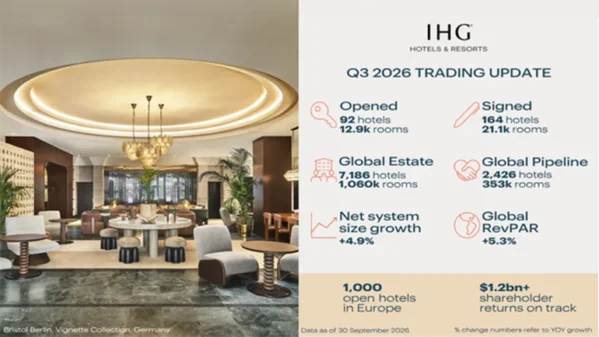
IHG Hotels & Resorts reported stronger global hotel performance in the third quarter of 2026, supported by business travel and group bookings. Revenue per available room increased 5.3% year on year, accelerating from 3.5% growth in the second quarter.
Systemwide group room revenue climbed 10%, while business transient room revenue increased 4%. Higher occupancy and room rates supported the improvement, although regional results varied considerably.
The Americas remained the strongest major region, while Europe, the Middle East, Asia and Africa recorded a substantial improvement. Greater China weakened, highlighting an uneven operating environment across the group’s international network.
Occupancy and Rates Lift Global Performance
IHG’s global average daily rate increased 3.9% compared with the third quarter of 2025. Occupancy improved by 0.9 percentage points.
These annual comparisons show how both pricing and room demand contributed to revenue growth. However, the comparison between consecutive quarters presents a different picture.
Reported global occupancy rose from 69.6% in the second quarter to 72% in the third. Revenue per available room increased from $94.17 to $97.16.
Meanwhile, average daily rate edged down from $135.25 to $134.92. Higher occupancy therefore supported the sequential revenue improvement despite the slightly lower average room rate.
Quarterly averages and year-on-year growth measure different changes and should be considered separately.
Corporate Travel Delivers a Stronger Contribution
Business transient room revenue increased 4% globally during the third quarter, compared with 2% growth across the first half.
The Americas delivered stronger corporate demand, with business transient revenue rising 6%. That compares with 3% growth during the first six months.
Chief Executive Elie Maalouf linked stronger American corporate demand to investment across several industries. These included technology, data centres, energy, pharmaceuticals, manufacturing, construction and defence.
For hotels, work-related journeys can generate demand beyond traditional holiday periods. They also connect accommodation performance with investment activity in local and regional economies.
However, the reported figures cover revenue growth rather than a direct count of additional business travellers.
Group Bookings Strengthen Event-Related Demand
Global group room revenue rose 10%, exceeding the 6% growth recorded across the first half. The earlier figure covers two quarters rather than the second quarter alone.
In the Americas, group room revenue increased 12%, reflecting demand associated with meetings, conferences and business events.
Chief Financial Officer Michael Glover also described a strong group booking pipeline. Forward bookings remained positive across regions.
For destinations with convention facilities and active event calendars, this segment can support accommodation demand and associated visitor spending. Nevertheless, the results do not quantify spending outside IHG properties.
Americas Lead While EMEAA Improves
The Americas recorded 6.8% growth in revenue per available room, compared with 5.4% in the second quarter.
Occupancy improved by 2.1 percentage points year on year, while average daily rate increased 3.9%. The stronger occupancy contribution indicates increased use of available accommodation.
EMEAA recorded the largest improvement in growth, reaching 5% after 0.6% in the preceding quarter.
Within the region, the UK increased 2.8%, while Continental Europe grew 3.8%. East Asia and Pacific delivered an 8.4% increase.
The Middle East was broadly flat after a 19% decline in the second quarter. However, the six Gulf Cooperation Council countries recorded a 12% decline amid continuing regional conflict.
These differences show why stronger regional averages should not be interpreted as uniform recovery across every destination.
Greater China Moves Into Decline
Greater China’s revenue per available room fell 3.3%, reversing the previous quarter’s 0.8% increase.
Average daily rate declined 0.8%, while occupancy decreased by 1.6 percentage points year on year.
IHG attributed the weaker results to adverse weather and changes in public holiday timing. Both factors affected travel patterns and accommodation demand.
The performance contrasts with the improvement elsewhere, demonstrating the importance of local conditions within global hotel results.
Hotel Openings Expand the Accommodation Network
IHG opened 92 hotels during the quarter and signed agreements for another 164 properties, representing approximately 21,100 rooms.
Its operating estate reached 7,186 hotels and approximately 1.06 million rooms. The development pipeline comprised 2,426 hotels with around 353,000 rooms.
Through 30 September, the company had opened 289 hotels and signed 516 properties during 2026.
Openings add operating accommodation, while pipeline agreements represent future projects whose delivery remains separate from current room availability.
IHG maintained confidence in meeting its annual expectations, with adjusted earnings per share towards the upper end of its long-term growth range. Continued corporate demand and group bookings remain central to that outlook.
For more travel news like this, keep reading Global Travel Wire