Connecting East London Directly to Continental Passenger Networks
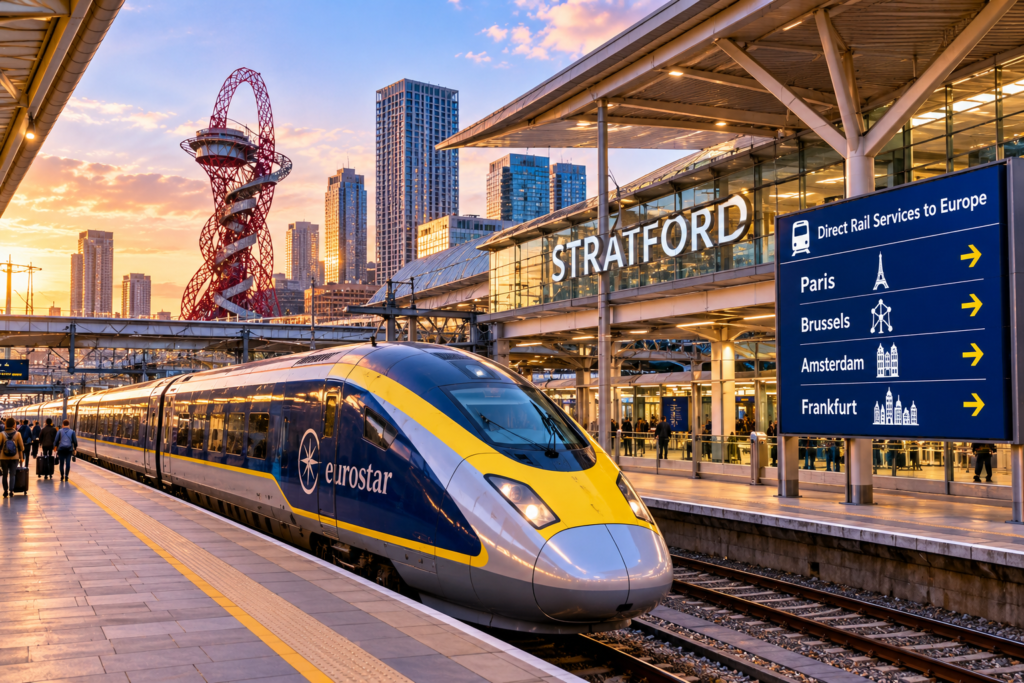
London’s international visitor economy stands to gain substantial momentum under municipal proposals to introduce direct cross-Channel passenger services to Stratford International station. The initiative aims to enable direct rail links between mainland Europe and the eastern districts of the British capital, decentralising international arrivals from central London and expanding regional connectivity across the United Kingdom’s inbound travel corridors.
For nearly two decades, cross-Channel rail passengers travelling to destinations such as Paris, Brussels, and Amsterdam have relied almost exclusively on central London terminals, primarily St Pancras International. Enabling passenger services to call at Stratford International would allow the transport hub to fulfil its foundational design purpose, providing an alternative direct port of entry for European holidaymakers, leisure travellers, and business visitors.
The Greater London Authority highlights that east London represents one of the largest and most successful regeneration initiatives in Europe. Integrating active cross-Channel passenger connections into this established transport and commercial ecosystem is positioned as a strategic lever to stimulate hospitality investment, generate employment, and broaden inbound visitor distribution across regional borough economies.
Delivering on High Speed Rail Infrastructure
Stratford International was constructed as an essential passenger stop along the High Speed 1 railway corridor. Completed in 2006, the station’s core tracks and platforms were designed specifically to accommodate high-speed international rolling stock traversing the Channel Tunnel.
Domestic high-speed rail operations commenced at the facility in 2009, and the interchange has since functioned as a vital domestic transport node served by regional high-speed services and the Docklands Light Railway. However, direct international passenger services have yet to call at the terminal, leaving its international processing capacity unused.
The proposed activation requires an estimated public capital investment of 20 million pounds to establish dedicated border control systems, customs clearance zones, and passenger screening checkpoints. These dedicated security environments must adhere strictly to international border protocols before cross-Channel operators can schedule scheduled passenger halts.
Discussions surrounding the delivery of this project reflect close cooperation between city authorities and central government departments, evaluating the national and regional economic benefits of diversifying passenger transit infrastructure on the High Speed 1 line.
Dispersing Tourism Spending Across East London
Tourism development frameworks indicate that establishing Stratford as a European gateway could deliver significant economic returns for local retail, culture, and hospitality operators. Regional business improvement districts and municipal commerce groups point out that introducing international arrivals would raise the global profile of east London destinations.
Under operational projections, up to one in three outbound and inbound passenger services travelling toward France could call at Stratford. This scheduling flexibility would encourage travellers to base their stays in eastern boroughs, directly benefiting local accommodation providers, entertainment complexes, and independent dining establishments.
Stratford has already developed into a popular overnight destination for domestic visitors and convention attendees, driven by its proximity to Queen Elizabeth Olympic Park, world-class athletic venues, cultural complexes, and expansive retail centres. Incorporating direct international rail accessibility would expand this visitor base to European short-break tourists and city-break travellers, who can disembark directly in east London without having to navigate crowded central London transit corridors.
Commercial town centre representatives note that international arrivals provide a crucial impetus for local service providers, converting transit passengers into multi-day visitors who spend within the local borough rather than transferring immediately to central city attractions.
Sustainable Transit and Future Visitor Mobility
The campaign to integrate Stratford into continental rail networks aligns closely with broader public transit and sustainable tourism policies. Modern transport policy frameworks across the United Kingdom and Europe prioritise the expansion of electrified high-speed rail as an environmentally sound alternative to short-haul aviation.
Stratford International offers direct surface connections to the domestic railway network, regional underground lines, and regional bus networks. Arriving travellers can disperse efficiently to destinations across Greater London, Essex, and the East of England without straining central transit hubs.
By utilising existing railway tracks, existing platforms, and established civil infrastructure, the proposal represents a resource-efficient intervention to expand national passenger capacity. Rather than constructing entirely new rights-of-way, capital outlays remain targeted on security retrofits and border facilities.
As international consumer preferences shift toward low-carbon transport options, direct railway links between continental Europe and expanding metropolitan hubs will define modern visitor economies. Restoring the international function of Stratford International station reinforces the capital’s accessibility, encouraging sustained tourist arrivals, boosting regional commercial ecosystems, and strengthening cross-border cultural exchange between the United Kingdom and European travel markets.
For more travel news like this, keep reading Global Travel Wire