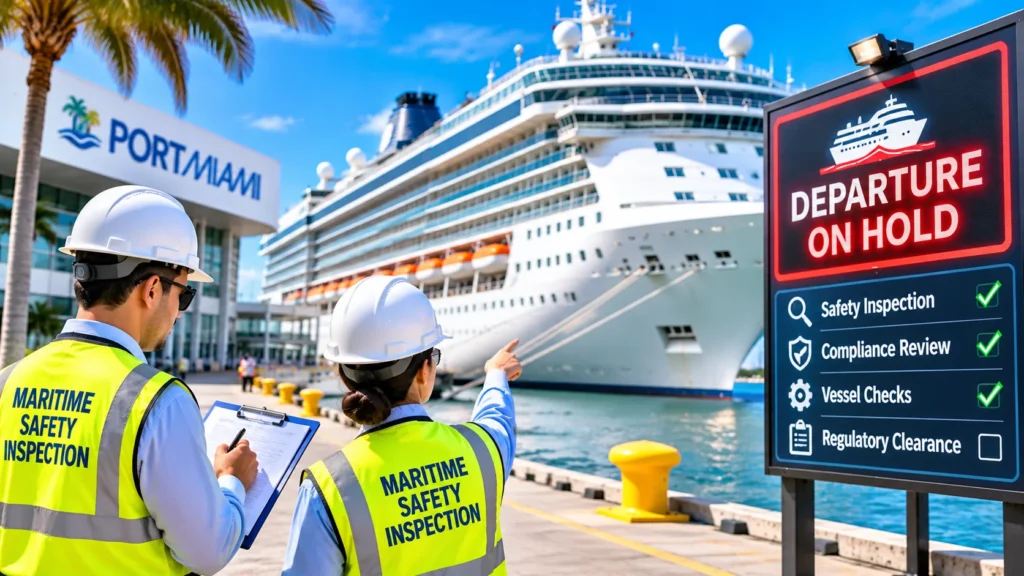
Federal maritime regulators have intervened at PortMiami to enforce stringent maritime safety and environmental protocols, placing an immediate administrative detention order on the MSC Poesia prior to its scheduled voyage across the Caribbean and Central America. Officials from the United States Coast Guard Sector Miami initiated an expanded inspection of the foreign-flagged vessel to confirm that structural, mechanical, and operational systems align with federal laws and international maritime conventions.
Under port-state control jurisdiction, the United States Coast Guard exercises statutory authority to examine all foreign passenger ships embarking travelers from domestic harbors. According to official statements issued by the Coast Guard, maritime safety personnel are charged with verifying secure commerce while protecting travelers, maritime crew, the physical vessel, and marine ecosystems. The Captain of the Port prioritized public safety and environmental protection by requiring exhaustive technical verifications before granting permission for the vessel to navigate open ocean waters.
Such comprehensive vessel evaluations focus on critical life-safety measures, including navigation equipment, automated fire-suppression mechanisms, emergency power distribution, watertight hull integrity, and lifeboat readiness. When federal inspectors uncover discrepancies or require further operational testing, the regulatory framework empowers authorities to halt passenger operations until full compliance is demonstrated.
Impact on Passengers, Itineraries, and Consumer Protections
The scheduled voyage of the MSC Poesia, structured as a multi-day round-trip itinerary connecting Florida to tourist ports in Jamaica, Colombia, and Costa Rica, was officially suspended when technical discussions and inspections could not be resolved prior to departure. The vessel, which maintains a passenger capacity exceeding 3,200 travelers alongside a complement of over 1,000 crew members, remained docked at the terminal during the expanded examination.
In an official public communication, the cruise line confirmed the voyage cancellation, stating that the decision was made after being unable to resolve the regulatory matter within the required departure window. The company issued a formal apology to affected holidaymakers for the disruption to their itineraries and affirmed complete cooperation with federal maritime inspectors.
To mitigate the financial impact on impacted vacationers, the operator instituted comprehensive passenger remediation measures. The carrier guaranteed complete refunds of all paid cruise fares, arranged ground logistical assistance, and provided financial coverage for homeward travel arrangements. These passenger protection steps conform to industry consumer commitments overseen by federal maritime agencies, ensuring that stranded travelers are protected during unforeseen operational halts.
Regulatory Frameworks and Environmental Protocols Governing Modern Cruise Vessels
International maritime tourism is governed by multilateral safety frameworks administered by the International Maritime Organization alongside national port-state directives. Key global conventions, including the International Convention for the Safety of Life at Sea and the International Convention for the Prevention of Pollution from Ships, govern the structural standards, emergency training schedules, and environmental discharge controls of every modern cruise liner.
In American waters, United States Coast Guard inspectors conduct mandatory periodic assessments to ensure compliance with these international standards. An expanded examination represents a deep-tier inspection procedure, triggered when preliminary reviews identify items warranting further operational verification. These reviews encompass crew safety drills, propulsion machinery reliability, emergency evacuation protocols, and advanced wastewater treatment operations.
Because modern mega-vessels operate as self-contained floating communities carrying thousands of international guests, port authorities and maritime safety agencies maintain zero tolerance for deferred maintenance or non-compliant emergency systems. The rigorous enforcement by the Captain of the Port highlights the federal mandate that commercial holiday schedules must never supersede passenger safety or marine environmental security.
Industry Implications for Global Cruise Tourism and Port Operations
PortMiami, recognized globally as the primary cruise departure hub of the world, handles millions of passenger movements annually across dozens of international cruise brands. The detention of a large-scale ocean liner serves as a clear reminder of the operational complexities inherent in modern maritime tourism. As travel demand continues to rise, port state control agencies remain the frontline defense against mechanical failures, onboard accidents, and marine contamination.
For tourism boards across the Caribbean and Central American destination ports, vessel delays and cancellations carry measurable economic effects. Destination port authorities, local tour providers, and municipal transport networks depend heavily on the timely arrival of international cruise guests. However, tourism authorities consistently acknowledge that rigorous safety governance preserves long-term public trust in maritime travel.
Moving forward, the collaborative oversight between cruise carriers, national coast guards, and international maritime bodies reinforces the standard of cruise ship safety compliance across the sector. By enforcing uncompromising technical inspections prior to open-ocean transit, maritime authorities ensure that holiday journeys across global waters remain safe, secure, and resilient for all international travelers.
For more travel news like this, keep reading Global Travel Wire