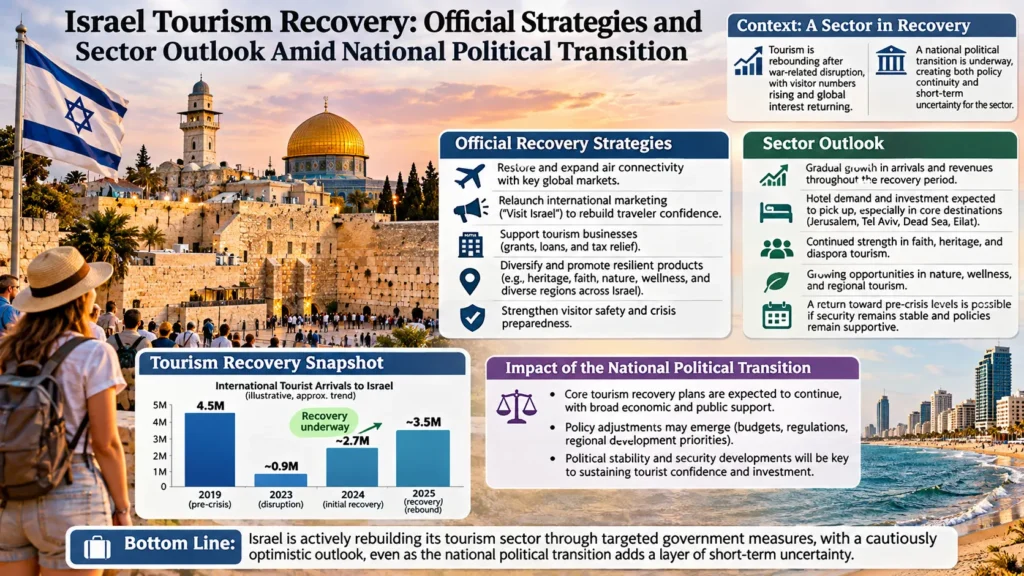
The political landscape in Jerusalem is experiencing a pivotal turning point following the official mandate granted to Yashar party leader Gadi Eisenkot to form the next governing coalition. As the national leadership navigates this constitutional transition, international travel stakeholders, hospitality operators, and destination planners are closely evaluating the state of the visitor economy. Official tourism board releases, statistical publications, and ministry policy statements reveal a focused effort to accelerate long-term sector resilience, protect hospitality investments, and revive international tourist arrivals across heritage and commercial travel corridors.
Official Statistical Benchmarks and Visitor Trends
Data released by the Ministry of Tourism highlights significant shifts in visitor volume and traveler demographics following extended regional disruption. According to the ministry’s annual activity reviews, inbound arrivals reached approximately 1.3 million international visitors at the conclusion of 2025. While this volume remains below the pre-2020 peak of 4.5 million entries, official tracking reflects a measurable upward trajectory compared to previous wartime lows.
The United States continues to serve as the dominant overseas market, accounting for approximately 400,000 visitors, followed by key European inbound markets including France with 159,000 arrivals and the United Kingdom with 95,000. Together, these primary source markets represent more than half of all incoming international traffic. Official survey assessments demonstrate that visitors arriving during this phase have spent an average of 1,622 US Dollars per person per trip excluding airfare, with family visits, heritage exploration, business travel, and pilgrimage defining the core entry profiles.
Concurrently, domestic tourism has served as an economic stabilizer. Israeli travelers generated over 13 million hotel room nights in a single nine-month span, maintaining commercial activity across regional hospitality hubs from the Galilee to the Dead Sea and Eilat.
Planning Reforms and Travel Sector Infrastructure Investment
To ensure that commercial hospitality infrastructure remains viable as air routes and bilateral connectivity normalize, government planning authorities have implemented major structural reforms. A landmark policy approved by the government permits a residential component of up to 49 percent within zones formally designated for hotel developments. The initiative was engineered to alleviate capital constraints for commercial developers, lower financial risks for new accommodation projects, and ensure the steady addition of modern hotel keys nationwide.
In parallel, public development funds have been allocated to shore up local municipal destinations. Official ministry statements confirm funding disbursements totaling approximately 174 million New Israeli Shekels distributed across 58 tourism projects extending from Mount Hermon in the north to the Red Sea port of Eilat. These grants target heritage site conservation, pedestrian pathways, coastal preservation, and visitor center upgrades, positioning local infrastructure for anticipated border normalizations.
In addition, bilateral outreach programs have expanded, including official memorandums of understanding and promotional delegations aimed at deepening inbound flows from emerging high-growth markets like India, alongside established commercial partnerships in Europe and the Americas.
Political Leadership and Long-Term Tourism Governance
The potential transition to an administration led by Gadi Eisenkot carries notable implications for national planning, regional stability, and international visitor confidence. Eisenkot, who previously led the Israel Defense Forces and later served within the emergency war cabinet, established his party platform around institutional integrity, structured governance, and civil resilience.
Tourism policy analysts recognize that sustainable inbound travel hinges upon dependable air corridors, safety assurances, and administrative predictability. Ministry leadership has affirmed that restored airline schedules and the gradual reduction of international travel advisories are the two primary catalysts required to return annual arrival figures to multi-million thresholds. The progression of coalition discussions at the Knesset will determine the allocation of ministerial portfolios, including the leadership tasked with driving the national tourism budget, foreign market campaigns, and airline subsidy programs for regional gateways.
Enhancing Visitor Assurance and Administrative Digitalisation
To support international travel logistics, authorities have rolled out new administrative frameworks to streamline foreign entries and enhance traveler assistance. The introduction of electronic travel authorization mechanisms has digitized cross-border administration, aligning entrance formalities with standard global protocols.
Simultaneously, the Virtual Tourism Bureau was established as an accessible digital service under the tourism ministry, delivering round-the-clock guidance on route access, active cultural venues, municipal transportation advisories, and certified guiding credentials. Official visitor exit surveys reflect that among current travelers, 88 percent expressed satisfaction with their experience, and 83 percent indicated a willingness to recommend travel to the region.
As constitutional procedures continue and parliamentary leaders work within statutory deadlines to construct a functional cabinet, the underlying tourism apparatus remains focused on institutional continuity, structural room expansion, and long-range economic revival.
For more travel news like this, keep reading Global Travel Wire