The Indian subcontinent is preparing to redefine mountain transit and high-altitude exploration with one of the most ambitious civil infrastructure proposals in modern history. Under official planning by the Ministry of Railways, the proposed 489-kilometre Bilaspur-Manali-Leh broad-gauge rail corridor is designed to forge an all-weather railway connection directly across the Trans-Himalayan expanse, linking the lower valleys of Himachal Pradesh to the rugged plateaus of Ladakh. If executed in accordance with technical surveys, the route will host the highest railway station on Earth, situated at an extraordinary elevation of approximately 5,256 metres (17,244 feet) above sea level.
For the international tourism sector, the proposed corridor represents a transformative development. Currently, overland journeys to Leh are restricted to seasonal mountain highways that remain shuttered during harsh winter freezes, leaving high-cost flights as the only year-round transit option. A permanent, climate-resilient railway would unlock regular, eco-conscious visitor access to Ladakh’s monastic heritage, glacial lakes, and unique high-altitude landscapes throughout the entire calendar year.
Surpassing Global Records at Tanglang La
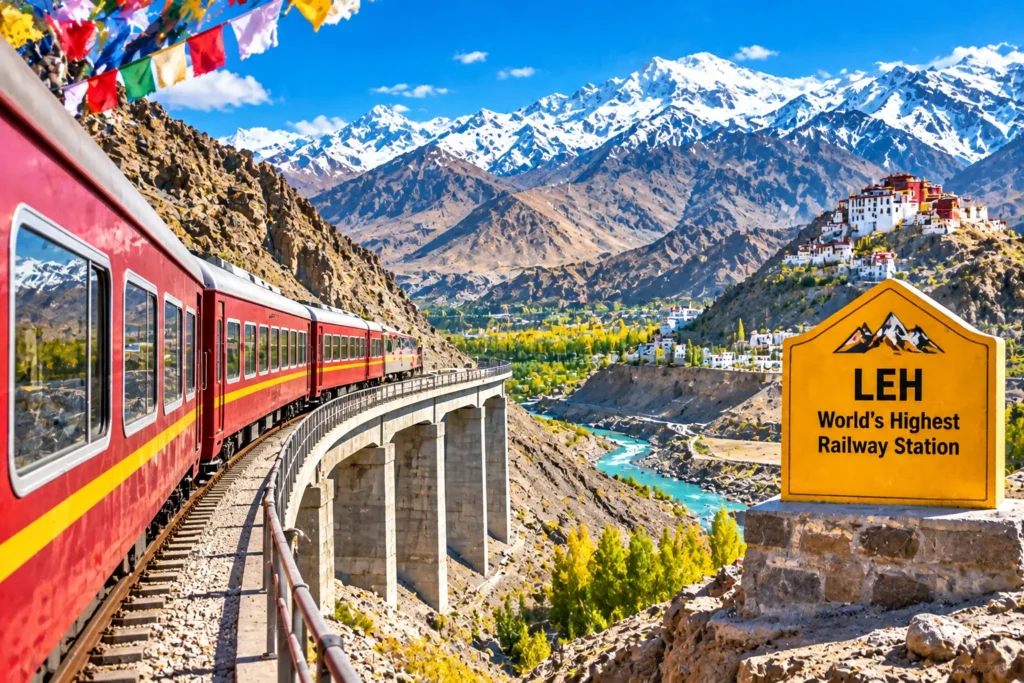
According to official planning documents and project outlines, the flagship feature of the proposed mountain corridor is a terminal planned deep beneath the Tanglang La mountain pass in Ladakh. Rising to approximately 5,256 metres, the station would comfortably exceed the current global record held by the Tanggula railway station along the Qinghai-Tibet Railway, which sits at roughly 5,068 metres.
The planned station would place an Indian mountain terminal nearly 188 metres higher than any operational passenger rail point on the planet. Tanglang La, already renowned among motorists as one of the highest navigable motor passes in the world, would transform into an unprecedented high-altitude rail junction. Official surveys also incorporate modern subterranean passenger hubs along earlier sections of the corridor, including a major underground facility planned at Keylong in Himachal Pradesh’s Lahaul-Spiti valley to insulate operations from severe mountain weather.
Technical Feasibility and Monumental Geological Challenges
Building an advanced broad-gauge railway system across the active Himalayan belt involves world-scale engineering complexities that extend far beyond ordinary surface highway construction. The Detailed Project Report (DPR) prepared by rail authorities projects an estimated capital investment of roughly ₹1.31 lakh crore (approximately 15 to 16 billion USD) to execute the 489-kilometre route.
To safeguard tracks against destructive winter avalanches, flash floods, and massive seasonal landslides, official design parameters call for over 55 percent of the total track length to be constructed entirely underground. The alignment features approximately 270 kilometres of deep mountain tunnels and more than 100 viaducts and high bridges spanning treacherous river gorges.
Operating at altitudes exceeding 5,000 metres requires specialized equipment, including pressurized passenger compartments and supplementary oxygen delivery systems to counteract severe atmospheric pressure drops, alongside automated track-heating technologies designed to function in sub-zero alpine conditions. While preliminary location surveys and project documentation have concluded, formal statutory construction clearances and inter-governmental funding frameworks remain in the planning pipeline.
Revolutionizing High-Altitude Cultural and Adventure Tourism
The prospective launch of passenger rail services along this corridor would establish a new golden era for tourism throughout Northern India. The route passes through several historic cultural hubs, including Sundernagar, Mandi, Manali, Sissu, Keylong, Darcha, Sarchu, Pang, and Upshi, before terminating at Leh.
Year-Round Accessibility to Remote Cultural Treasures
Ladakh’s ancient Buddhist monasteries, historic gompas, and cultural festivals such as Hemis and Dosmoche have traditionally experienced severe off-season slumps when road corridors close between November and May. A continuous broad-gauge railway would democratize winter travel, making Ladakh’s frozen landscapes, winter trekking circuits, and traditional snow leopard expeditions reliably accessible to travelers from all demographics without reliance on unpredictable winter air corridors.
Promoting Sustainable, Low-Emission Mountain Transit
Mountain environments are acutely vulnerable to vehicle emissions and surface traffic congestion. Currently, the Manali-Leh and Srinagar-Leh highways witness thousands of fossil-fuel-powered utility vehicles and trucks traversing pristine valleys during peak summer months. Transitioning significant passenger and freight traffic onto electrified rail networks aligns directly with official national green tourism initiatives, significantly lowering the per-passenger carbon footprint across fragile alpine ecosystems.
Decentralized Economic Growth for Rural Communities
High-altitude railway stops along the alignment will distribute economic benefits beyond traditional tourist hubs. Remote settlements along the Pir Panjal, Zanskar, and Ladakh ranges will gain direct commercial links to larger urban markets. Local homestays, indigenous craft cooperatives, and regional trekking guides will benefit from steady visitor arrivals, creating sustainable employment opportunities for young Himalayan residents without forcing urban migration.
A Global Benchmark for Civil Engineering and Heritage Exploration
The proposed Bilaspur-Manali-Leh railway project stands as a monumental vision for global transportation and experiential mountain travel. By connecting the sub-Himalayan valleys of Himachal Pradesh to the high desert of Ladakh through pioneering subterranean engineering, India aims to set an unmatched world benchmark in mountain infrastructure.
When operational, the line will not merely serve as an administrative transit corridor; it will become one of the world’s most sought-after scenic railway journeys, inviting international travelers to gaze across snow-bound Himalayan passes and high-altitude plateaus from the highest railway platform in human history.
For more travel news like this, keep reading Global Travel Wire