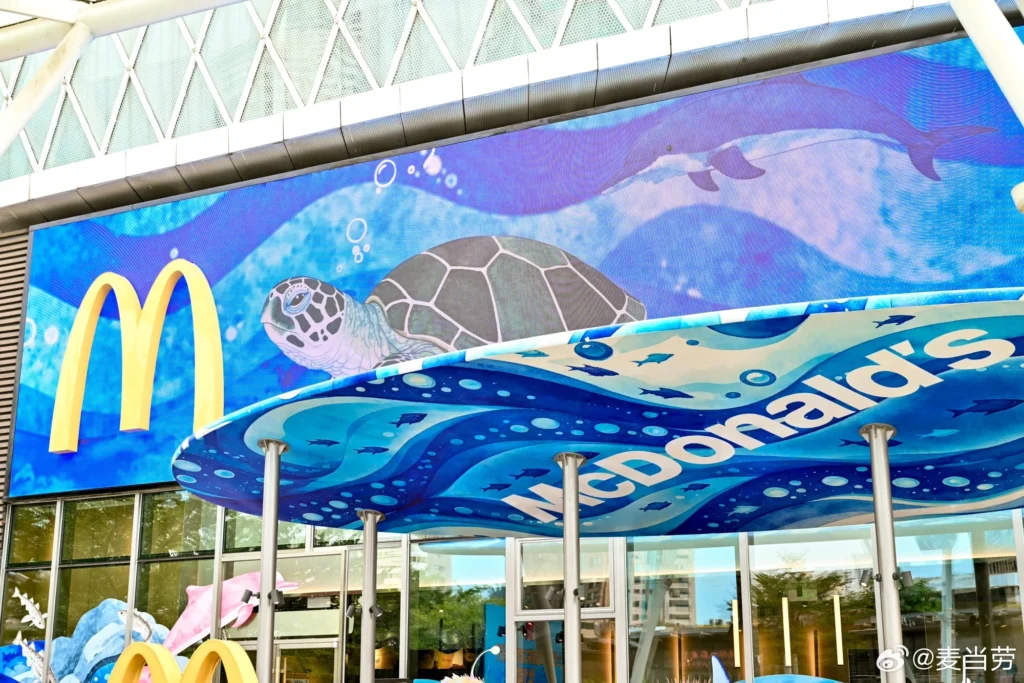
McDonald’s China opened its first ocean-themed restaurant on 27 October 2026 at Sea World in Shenzhen’s Nanshan District. The Wanghai Road branch combines a working restaurant with underwater footage, recycled furnishings and displays that explain where the fish in some of its burgers comes from.
Developed with the Marine Stewardship Council, the project brings marine education into a familiar setting. For families visiting Shekou, the restaurant offers a short stop that can fit between a visit to the landmark Minghua ship, time in Sea World Plaza and a walk along the waterfront.
Underwater Footage and Reused Materials Shape the Dining Room
Marine imagery and a surfboard-inspired canopy mark the entrance. Inside, a large screen on the second floor shows underwater footage, while the service counter takes its design cues from warm and cold ocean currents. Graphics on tabletops introduce marine life, Alaska pollock and fishing standards in a format diners can read while they eat.
Some of the materials carry the theme further. The restaurant uses recycled ocean plastic in chairs and recycled shell material in tabletops. It also displays a transparent sculpture modelled on the Filet-O-Fish. McDonald’s used 7.7 kilograms of recycled plastic to produce the sculpture through 3D printing. The small fish figures inside it came from repurposed McDonald’s toys.
For children, the sculpture and furniture provide visible examples of what happens when discarded materials become part of a new product. Families can explore those details during an ordinary meal, without having to arrange a separate exhibition visit.
The Menu Gives the Seafood Displays a Practical Example
McDonald’s China says the Alaska pollock used in its Filet-O-Fish, Double Deep-Sea Cod Burger and Fish Burger comes from fisheries certified to the Marine Stewardship Council’s sustainability standard. Diners can look for the council’s blue ecolabel on the packaging of relevant products.
The label relates to the seafood and its sourcing, including fisheries management and traceability. The recycled furnishings illustrate a separate design decision. Together, the two features give the restaurant different ways to explain what happens before seafood reaches a kitchen and how materials can be reused after their original purpose ends.
The opening also featured ocean-themed drawings by children. McDonald’s and the Marine Stewardship Council plan further exhibitions and learning activities, with a full public schedule still to be announced. Families interested in a particular workshop should confirm its date and any registration requirements before planning a visit around it.
Sea World Offers More to See Around the Restaurant
The Wanghai Road branch sits within Shekou’s established waterfront leisure district. Sea World Plaza and the Minghua ship give visitors nearby landmarks to explore before or after lunch. The Sea World Culture and Arts Center offers another possible stop, with access and charges varying by exhibition.
General admission to Sea World is free. Food and drink are purchased separately, and the restaurant’s launch announcement did not list a sightseeing admission fee. Visitors can therefore treat the restaurant as a dining stop and budget separately for any cultural programme they choose to attend.
Travellers with more time can continue towards the Shenzhen Bay Greenway. The 13-kilometre coastal route links parks and public spaces in Nanshan and offers room for walking and cycling. Families can choose a shorter section if they want to combine the waterfront with the restaurant and the arts centre in one outing.
Metro Access Makes a Short Visit Easier to Plan
Shenzhen Metro Lines 2 and 8 serve Sea World Station, from which visitors can continue on foot towards Wanghai Road and the plaza. For travellers arriving from elsewhere in Shenzhen, the journey depends on their starting point and any transfers.
The permanent restaurant displays make the stop easy to fit around other plans. Visitors can see the underwater footage and recycled furnishings during a meal, then spend the rest of the visit in the plaza or along the coast. An organised marine activity requires a different itinerary, built around the session time and any booking conditions.
That distinction is part of the venue’s appeal for independent travellers. A family can stop for lunch and let the children explore the displays at their own pace, while a group with more time can make the meal one part of a longer visit to Shekou’s waterfront.
For more travel news like this, keep reading Global Travel Wire