Crossing an international border involves satisfying entry requirements set by sovereign immigration authorities at the port of entry. According to official guidance from the United States Department of State, the European Union Schengen Borders Code, and national border agencies, holding a valid passport, visa, or electronic travel authorization grants permission to travel to a border checkpoint rather than an unconditional right to enter. Understanding the legal distinctions between routine entry refusal, secondary inspection, digital device screening, and formal removal orders is essential for international travelers navigating global border controls.
Grounds for Admission Refusal at Ports of Entry
Under international law and domestic immigration statutes, sovereign states retain broad authority to regulate the admission of foreign nationals. Under Article 6 of Regulation (EU) 2016/399, known as the Schengen Borders Code, short-stay visitors must present valid travel documents, justify the purpose and conditions of their intended stay, demonstrate sufficient financial means of subsistence, and pose no threat to public policy or internal security.
Border officials evaluate whether an arriving traveler’s stated itinerary aligns with their visa category and whether sufficient funds exist to cover the trip and return journey. Missing accommodation records, inconsistencies during questioning, prior overstays, or suspected unauthorized work can result in an unfavorable admissibility determination. Crucially, immigration statutes distinguish between an insufficient evidentiary showing—such as lacking proof of return travel—and deliberate fraud or willful misrepresentation of material facts, which carries stricter statutory bars under provisions such as Title 8 of the United States Code.
Secondary Inspection and Electronic Device Screening Rules
When border officers require additional verification, travelers may be referred to secondary inspection. Referral does not automatically indicate inadmissibility; it allows officers to verify documentation, clarify travel plans, or resolve database alerts. While travelers must remain in designated inspection zones during processing, international legal frameworks—including rulings by the European Court of Human Rights—recognize that prolonged confinement in airport transit areas can engage statutory protections against arbitrary deprivation of liberty.
Electronic device inspections are also governed by updated administrative directives in 2026:
United States: Under U.S. Customs and Border Protection Directive 3340-049B, effective January 1, 2026, officers may conduct manual basic searches of mobile phones and laptops without individualized suspicion, while advanced forensic searches require reasonable suspicion of legal violations or national security concerns plus supervisory approval. The 2026 directive also instructs officers to prevent access to data stored exclusively on remote cloud servers.
Canada: Under guidance from the Canada Border Services Agency and the Customs Act, officers may inspect digital devices when border compliance concerns arise, with network connectivity disabled during examination and strict protections applied to solicitor-client privileged material.
Consular Assistance and Return Transportation Procedures
Procedural rights during border screening depend on whether an individual is undergoing routine admissibility questioning or formal detention. Under Article 36 of the Vienna Convention on Consular Relations, authorities must inform detained foreign nationals without delay of their right to contact their consular post. Consular officers can assist with identity verification, family communication, and local legal information, though they cannot compel a foreign government to overturn a lawful admission decision.
When admission is formally refused, aviation facilitation standards under Annex 9 to the Chicago Convention—updated in its seventeenth edition—outline operational coordination between state authorities and airlines to arrange return transport. Depending on carrier terms and national regulations, airlines may transport inadmissible passengers back to their point of embarkation and seek cost recovery where permitted by law.
Refusal of Entry Versus Withdrawal and Formal Removal
Official immigration records distinguish carefully between different outcomes at the border, as each carries distinct consequences for future international travel:
Application Withdrawal: Under provisions such as Title 8 of the United States Code and Canada Border Services Agency parliamentary guidance issued in May 2026, officers may exercise discretion to allow an inadmissible traveler to voluntarily withdraw their application for admission and depart immediately without a formal removal order.
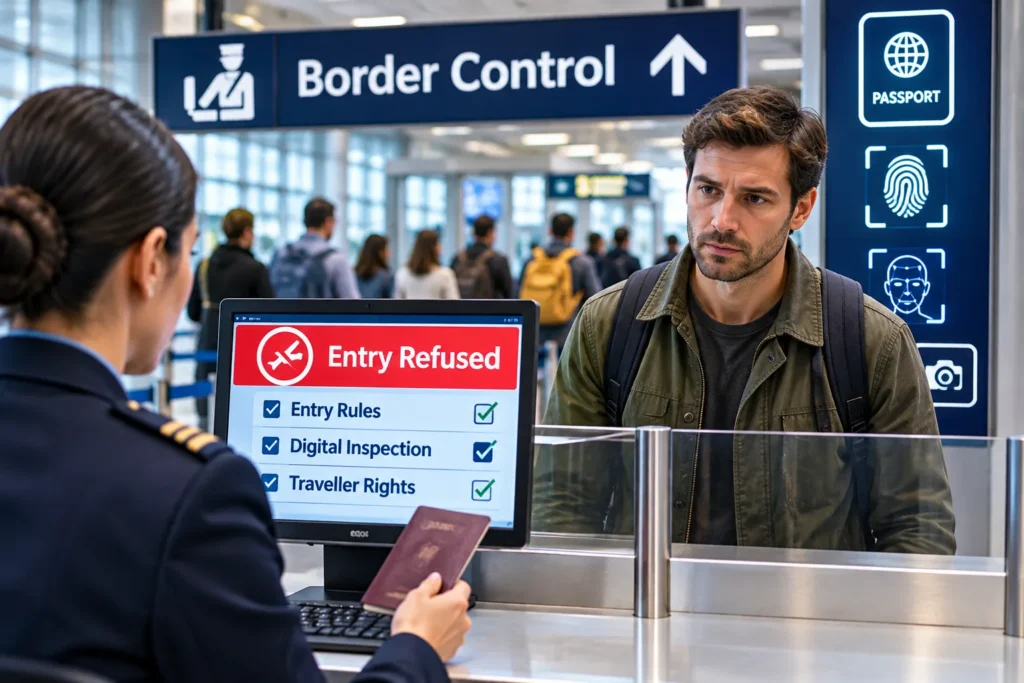
Entry Refusal: Under the Schengen Borders Code, third-country nationals refused entry receive a standardized written form stating the precise reasons for refusal and outlining statutory appeal procedures.
Formal Removal or Deportation: Expedited removal or formal deportation orders involve binding administrative directives that frequently carry multi-year re-entry bars.
Finally, international human rights treaties—including Articles 12 and 13 of the International Covenant on Civil and Political Rights—protect a citizen’s right to enter their own country and prohibit returning any individual to a substantial risk of torture. For international visitors, maintaining transparent documentation, verifiable accommodation details, and clear financial records remains the most effective safeguard for smooth border clearance.
For more travel news like this, keep reading Global Travel Wire