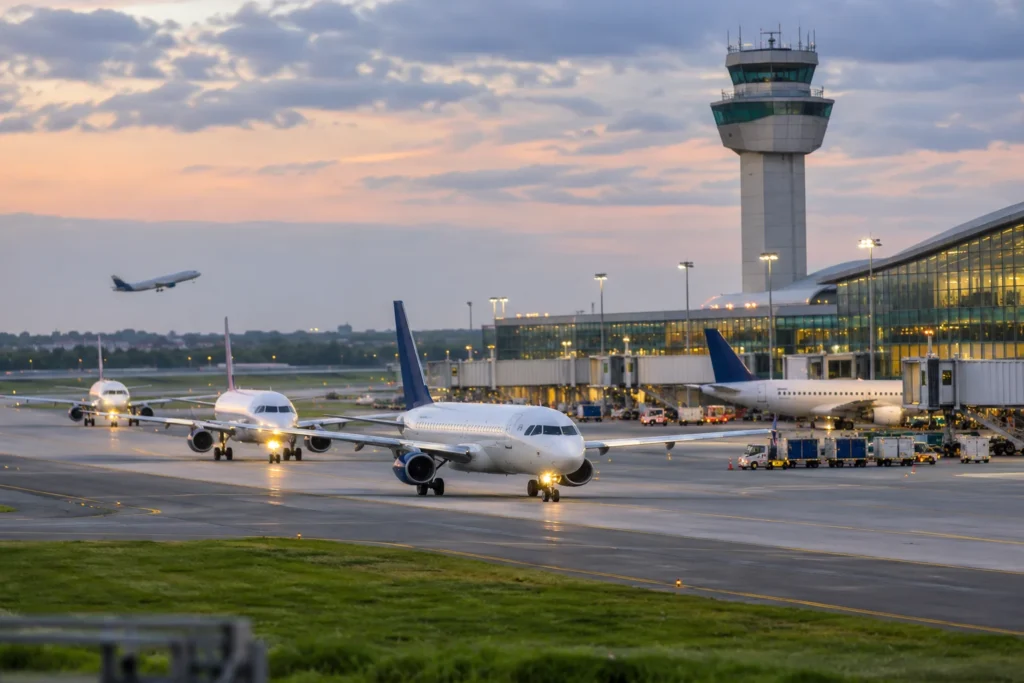
Domestic and international tourism across the United States faced an unprecedented operational standstill on Friday after the Federal Aviation Administration implemented a mandatory nationwide ground stop for all departing flights. Lasting for more than four hours, the directive abruptly halted commercial departures across major aviation hubs, leaving hundreds of thousands of vacationers, business travelers, and international visitors stranded inside crowded terminal concourses as the busy autumn travel season approaches its peak.
The Federal Aviation Administration initially issued the emergency directive at 3:54 p.m. Eastern Time, citing extraordinary circumstances and an overriding commitment to aviation safety. Under the order, all departing aircraft were required to remain parked at gates or on taxiways until federal regulators could verify the stability of national airspace communications. By 8:15 p.m. Eastern Time, following rigorous diagnostic testing by federal technicians, the agency officially lifted the restriction and reopened American airspace. However, the ripple effects across the tourism and hospitality sectors continued well into Saturday morning as carriers worked through thousands of cancellations and widespread schedule dislocations.
Legacy Infrastructure Behind the Telecommunications Outage
During an official White House press briefing held Friday evening, U.S. Department of Transportation Secretary Sean P. Duffy outlined the technical chain of events that triggered the nationwide pause. According to statements released by the Department of Transportation, air traffic control facilities began experiencing data instability at 3:36 p.m. Eastern Time across regional Terminal Radar Approach Control centers and En Route Centers.
Secretary Duffy explained that legacy network routers and switches within the decades-old air traffic control infrastructure became overloaded with incoming data. This surge produced inconsistencies in radar displays and voice communications between ground controllers and airborne pilots. Rather than risk operating with unreliable tracking data, federal aviation officials exercised standard safety protocols and halted all outbound departures while controllers safely guided more than 3,500 airborne aircraft to their destinations.
Official statements from the Department of Transportation confirmed that the malfunctioning legacy hardware was subsequently isolated and taken offline. Secretary Duffy also clarified that newly deployed modernization tools, including the artificial intelligence-assisted airspace management platform known as SMART, remained completely disconnected from the affected analog systems and played no role in the disruption.
Addressing public concerns regarding national security, Department of Homeland Security Secretary Markwayne Mullin confirmed in an official agency statement that federal investigators found no indication of a cyberattack or malicious intrusion. Secretary Mullin emphasized that interagency emergency procedures functioned as designed, ensuring that passengers in the air were never placed in danger during the telecommunications outage.
Ripple Effects Across Tourism and Holiday Travel
For the broader travel and tourism industry, the timing of the outage presents an immediate logistical challenge. With the Thanksgiving travel rush less than two weeks away, airlines, airport authorities, and hospitality providers are racing to reposition displaced aircraft and flight crews. When a nationwide ground stop halts operations for over four hours, flight crews frequently reach mandatory federal duty-time limits, requiring mandatory rest periods before they can operate subsequent legs.
Major domestic carriers began resuming scheduled departures late Friday night, though airport terminals from coast to coast experienced heavy congestion as travelers rebooked missed connections, extended hotel stays, and adjusted ground transportation plans. Officials from the Department of Transportation advised travelers with weekend itineraries to verify flight statuses directly with their carriers before departing for the airport, noting that unwinding the backlog of displaced aircraft will require a phased recovery throughout the weekend. Despite the immediate friction for weekend holidaymakers and tour operators, Secretary Duffy stated that national airspace operations are expected to normalize fully ahead of the Thanksgiving holiday surge.
Federal Push for Air Traffic Control Modernization
The incident has renewed urgent policy discussions in Washington regarding the long-term reliability of American aviation infrastructure. In official remarks following the briefing, both Secretary Duffy and Secretary Mullin underscored that decades-old analog hardware remains vulnerable to data bottlenecks and component failures, pointing to previous localized radar interruptions such as the 90-second screen blackout at Newark Liberty International Airport in May 2025.
While Congress previously approved $12.5 billion as an initial down payment toward air traffic control upgrades, Transportation Department leadership is urging lawmakers to authorize the full $50 billion needed to complete a comprehensive nationwide overhaul. Federal officials noted that replacing aging copper wiring and legacy routers with modern fiber-optic networks and digital communication suites is essential to safeguarding the future of American tourism, preventing recurring travel bottlenecks, and maintaining the highest global standards of aviation safety.
For more travel news like this, keep reading Global Travel Wire