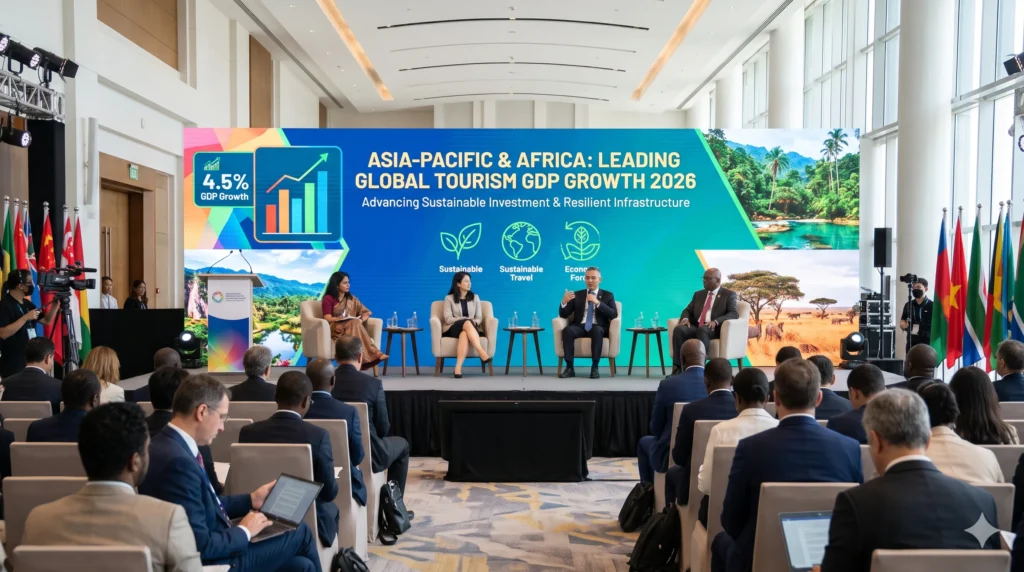
Global travel and tourism is projected to deliver a record economic contribution of 11.9 trillion US dollars in 2026, accounting for nearly 10 percent of global gross domestic product and supporting approximately 375 million jobs worldwide, or one in every nine positions across the global workforce. According to official economic impact research released by the World Travel and Tourism Council, Asia Pacific and Africa are set to lead regional expansion, each posting sector GDP growth of 4.5 percent in 2026. This momentum builds upon a strong performance in 2025, when travel and tourism generated 13.5 percent of overall global economic growth, reaffirming the sector’s position as a primary engine of international employment and economic resilience.
Shifting Destination Metrics From Volume to Value and Sustainability
While international arrival numbers remain an important benchmark, national tourism ministries and destination authorities are increasingly evaluating success through visitor expenditure, environmental stewardship, and direct benefits to local enterprises. Speaking at World Travel Market in London, World Travel and Tourism Council President and Chief Executive Officer Gloria Guevara emphasized that forward-looking destinations are placing equal weight on visitor spending alongside arrival counts, recognizing how sustained expenditure strengthens small businesses, municipal infrastructure, and host communities.
To ease congestion in high-density urban and coastal hubs, destinations are actively promoting lesser-known regions, encouraging longer stays, and embedding sustainable practices into national tourism strategies. Destinations that prioritize environmental responsibility and higher per-capita visitor spending are proving significantly more attractive to institutional and private investors, particularly when backed by transparent governance and coordinated public-private planning.
Seven Principles for Attracting Long-Term Tourism Investment
To help governments and destination authorities unlock capital for resilient infrastructure, aviation connectivity, and hospitality development, the World Travel and Tourism Council outlined seven foundational principles for strengthening tourism investment:
Legal certainty and regulatory stability that protect long-term capital commitments across multi-year development cycles.
A single-window or one-stop-shop framework to streamline licensing, land-use approvals, and investment onboarding.
Strategic alignment across ministries and stakeholders so transport, environment, finance, and tourism policies reinforce one another.
Competitive fiscal and investment incentives tailored to encourage sustainable construction, regional dispersal, and local supply-chain integration.
Decisive government leadership that elevates tourism as a core pillar of national economic development.
Comprehensive destination master plans supported by a clear, transparent pipeline of bankable infrastructure and hospitality projects.
Sustained demand growth underpinned by strong air and ground connectivity, favorable demographic trends, and continuous workforce upskilling.
Regional Arrivals and Economic Performance Across Major Markets
Official regional projections for 2026 illustrate a distinct contrast between total visitor volume and economic growth velocity. Europe remains the world’s most visited region by volume, projected to welcome approximately 826 million international visitors in 2026, more than double the 361 million international arrivals forecast for Asia Pacific. North America is expected to record 138 million international arrivals, followed by Africa with 108 million inbound travelers.
However, rapid domestic demand expansion, expanding regional aviation networks, and rising intra-regional mobility enable Asia Pacific and Africa to achieve the fastest sector GDP growth rates globally at 4.5 percent each. Europe is forecast to record 3.1 percent travel and tourism GDP growth, followed by the Caribbean at 2.9 percent, Central and South America at 1.6 percent, and North America at 1.2 percent.
Among major European economies, the United Kingdom is projected to achieve 2.7 percent growth in travel and tourism GDP in 2026, outpacing France at 2.6 percent and Germany at 1.4 percent. Official research further indicates that the United Kingdom will rank fourth globally in domestic visitor spending, with domestic expenditure rising 3.5 percent to 247.7 billion US dollars, while international visitor spending is forecast to climb 6.9 percent to 58.2 billion US dollars.
Taken together, these official projections highlight a maturing global visitor economy. By pairing disciplined investment frameworks with sustainability commitments and community-centered development, tourism destinations across Asia Pacific, Africa, Europe, and the Americas are positioning themselves for durable, inclusive prosperity throughout 2026 and beyond.
For more travel news like this, keep reading Global Travel Wire