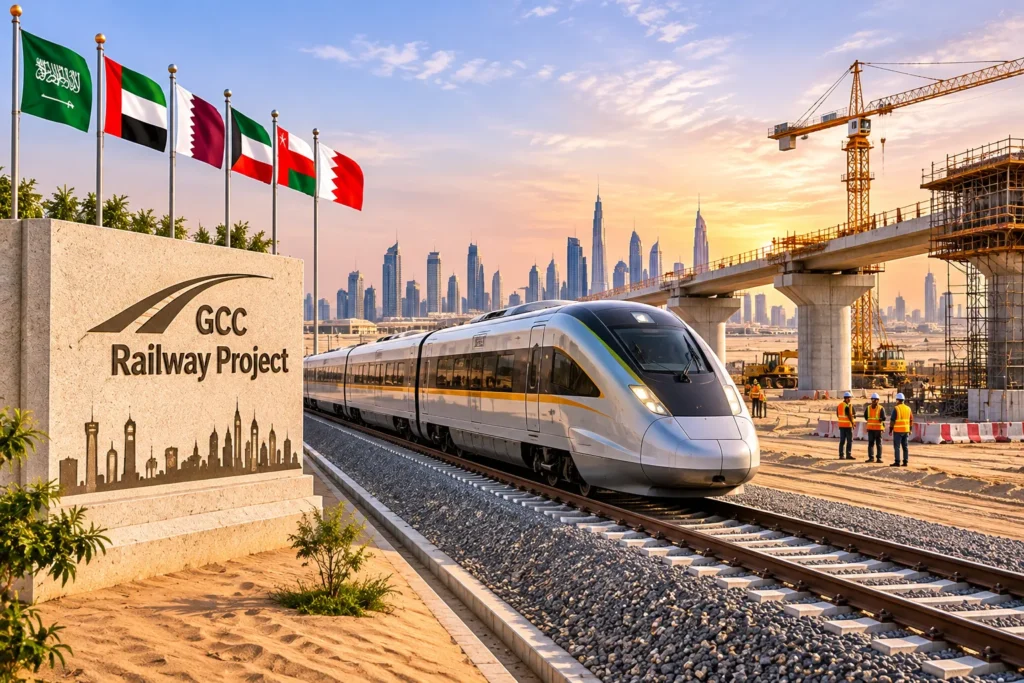
Regional connectivity and overland tourism across the Arabian Peninsula have achieved a historic milestone as the GCC Railway Project reaches 55.92 percent overall completion ahead of its scheduled December 2030 operational launch. Following the signing of the landmark General Agreement for the GCC Railway Project in Bahrain in November 2026, Gulf Cooperation Council (GCC) Secretary-General Jasem Al-Budaiwi confirmed that all six member states—Bahrain, Kuwait, Oman, Qatar, Saudi Arabia, and the United Arab Emirates—are advancing toward a unified cross-border rail network. Designed to strengthen supply chain resilience, reduce reliance on vulnerable maritime corridors such as the Strait of Hormuz, and revolutionize passenger mobility, the 1,768-kilometer railway promises to unlock seamless multi-destination travel throughout the Gulf.
Strategic Urgency and Landmark Intergovernmental Alignment
Originally approved by the GCC Supreme Council in December 2009 and supervised by the Gulf Railway Authority—which was formally established in December 2021—the infrastructure initiative has gained heightened strategic momentum throughout 2026. Recent maritime disruptions in the Strait of Hormuz have underscored the vital importance of establishing reliable, high-capacity overland transport corridors linking the Arabian Gulf to the Gulf of Oman.
During the official signing ceremony at Riffa Al Zahir Palace in Bahrain, held under the patronage of Bahraini Crown Prince and Prime Minister Prince Salman bin Hamad Al Khalifa, member states finalized the unified legal, regulatory, and operational framework required to synchronize national rail systems. According to official disclosures from the GCC General Secretariat, basic infrastructure development is estimated at between US$15.4 billion and US$16 billion, with member governments coordinating engineering standards, customs protocols, and financing mechanisms to overcome cross-border technical hurdles and meet the December 2030 target.
Route Architecture Across Six Gulf Nations
When fully operational, the main coastal trunk line will stretch 1,768 kilometers from Kuwait City in the north to the Omani capital of Muscat in the south, weaving together major economic hubs, international airports, and cultural destinations. According to official GCC Secretariat route specifications, the network’s track distribution across the six member states comprises:
Saudi Arabia: 672 kilometers, forming the central backbone of the corridor through Dammam and connecting westward and southward.
United Arab Emirates: 461 kilometers, linking Abu Dhabi and Al Ain with neighbouring networks.
Oman: 330 kilometers, extending from the UAE border via the port city of Sohar to Muscat.
Qatar: 141 kilometers, integrating Doha into the wider regional rail grid.
Kuwait: 111 kilometers, anchoring the northern terminus of the Gulf corridor.
Bahrain: 53 kilometers, connected to Saudi Arabia via a dedicated maritime railway bridge.
High-Speed Passenger Mobility and Tourism Growth
Beyond bolstering regional freight logistics and food security, the GCC Railway Project is poised to transform the regional visitor economy by enabling effortless cross-border rail travel for residents and international tourists alike. Equipped with advanced European signaling technology, passenger trains will operate at speeds of up to 200 kilometers per hour, while freight services will run between 80 and 120 kilometers per hour.
Official GCC projections indicate that the network will transport approximately 6 million passengers and 200 million tons of freight annually upon launching in 2030, scaling to more than 8 million passengers and 271 million tons of cargo by 2045. For the tourism and hospitality sectors across the Arabian Peninsula, this high-speed connectivity will complement the upcoming GCC unified tourist visa—often referred to as the GCC Grand Tours initiative—allowing international visitors to explore multiple Gulf countries on a single itinerary without relying exclusively on short-haul flights or long highway drives.
Building an Integrated Future for Gulf Hospitality
As national rail authorities accelerate track laying, station construction, and rolling stock procurement over the next four years, the GCC Railway Project stands as a cornerstone of regional economic diversification. By linking historic souqs, desert resorts, coastal cities, and world-class museums across six nations into one cohesive transit corridor, the network will foster deeper cultural exchange, stimulate private-sector hospitality investment, and position the Gulf Cooperation Council as a premier, interconnected global tourism destination by 2030.
For more travel news like this, keep reading Global Travel Wire