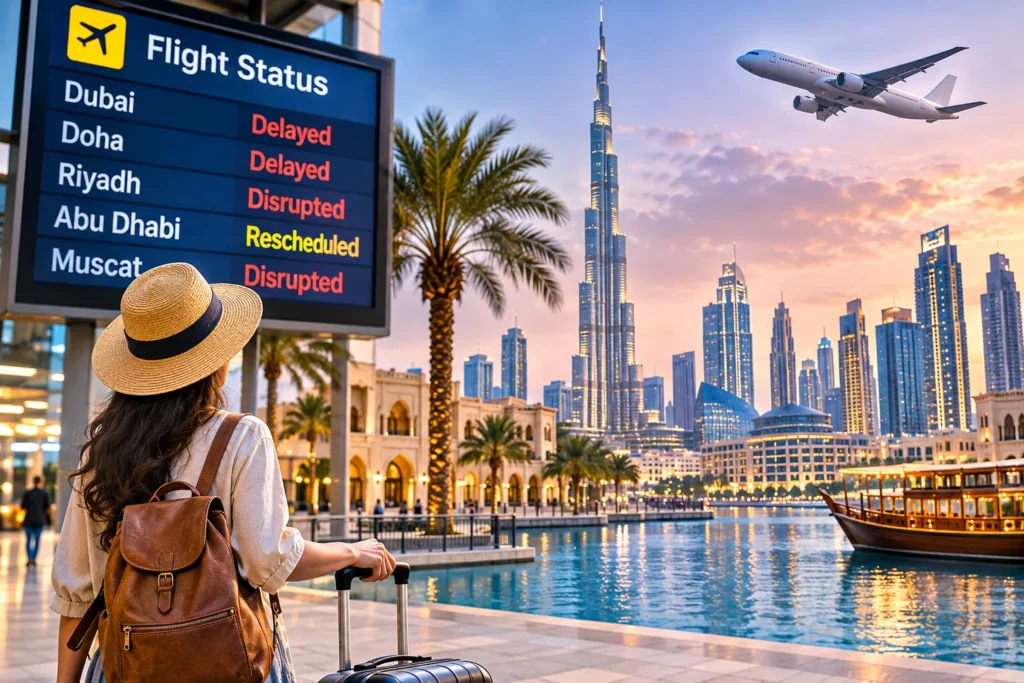
Dubai, November 25, 2026 — For more than a decade, international hospitality and aviation planning across the Gulf rested on a clear set of long-term assumptions. Global air transit would flow reliably through major Gulf hubs, long-haul international visitors would discover and return to the region in growing numbers, and large-scale attractions and mega-events would capture sustained global demand well into the next decade.
Over the past nine months of 2026, ongoing conflict and security instability across the Middle East have severely tested every pillar of that growth model. Intermittent airspace restrictions, conflict zone aviation bulletins, and flight reroutings have forced international carriers to adjust schedules and temporarily suspend selected routes. Official data from the UN Tourism World Tourism Barometer confirms that international tourist arrivals to the Middle East fell by 22% during the first half of 2026 compared to the same period in 2025, contrasting sharply with modest positive growth in overall global arrivals.
Airspace Restrictions Test Gulf Aviation Connectivity
The operational backbone of Gulf tourism has always been uninterrupted super-connector aviation linking Europe, Asia, Africa, and the Americas. Throughout 2026, civil aviation authorities and international safety regulators issued periodic airspace advisories and temporary operational restrictions across parts of the Persian Gulf and surrounding flight information regions.
While national aviation authorities worked rapidly to restore normal terminal operations and maintain safe corridors, rerouted flight paths and elevated operational costs compelled several international carriers to trim frequencies or pause specific services. For destination marketers and airport operators, these disruptions underscored how quickly geopolitical instability can interrupt transit traffic and long-haul leisure bookings, even when ground infrastructure remains world-class.
Hospitality Shifts Toward Domestic and Short-Haul Markets
With long-haul international arrivals softening, hotels, resorts, and entertainment venues across the Gulf Cooperation Council have pivoted rapidly to protect occupancy rates. Hospitality operators have leaned heavily on domestic staycations, intra-regional GCC travel, and resilient short-haul corridors from neighbouring markets to offset declines in intercontinental visitors.
Unified regional visa frameworks, cross-border road connectivity, and targeted seasonal promotions have played a vital role in sustaining weekend and holiday demand. Rather than relying exclusively on long-haul European or North American tourists, tourism authorities have placed renewed emphasis on regional cultural events, family entertainment, and accessible short-break packages tailored to residents and nearby neighbours.
Five Strategic Decisions Shaping the Next Decade
Confronted with the realities of 2026, ministries of tourism, national carriers, sovereign hospitality developers, and event organisers across the Middle East are weighing five fundamental strategic choices that will define the sector’s trajectory into 2027 and beyond:
Separating Short-Term Shocks from Structural Shifts: Destination planners must determine how much of the 2026 downturn represents a temporary reaction to regional security events versus a permanent change in how global airlines and travellers perceive transit risk through Middle Eastern airspace.
Rebalancing Long-Haul Transit Against Point-to-Point Demand: National tourism strategies are reassessing whether future growth should remain anchored in global transit stopovers or shift toward generating direct, point-to-point destination demand that is less vulnerable to intercontinental route diversions.
Recalibrating Mega-Project Timelines and Capital Allocation: With billions invested in luxury resorts, cultural districts, and entertainment destinations, public and private stakeholders are evaluating whether to maintain aggressive construction schedules or phase openings to align with revised visitor forecasts.
Institutionalising Domestic and Regional Resilience: Tourism boards are deciding how to lock in the domestic and intra-GCC travel gains achieved during 2026, ensuring local demand remains a permanent buffer rather than a temporary crisis fallback.
Strengthening Crisis Communication and Aviation Coordination: Government ministries and civil aviation regulators are reviewing how transparent safety advisories, flexible booking policies, and coordinated regional messaging can preserve traveller confidence during periods of heightened geopolitical uncertainty.
Charting a Resilient Path Forward
As UN Tourism noted in its 2026 assessment, global travel continues to demonstrate underlying demand, yet regional disruptions highlight the necessity of building structural resilience before crises emerge. For the Middle East, immense investments in modern airports, cultural heritage sites, and hospitality infrastructure remain powerful long-term assets.
However, the experiences of the past nine months have made clear that ambitious visitor targets cannot rely on past assumptions alone. How regional leaders balance global connectivity with localized demand, disciplined capacity growth, and coordinated crisis management will determine how swiftly Middle East tourism regains its upward momentum in the years ahead.
For more travel news like this, keep reading Global Travel Wire