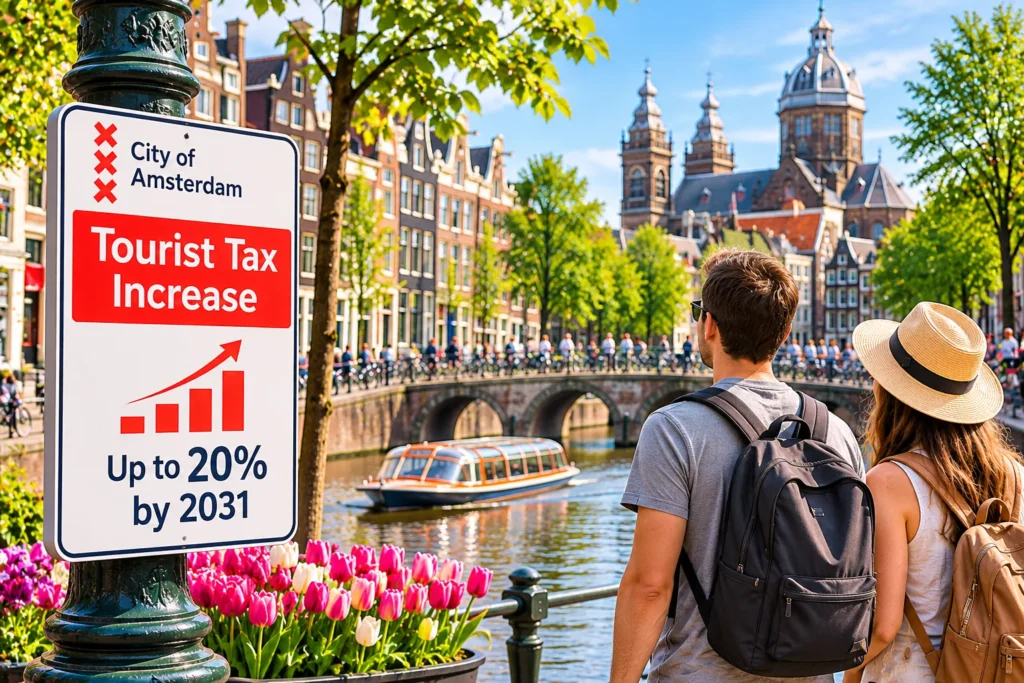
Amsterdam, Netherlands, November 25, 2026 — Travelling to the Dutch capital is set to become substantially more expensive over the coming years as municipal authorities move forward with plans to introduce one of the world’s steepest visitor levies. Under the municipal coalition agreement unveiled by governing partners PRO and D66, the Amsterdam tourist tax will rise incrementally from its current 12.5% rate to 20% by 2031 as part of a broader policy effort to curb overcrowding and rebalance the city’s visitor economy.
Under the phased schedule outlined in the coalition framework, the municipal overnight accommodation tax is set to increase from 12.5% to 16% in 2027, followed by annual one-percentage-point increments until reaching 20% in 2031. This local surcharge compounds a major national fiscal change introduced by the Dutch government on January 1, 2026, which raised the national value-added tax (VAT) on hotel and short-stay accommodations from 9% to the standard 21% rate.
When the planned municipal increases are fully implemented alongside the 21% national VAT, overnight guests staying in Amsterdam will face a combined accommodation tax burden of 41% by 2031.
Curbing Visitor Volumes and Rebalancing Urban Life
Official figures from Statistics Netherlands (CBS) illustrate the scale of tourism pressure driving these municipal policy measures. In 2025, Amsterdam recorded more than 22 million overnight hotel stays, placing sustained strain on historic canal neighbourhoods, public transport, and residential housing availability.
Over recent years, the Municipality of Amsterdam has paired fiscal disincentives with strict regulatory interventions to protect local liveability. These official measures include capping annual overnight stays, restricting new hotel construction, scaling back river cruise calls, planning the relocation of the Passenger Terminal Amsterdam for sea cruise ships outside the city centre, and launching targeted discouragement campaigns aimed at disruptive visitor segments.
By raising the Amsterdam tourist tax, municipal policymakers intend to moderate visitor growth while generating dedicated public revenue to fund street maintenance, municipal infrastructure, and neighbourhood services for local residents.
Industry Concerns Over Occupancy and Regional Spillover
While municipal leaders view higher visitor levies as a necessary tool for sustainable urban management, hospitality trade bodies and accommodation operators across the Amsterdam metropolitan region have raised concerns about the cumulative financial impact. According to the Royal Dutch Hospitality Association (KHN), Amsterdam already enforces the highest tourist tax in Europe, and reaching 20% by 2031 will place the Dutch capital among the highest-taxed destinations globally.
Hotel operators within Amsterdam and neighbouring municipalities—including incorporated areas such as Weesp, which are subject to the same municipal tax regime—report that the January 2026 jump in national hotel VAT has already weighed on demand. Several local hoteliers have observed occupancy declines of roughly 10% following the initial VAT increase, noting that when municipal levies, national VAT, and third-party distribution commissions are combined, taxes and fees can absorb well over half of a room’s gross booking price.
Hospitality representatives also caution that steep accommodation taxes in the city centre risk shifting demand toward surrounding municipalities with lower local tax rates, such as Amstelveen and Zaanstad, or encouraging higher volumes of day-trippers who contribute to daytime congestion without paying overnight lodging levies.
Broader European Shift Toward Destination Management
Amsterdam’s tax roadmap reflects a wider policy shift across high-demand European cultural capitals grappling with mass tourism. Across popular Mediterranean and Northern European cities, local governments are increasingly turning to entry fees, cruise passenger levies, short-term rental caps, and higher occupancy taxes to manage peak-season congestion and fund urban preservation.
As the phased increases take effect between 2027 and 2031, both municipal authorities and Dutch hospitality stakeholders will closely monitor how higher room rates influence visitor length of stay, booking patterns, and the long-term balance between economic vitality and resident quality of life in the Netherlands.
For more travel news like this, keep reading Global Travel Wire