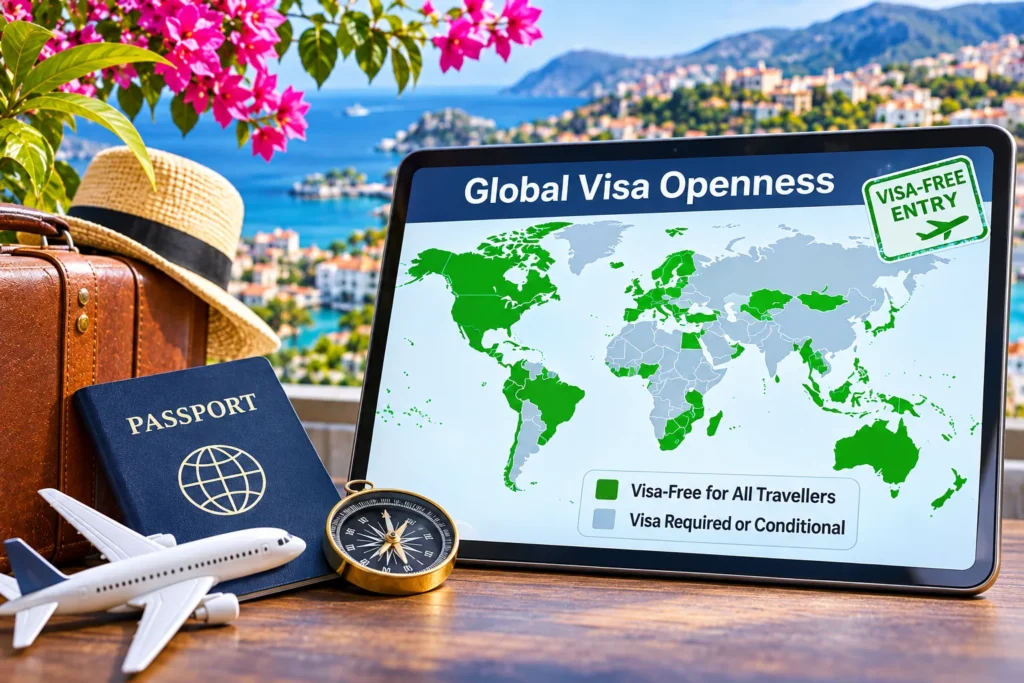
London, United Kingdom, November 25, 2026 — While passport rankings typically measure how easily citizens can travel abroad, a revealing assessment of global visa openness turns the lens inward—examining how welcoming countries actually are to incoming international visitors. According to international border policy data tracking entry rules across 199 passports and 227 destinations, just 19 countries worldwide currently permit citizens of all 198 other nationalities to enter visa-free, via a visa on arrival, or through a streamlined electronic travel authorisation (ETA).
The findings highlight a striking geographic divide in international tourism policy. While several of the world’s highest-volume tourism economies enforce strict pre-departure visa screening for most travellers, emerging destinations across Africa, Asia, and the Pacific are actively dismantling border barriers to stimulate visitor arrivals, foreign investment, and regional trade.
Africa Leads the World in Universal Border Access
Africa stands at the forefront of global visa openness, accounting for 13 of the 19 nations that extend visa-free, visa-on-arrival, or ETA access to every nationality on Earth. Across the continent, national tourism ministries and regional economic communities—including the African Union’s broader push toward continental free movement—have increasingly adopted open-border frameworks to capture international leisure and business travel.
Among the African nations offering universal simplified entry are island destinations and mainland hubs alike, including Seychelles, Mauritius, Comoros, Madagascar, Rwanda, Kenya, Uganda, Djibouti, Burundi, Guinea-Bissau, Mauritania, Mozambique, and Somalia. In East Africa, countries such as Rwanda and Kenya have paired universal ETA or visa-free entry with regional joint-tourist visa initiatives, positioning wildlife safaris, conference tourism, and conservation travel as accessible pillars of economic growth.
Outside Africa, universal simplified entry is concentrated in Asia-Pacific island states and select Asian destinations—including Maldives, Timor-Leste, Cambodia, Tuvalu, Samoa, and Micronesia—where tourism represents a vital contributor to national gross domestic product and employment.
Major Tourism Economies Maintain Selective Entry Regimes
In sharp contrast to the world’s most open borders, several of the globe’s wealthiest and most heavily visited nations impose traditional embassy visa requirements on the vast majority of international travellers. Both the United States and Australia admit citizens of only 46 nationalities under visa-free or electronic travel authorisation arrangements, requiring travellers from more than 150 countries to complete formal consular applications, biometric appointments, and advance screening prior to departure.
Similarly, member states of the European Schengen Area and the United Kingdom generally restrict visa-free or digital ETA entry to roughly 60 to 85 nationalities, prioritising bilateral reciprocity agreements and border security frameworks over universal access.
At the very bottom of the global openness spectrum sit Afghanistan, North Korea, and Turkmenistan, which grant visa-free or visa-on-arrival entry to zero foreign nationalities—requiring virtually every international visitor to secure formal governmental authorisation before arrival.
Digital Border Systems Reshape Travel Facilitation in 2026
The 2026 global mobility landscape also reflects a structural transition away from traditional paper visa stickers toward automated digital pre-clearance platforms. Across Europe, North America, the United Kingdom, and parts of Asia, governments have expanded Electronic Travel Authorisations and digital arrival cards designed to verify traveller identities prior to boarding while accelerating automated passport-gate processing at major international airports.
Meanwhile, UN Tourism’s global visa openness monitoring underscores that visa facilitation remains one of the most direct policy levers available to national governments seeking to boost international arrivals. Whenever destinations replace cumbersome consular paperwork with electronic visas or visa-on-arrival schemes, visitor demand and air route connectivity respond rapidly.
For international travellers planning itineraries in 2026 and beyond, understanding the distinction between passport power and destination openness offers a clearer picture of global mobility—demonstrating that some of the world’s warmest welcomes await in destinations actively opening their doors to the entire world.
For more travel news like this, keep reading Global Travel Wire