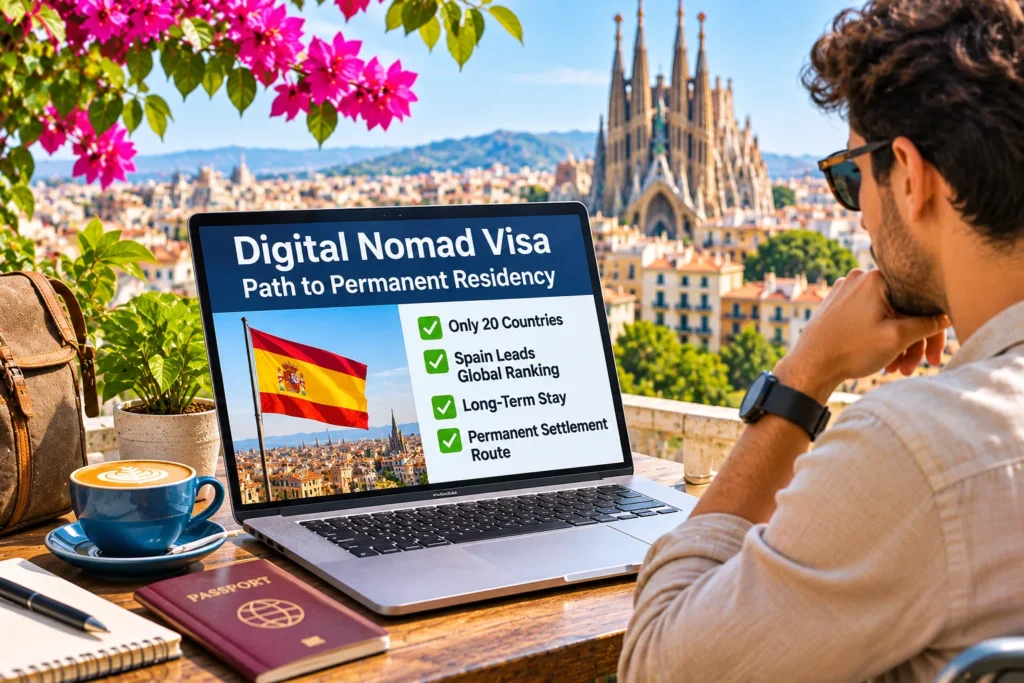
London, United Kingdom, November 25, 2026 — Governments competing for internationally mobile professionals are shifting their focus from short-term post-pandemic tourism recovery toward long-term talent retention, yet a major divide persists between temporary remote work access and permanent settlement. According to findings from the Global Digital Nomad Index 2026, compiled by the Global Intelligence Unit at Global Citizen Solutions across 56 jurisdictions worldwide, only 20 countries—or 35.7%—allow time spent on a digital nomad visa to count toward permanent residency or citizenship.
At the top of the 2026 ranking, Spain secured the world’s leading position for the third consecutive year with a score of 85.36 points, outpacing second-placed New Zealand (80.35 points) by 5.01 points and third-placed Uruguay (80.34 points). While entry procedures, family sponsorship, and online applications have become widely standardized across global remote work programmes, long-term settlement eligibility has emerged as the decisive differentiator for professionals planning multi-year international relocation.
Europe Dominates Top Ten Destinations for Digital Nomad Visa Residency
European nations claim eight of the top ten positions in the 2026 assessment, underscored by Schengen Area mobility, public infrastructure, quality of life, and clearer statutory pathways to long-term residence. Following Spain at number one, the top ten includes New Zealand (second), Uruguay (third), Greece, Estonia, Portugal, Italy, Croatia, Andorra, and Slovenia.
Spain’s sustained leadership reflects its balanced performance across streamlined residence authorization, lifestyle appeal, international mobility rights, and legal continuity under its national international telework framework. Across the broader dataset of 56 jurisdictions, 23 programmes were launched in 2023 or later, illustrating how national immigration ministries have rapidly institutionalized remote work visas as formal economic and demographic policy tools.
Easy Entry Versus Long-Term Settlement: A Growing Policy Divide
Data from the 2026 index reveals that initial access is no longer a rare advantage among remote work destinations:
Family Inclusion: 87.5% of assessed programmes permit spouses and dependent family members to accompany the principal applicant.
Visa Renewals: 83.9% allow extensions or multi-year renewals beyond the initial stay period.
Remote Filing: 78.6% accept digital applications submitted from abroad prior to arrival.
Permanent Settlement: Only 35.7%—20 of the 56 jurisdictions—credit years lived under remote work status toward permanent residency or naturalization.
New Zealand exemplifies the distinction between high visitor appeal and long-term retention. Despite ranking second overall due to strong scores in quality of life, digital application efficiency, and technological infrastructure, New Zealand’s remote work arrangement functions as a temporary visitor permission rather than a direct immigration track, requiring professionals to transition into a separate qualifying visa category if they wish to pursue permanent residence.
Regional Contrasts Across the Americas and Tax-Friendly Jurisdictions
Across the Western Hemisphere, national strategies diverge sharply between permanent integration and temporary tax-free stays. In South America, Uruguay ranks third globally and Brazil places fifteenth, buoyed by accessible residence renewal rules and statutory pathways toward naturalization. Conversely, prominent Caribbean destinations—including Dominica, Curaçao, and Barbados—achieve top marks for tax exemptions and coastal lifestyle appeal, yet operate strictly as temporary stay permits that do not accumulate residence time toward citizenship.
Interestingly, low living costs and zero-tax regimes alone do not propel destinations into the global top ten. Five jurisdictions earned maximum scores in tax optimization, yet none ranked among the top ten overall. Instead, the ten highest-scoring nations require an average annual minimum income of $47,356—roughly 22% higher than the global index average of $38,769—demonstrating that remote professionals increasingly prioritize healthcare reliability, legal certainty, international connectivity, and family stability over tax savings alone.
What the 2026 Shift Means for Remote Workers and Destinations
Evaluated across six core pillars and 19 policy indicators—covering application procedures, citizenship and mobility, economic conditions, tax optimization, quality of life, and technology and innovation—the 2026 findings signal a maturing global market for location-independent professionals. Several early pandemic-era remote work schemes have been discontinued or tightened as governments refine eligibility thresholds and clarify tax residency obligations.
For remote workers and families evaluating where to establish a long-term base, experts emphasize looking beyond initial visa approval times to examine whether a destination provides genuine residence continuity. As nations compete to attract skilled international earners, those combining transparent tax rules with credible digital nomad visa residency pathways are best positioned to convert temporary visitors into long-term contributors.
For more travel news like this, keep reading Global Travel Wire