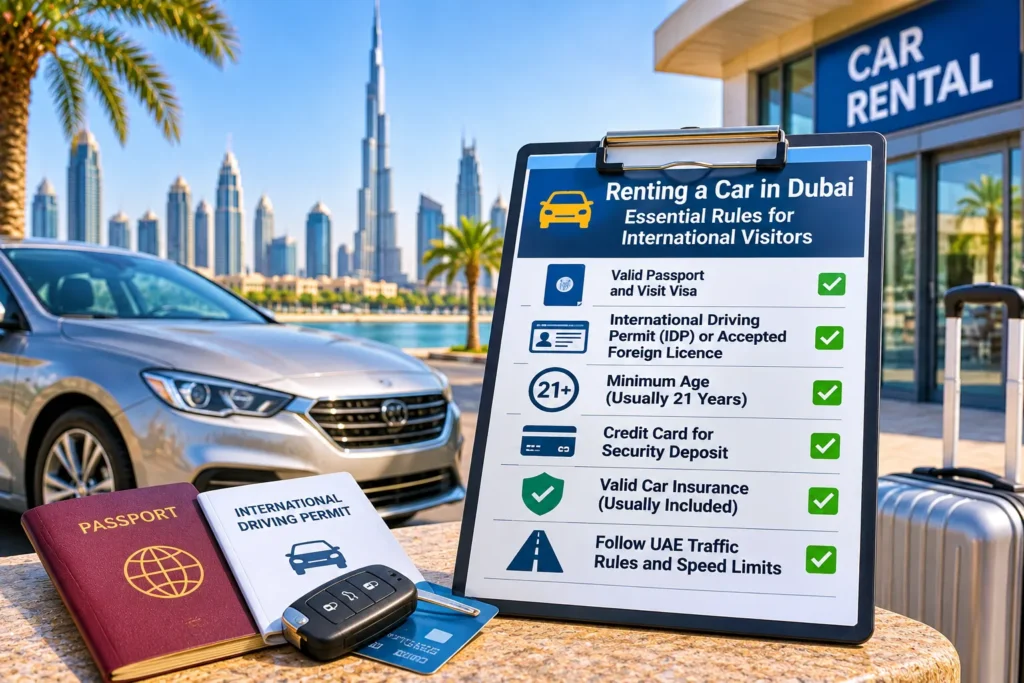
Dubai, United Arab Emirates, November 25, 2026 — Exploring Dubai and the wider United Arab Emirates by road gives international visitors unmatched flexibility to travel between coastal districts, cultural landmarks, and desert resorts at their own pace. However, renting a car in Dubai operates under specific regulatory frameworks administered by the UAE Ministry of Interior, Dubai’s Roads and Transport Authority (RTA), and Dubai’s Department of Economy and Tourism (DET). Understanding licensing eligibility, digital contracts, deposit safeguards, and traffic reporting procedures prior to arrival ensures a seamless experience at the rental counter.
Driving Licence Eligibility and Required Documents
Under UAE federal traffic regulations published by the Ministry of Interior, tourists visiting on a valid visit visa may drive in Dubai using their original home-country driving licence if it was issued by one of roughly 50 approved countries—including Gulf Cooperation Council (GCC) member states, the United Kingdom, the United States, Canada, Australia, Japan, South Korea, Singapore, and most European nations. Visitors holding licences from countries outside the approved list must carry an International Driving Permit (IDP) issued in their home country alongside their original domestic licence, as UAE-issued IDPs are restricted exclusively to UAE residents.
Regardless of nationality, travellers must present their original passport, valid entry stamp or visit visa, and original driving licence at pickup. Individual rental operators may also enforce stricter commercial eligibility thresholds, such as requiring drivers to be at least 21 years old—or 25 for luxury and high-performance vehicles—and to have held a full licence for a minimum of 12 months. Under UAE law, rental agencies are strictly prohibited from retaining a visitor’s passport or personal identification card as collateral.
The RTA Unified Contract and Digital Inspection Process
All licensed vehicle rental offices in Dubai operate under the RTA’s Transport Activities Rental System, which mandates a standardized unified electronic contract verified via a one-time password sent to the renter’s mobile phone. This digital agreement embeds time-stamped photographs documenting the vehicle’s exterior and interior condition at handover and return. Visitors are strongly advised to review the official handover images carefully and capture their own photographs before departing the lot.
Under RTA regulations, agencies cannot impose undisclosed administrative fees outside the unified contract, nor may they bill customers for lost rental revenue while a vehicle undergoes accident repairs.
Consumer Protection Rules on Security Deposits
Regulatory directives enforced by Dubai’s Department of Economy and Tourism provide clear financial protections for visitors paying a refundable security deposit:
Hold Rather Than Purchase: Card deposits must be placed as a temporary pre-authorisation hold rather than processed as a retail purchase transaction, and card payment surcharges are prohibited.
30-Day Release Mandate: Rental providers must release blocked security deposits within a maximum of 30 days after the vehicle is returned, provided there are no unpaid traffic fines, toll charges, or verified damage claims.
Itemised Deductions: Any deductions must correspond strictly to documented expenses such as Salik road tolls, traffic violations, missing fuel, or uninsured damage. Operators violating DET deposit regulations face administrative fines starting from AED 10,000, and travellers may lodge formal complaints through DET’s Commercial Compliance and Consumer Protection channels if a deposit is unlawfully withheld.
Insurance Coverage and Mandatory Police Reports
By law, every rental vehicle in the UAE carries basic third-party liability insurance, which covers injury or property damage caused to others. Collision Damage Waiver (CDW) or comprehensive protection covering damage to the rental car itself is typically offered as an optional upgrade and carries an excess deductible specified in the contract. Off-road driving and desert dune bashing are almost universally excluded from standard rental insurance policies.
In the event of any traffic collision or even minor parking lot damage, UAE law requires an official police report before any insurance claim can be processed. For minor incidents involving no injuries, drivers should move vehicles safely out of traffic flow and submit a report via the Dubai Police smart application or by calling 901, remaining at the scene until the report is issued.
Tolls, Fuel, Mileage, and Safety Regulations
Before signing the rental agreement, travellers should verify key operational terms to avoid post-trip charges:
Salik Road Tolls: Dubai’s electronic toll gates automatically register crossings linked to the vehicle’s plate, with accumulated tolls billed by the rental operator during or after the trip.
Fuel and Mileage Policies: Most agreements operate on a full-to-full fuel basis and include daily mileage allowances typically ranging from 200 to 300 kilometres, with per-kilometre surcharges applied beyond the cap.
Child Safety and Traffic Enforcement: Children aged four and under must travel in an approved child safety seat, mobile phone use without hands-free equipment is strictly penalised, and the UAE enforces a zero-tolerance policy toward driving under the influence of alcohol.
For more travel news like this, keep reading Global Travel Wire