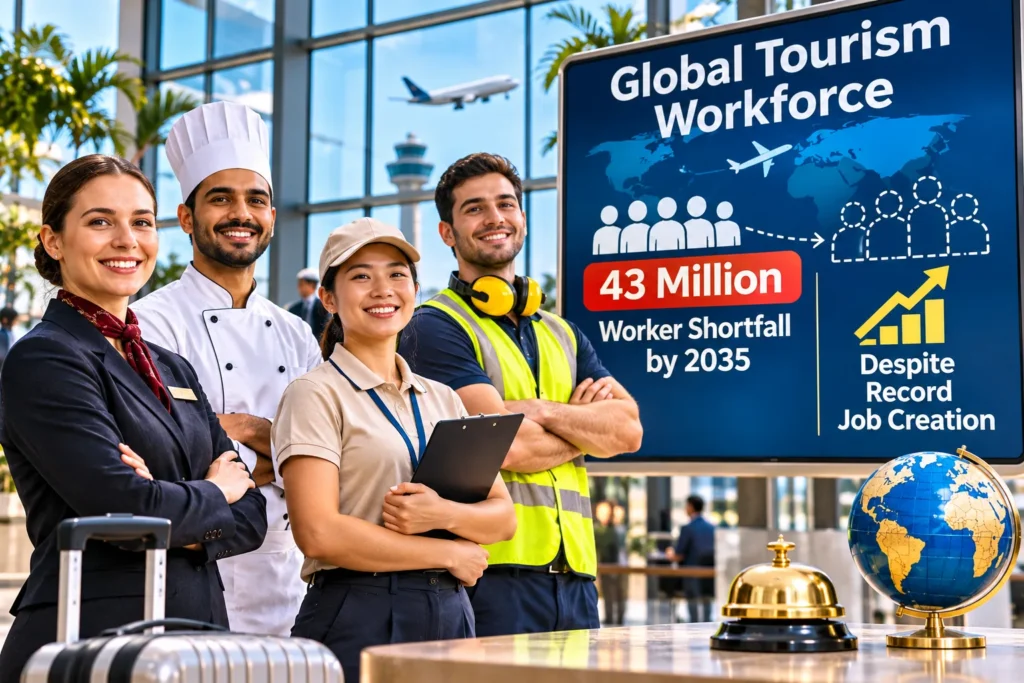
Riyadh, Saudi Arabia, November 26, 2026 — While international travel and hospitality continue to expand at an unprecedented pace, a structural labour gap threatens to constrain the sector’s long-term momentum unless governments, educational institutions, and employers overhaul how they recruit and train talent. According to a new white paper titled The Talent Imperative: How Travel and Tourism Will Build Its Next Generation Workforce, released by the global tourism platform TOURISE in collaboration with travel intelligence firm Skift, the global tourism workforce could face a shortfall of more than 43 million workers by 2035, leaving labour supply roughly 16% below projected industry demand.
Drawing upon empirical research and executive consultations across hospitality, commercial aviation, cruise lines, destination marketing organisations, online travel platforms, and higher education, the report highlights a striking paradox in global employment. Travel and tourism supported a record 366 million jobs worldwide in 2025 and is projected to generate 91 million additional positions by 2035—accounting for one in every three net new jobs created globally over the coming decade. Without coordinated workforce development, however, surging demand for operational and specialist roles risks outstripping available human capital.
Investing in People Alongside Destinations and Infrastructure
Addressing the release of the findings, His Excellency Ahmed Al Khateeb, Minister of Tourism of Saudi Arabia and Chairman of TOURISE, underscored that physical destination development cannot succeed in isolation from human capability. He noted that tourism’s next chapter will be shaped as much by people as by places, stressing that capital commitments to airports, resorts, and cultural attractions must be matched by sustained investment in the professionals who bring visitor experiences to life.
Minister Al Khateeb called on national governments, private-sector operators, and academic leaders to establish clearer entry pathways into hospitality and aviation, accelerate vocational and digital skills training, and offer young professionals rewarding, long-term career trajectories. While emerging technologies will continue to transform daily workflows, he emphasized that human warmth, cultural hospitality, and personal judgment remain irreplaceable pillars of the travel experience.
Five Structural Shifts Redefining Tourism Talent Development
The study outlines five interconnected priorities that industry stakeholders must address to close the projected 43 million worker gap ahead of 2035:
Workforce Readiness as a Core Growth Constraint: With labour supply projected to lag demand by 16% by 2035, talent availability has moved from a routine human-resources function to a strategic economic imperative governing destination competitiveness and service standards.
Accelerating Speed-to-Readiness Over Speed-to-Hire: Recruitment alone does not resolve operational bottlenecks. Survey data in the report indicates that 42% of hiring managers report new employees require four to six months to reach full operational productivity, demonstrating the need for modernised onboarding, practical apprenticeships, and continuous upskilling.
Aligning Careers with Next-Generation Expectations: Younger entrants—particularly Generation Z professionals—place high priority on workplace flexibility, transparent organisational values, and rapid career progression. Employers must replace flat, seasonal job structures with visible advancement ladders and competitive development pathways.
Connecting Local Talent Pipelines with Global Ecosystems: Deepening partnerships among local communities, vocational schools, universities, and hospitality employers expands equitable access to employment while creating resilient regional talent pipelines.
Deploying Artificial Intelligence to Augment Human Capability: Rather than displacing hospitality staff, artificial intelligence and workflow automation can absorb repetitive administrative tasks, streamline staff training, and boost operational efficiency—freeing employees to focus on empathy, problem-solving, and personalised guest engagement.
Aligning Public Policy and Industry Action Ahead of TOURISE 2027
Echoing the urgency of structural reform, Skift Founder and Chief Executive Officer Rafat Ali observed that capturing the sector’s next decade of growth requires designing careers that workers actively want to build and remain in, rather than merely filling short-term vacancies. Organisations that embed structured training, clear upward mobility, and supportive workplace cultures will hold a decisive competitive advantage across aviation, hospitality, and destination services.
As TOURISE prepares to convene global policymakers, ministers, investors, and industry leaders in Riyadh from March 23 to 25, 2027, The Talent Imperative sets a clear agenda for public-private alignment—positioning workforce education, vocational accreditation, and human-centric innovation at the centre of sustainable global tourism growth.
For more travel news like this, keep reading Global Travel Wire