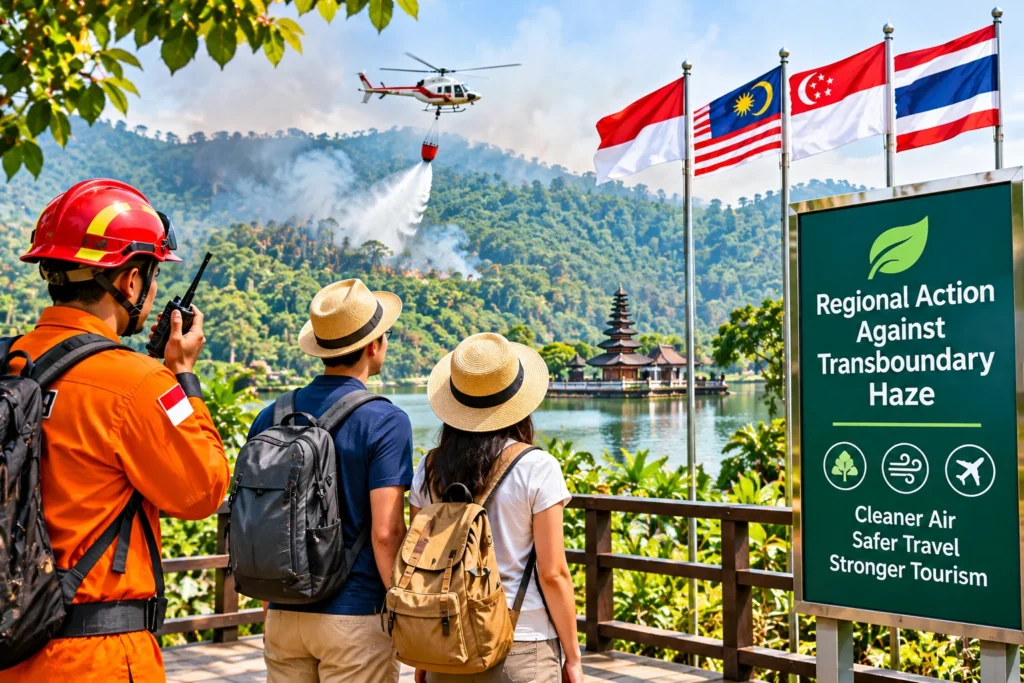
Jakarta, Indonesia, November 26, 2026 — Severe dry-season forest and peatland fires across Indonesia during the second half of 2026 have renewed regional focus on environmental resilience, public health protection, and aviation and tourism continuity across Southeast Asia. Intensified by El Niño weather conditions and prolonged dry spells across Sumatra and Kalimantan, the 2026 fire season generated widespread smoke plumes that degraded air quality domestically and drifted across neighbouring borders into Singapore, Malaysia, and parts of the Philippines.
As seasonal rainfall in late October and early November 2026 brought down fire hotspots and allowed Singapore’s National Environment Agency (NEA) to lift its daily haze advisories on November 7, regional governments have moved swiftly to strengthen joint monitoring, peatland restoration, and bilateral coordination. For the region’s tourism and hospitality sectors, breaking the recurring cycle of Southeast Asia transboundary haze remains vital to safeguarding visitor confidence, outdoor attractions, and international air connectivity.
Why Peatland Ecosystems Hold the Key to Fire Prevention
According to environmental and forestry assessments from Indonesia’s Ministry of Forestry and European Union Copernicus Atmosphere Monitoring Service (CAMS) satellite records, cumulative fire emissions in Indonesia during 2026 ranked among the highest recorded over the past decade. Satellite mapping indicates that roughly 1.9 million hectares of land were affected by fire through September alone, with burning continuing into October before monsoon rains arrived.
At the heart of the challenge are Indonesia’s tropical peatlands. Holding roughly 36% of the world’s tropical peat reserves across more than 24 million hectares, these waterlogged organic ecosystems act as massive natural carbon sinks and remain naturally fire-resistant when intact. However, when drained by agricultural canals or degraded for land clearing, dried peat becomes highly combustible. Unlike surface brush fires, peat fires smoulder deep underground for weeks, making suppression difficult while releasing dense concentrations of fine particulate matter (PM2.5) and carbon emissions.
Although land clearing by burning has been prohibited under Indonesian statutory law since 2009, prolonged drought conditions during El Niño years drastically increase ignition risks across previously drained peatland zones in Sumatra and Kalimantan.
Impacts on Regional Travel, Outdoor Events, and Public Health
During peak haze episodes between August and October 2026, unhealthy air quality readings prompted precautionary public health and event adjustments across multiple Southeast Asian destinations:
Event Postponements and Outdoor Adjustments: In Malaysian Borneo, state education and event authorities in Sarawak postponed school athletics championships and relocated public celebrations indoors during August to protect participants from elevated PM2.5 levels. In Singapore, organisers rescheduled major outdoor community gatherings, while the government’s 28-agency Haze Task Force activated air-conditioned community haze shelters and mask distribution protocols.
Aviation and Visitor Experience: While major international airports across Singapore, Kuala Lumpur, and Jakarta maintained operations, reduced visibility and outdoor air-quality advisories underscored how transboundary smoke directly affects sightseeing, wildlife ecotourism—including orangutan conservation sanctuaries in Kalimantan—and regional leisure travel.
Public Health Burden: Health agencies across affected nations recorded elevated respiratory consultations, prompting targeted medical subsidies and air-quality alert systems to safeguard both residents and visiting travellers.
New Bilateral and ASEAN Frameworks Strengthen Regional Cooperation
In response to the 2026 haze episode, Southeast Asian leaders have prioritized institutional cooperation over diplomatic friction. During the 49th ASEAN Summit in Manila in mid-November 2026, Indonesian President Prabowo Subianto expressed regret to neighbouring Singapore and Malaysia over the transboundary smoke impacts.
In October and November 2026, Indonesia and Singapore announced two concrete institutional initiatives to fortify fire prevention and rapid response:
Bilateral Haze Task Force: A dedicated joint mechanism enabling Indonesian and Singaporean environmental authorities to share real-time satellite hotspot telemetry, weather forecasting, and technical fire-management expertise.
Operationalising the ASEAN Coordinating Centre for Transboundary Haze Pollution Control: Advancing the regional treaty framework established under the ASEAN Agreement on Transboundary Haze Pollution to coordinate early-warning systems, peatland rewetting programmes, and cross-border firefighting assistance.
By combining stricter enforcement against illegal land burning, large-scale canal blocking and peatland rewetting, and transparent regional data sharing, Southeast Asian governments aim to protect public health, preserve biodiversity, and ensure clean skies for regional tourism in 2027 and beyond.
For more travel news like this, keep reading Global Travel Wire