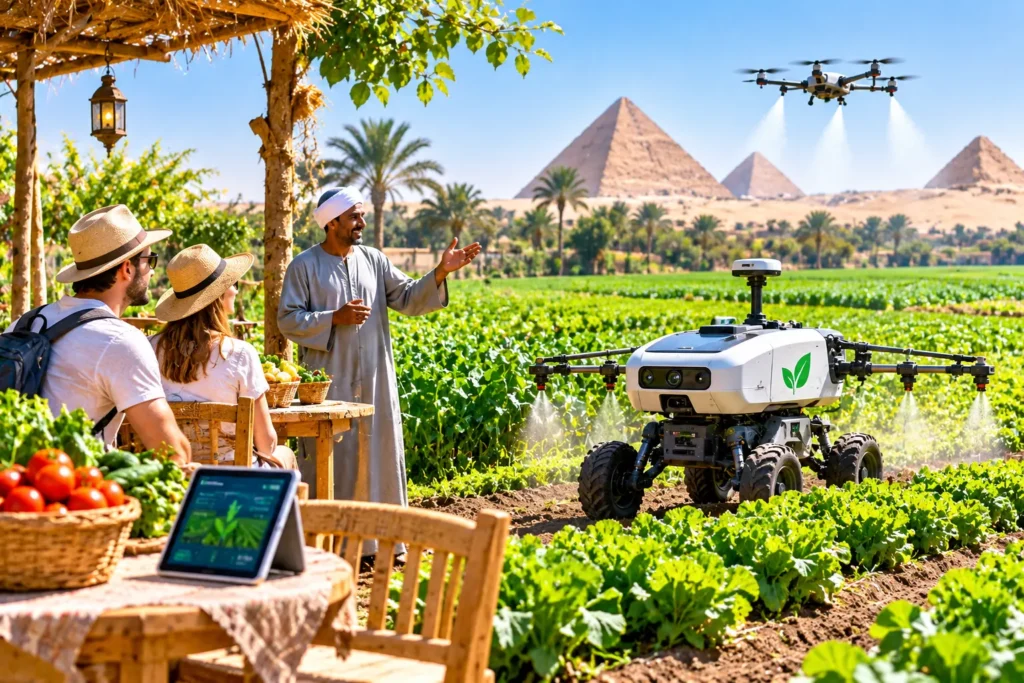
As travelers increasingly seek authentic rural experiences, farm-to-table dining, and eco-conscious cultural journeys, technological innovation in farming is emerging as an unexpected catalyst for sustainable destination development. In Egypt, a breakthrough in autonomous farming software developed by Egyptian engineer Yasmina Reda Mahdy highlights how homegrown artificial intelligence can modernize rural landscapes, preserve traditional agricultural heritage, and enrich agritourism in Egypt alongside the nation’s rapidly expanding visitor economy.
Awarded international recognition for her engineering achievement, Mahdy designed a self-learning system tailored specifically for autonomous agricultural robots. Unlike conventional artificial intelligence models that depend on massive, time-consuming collections of raw training data before functioning effectively, her technology enables robotic platforms to learn independently in the field. By recognizing visual surroundings, interpreting environmental images in real time, and applying that information immediately, the prototype robot is being developed to navigate farmland autonomously, plant seeds, and manage precision irrigation with minimal manual labor.
Connecting Rural Innovation with Egypt’s Record Tourism Growth
The emergence of smart agricultural robotics arrives at a transformative moment for Egypt’s broader travel sector. According to official statistics released by Egypt’s Ministry of Tourism and Antiquities and the State Information Service, the country welcomed a historic milestone of approximately 19 million international tourists in 2025, representing a 21 percent increase over the previous year. Momentum has continued strongly into 2026, with Central Bank of Egypt balance-of-payments data confirming record travel receipts of 18.4 billion US dollars during the 2025–2026 fiscal year.
While iconic archaeological monuments in Luxor, coastal resorts along the Red Sea, and the Grand Egyptian Museum remain primary magnets for global visitors, national development strategies place growing emphasis on sustainable tourism that distributes economic benefits across diverse governorates. Rural communities along the Nile Delta, Faiyum Oasis, and Upper Egypt possess centuries-old agricultural traditions that naturally complement cultural sightseeing. Integrating smart agricultural robotics into working farms helps keep rural cultivation productive, environmentally resilient, and visually vibrant for visitors exploring countryside itineraries.
How Smart Farming Enhances Sustainable Rural Tourism
For travelers drawn to agritourism in Egypt, the appeal lies in experiencing living agricultural landscapes—from date palm groves and citrus orchards to organic herb farms and artisanal culinary workshops. However, smallholder farmers often face intense physical labor demands, seasonal water constraints, and rising operational costs that can threaten the continuity of traditional farms.
By automating repetitive and physically taxing tasks such as precision planting and targeted watering, self-learning agricultural robots allow farmers to dedicate more time to hospitality, guided farm tours, and direct-to-visitor culinary experiences. Furthermore, automated precision irrigation directly supports water conservation across arid and semi-arid farming regions, aligning rural hospitality with international eco-tourism standards. Visitors touring modernizing Egyptian estates gain a firsthand look at how ancient Nile cultivation wisdom harmonizes with twenty-first-century artificial intelligence.
Farm-to-Table Hospitality and Culinary Heritage
Culinary tourism has become a major driver of international travel decisions, and resorts across Cairo, Giza, Luxor, and Aswan increasingly source fresh organic produce directly from nearby agricultural cooperatives. When local farms adopt self-learning robotics to optimize crop yields and reduce resource waste, hotels and eco-lodges benefit from more consistent, traceable supplies of seasonal fruits, vegetables, and aromatic herbs.
This synergy strengthens the farm-to-table value chain within the hospitality industry. Guests staying at countryside eco-retreats or Nile river lodges can participate in harvesting experiences, learn about sustainable desert agriculture, and enjoy authentic regional cuisine knowing that local farming livelihoods are supported by efficient, locally engineered technology.
A Future-Ready Vision for Rural Destination Development
Although Mahdy’s autonomous agricultural robot remains in its active development phase, its core breakthrough—eliminating the heavy data-processing bottleneck that typically restricts AI deployment in developing agricultural regions—holds immense promise for both Egypt and international farming communities. Accessible, adaptable automation ensures that small and medium-sized farms are not left behind as global agriculture digitizes.
As Egypt advances toward its long-term national vision of welcoming 30 million annual visitors through diversified, sustainable tourism offerings, innovations originating from Egyptian engineers and researchers play a vital role. By easing the daily burden on farmers while safeguarding fertile landscapes, smart agricultural robotics helps transform rural heartlands into thriving pillars of sustainable rural tourism and cultural discovery.
For more travel news like this, keep reading Global Travel Wire