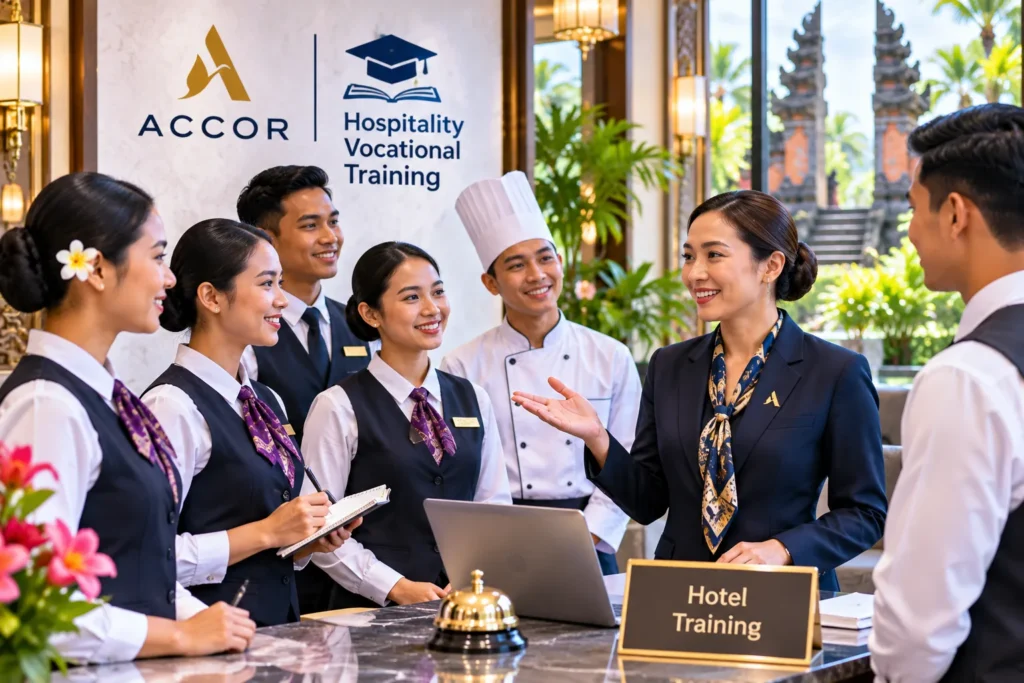
Indonesia is bridging the gap between classroom instruction and international hospitality standards through a new vocational education partnership launched in Jakarta. On November 27, 2026, the Ministry of Primary and Secondary Education, operating through the Directorate General of Secondary and Special Education, formalized a Cooperation Agreement with global hospitality operator Accor at Pullman Jakarta Central Park. Supported by the French Embassy in Indonesia, the initiative establishes a structured, industry-based learning program tailored for vocational high school students specializing in hospitality and culinary arts.
Alternating Learning Model Connects Classrooms With Hotel Operations
Scheduled to run for 18 months from January 2027 through July 2028, the pilot program enrolls 72 students from two prominent public vocational institutions in the capital: SMKN 27 Jakarta and SMKN 57 Jakarta. Rather than limiting workplace exposure to a brief end-of-term internship, the curriculum introduces a continuous two-week rotational system. Participating students spend two weeks completing academic coursework in school, followed immediately by two weeks of hands-on operational practice inside working hotels.
During the initial rollout, between 10 and 12 Accor properties across Indonesia will serve as active training environments and professional learning hubs. By immersing students directly in front-office operations, housekeeping management, food and beverage service, and commercial kitchens, the alternating schedule reinforces theoretical lessons with real-time guest service execution.
Aligning Vocational Competencies With Global Industry Standards
Director General of Secondary and Special Education Tatang Muttaqin emphasized that the collaboration represents a strategic effort to align vocational school curricula with evolving workforce demands across the tourism and service sectors. Beyond elevating student readiness, the initiative incorporates targeted competency development for vocational teachers and education personnel so that classroom instruction stays synchronized with modern hotel operations.
Secretary of the Directorate General of Secondary and Special Education Suparto noted that granting students direct access to international-standard hotel facilities creates a contextual, practical learning ecosystem. He added that this Jakarta cohort functions as an operational pilot to evaluate the alternating learning model before scaling similar industry-integrated classes to additional vocational schools and hospitality partners nationwide.
Industry Certification and Career Pathways for Young Talent
Garth Simmons, Chief Operating Officer for Accor Asia, underscored the group’s long-standing commitment to cultivating local talent across Indonesia, where the company has operated for more than three decades. Through this partnership with the ministry, Accor provides dedicated workplace mentors, structured training modules, and safe, supervised operational environments designed to protect student welfare throughout their placements.
Students who successfully complete the 18-month curriculum and meet competency benchmarks will undergo formal evaluations to earn recognized industry certifications. Furthermore, graduates of the program will gain access to priority recruitment pathways across Accor’s extensive hotel network, creating a direct bridge from secondary education to formal employment in the tourism sector.
Preparing Job-Ready Graduates for Indonesia’s Tourism Economy
School leaders welcomed the agreement as a transformative step for student employability. Acting Principal of SMKN 27 Jakarta Khairan Deslina expressed confidence that aligning workplace rotations with students’ academic progression will equip graduates with the practical confidence and technical discipline required to enter the workforce immediately upon completing school.
The initiative complements broader national workforce development priorities, including the government’s SMK Go Global agenda aimed at equipping Indonesian vocational graduates with internationally competitive skills. As Indonesia continues to expand its domestic and international tourism offerings, collaborative training frameworks between education ministries and global hospitality operators ensure that emerging local professionals are prepared to deliver world-class service across the archipelago.
For more travel news like this, keep reading Global Travel Wire