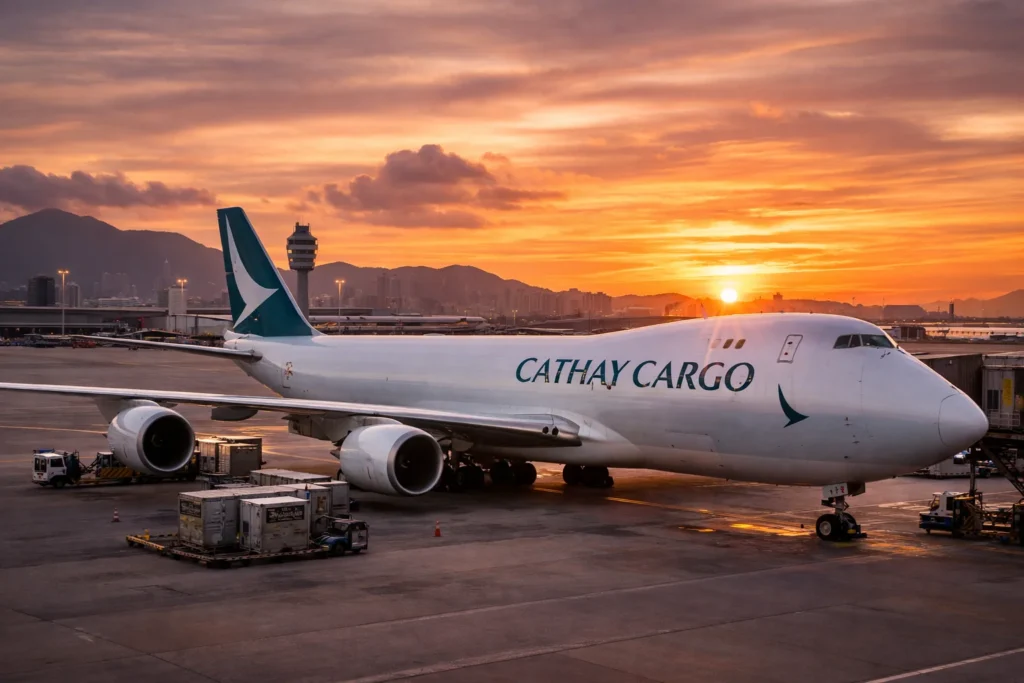
Cathay Cargo is actively reviewing alternative routing strategies across its Asia-Europe network as ongoing operational challenges and rising fuel costs reshape global aviation logistics. The move reflects broader industry adjustments as airlines respond to changing airspace conditions and economic pressures affecting both passenger and cargo services.
The airline has confirmed that modifications to its flight operations have resulted in capacity limitations, particularly on routes that previously relied on stopovers in key Middle Eastern hubs. Adjustments to services in the region have led to a shift toward direct long-haul operations, which, while maintaining connectivity, have introduced payload restrictions due to increased flight distances.
These developments are closely linked to operational decisions involving destinations such as Dubai and Riyadh, where services have been temporarily adjusted. As a result, Cathay Cargo is now exploring mid-point stops along the Asia-Europe corridor to optimise efficiency and restore capacity levels.
The search for suitable mid-point locations is aimed at balancing operational constraints while maintaining reliable cargo services. Mid-point stops can help airlines manage fuel loads, reduce payload limitations, and improve overall route efficiency. This strategy is increasingly being adopted by carriers facing similar challenges in long-haul operations.
Hong Kong remains a central hub for Cathay Cargo’s operations, supported by its position as one of the world’s busiest cargo gateways. Authorities overseeing aviation infrastructure in the region continue to prioritise efficiency and resilience, ensuring that cargo operations remain robust despite external challenges.
The airline’s response also highlights the growing impact of rising aviation fuel costs on global air transport. According to industry data referenced by aviation bodies, jet fuel prices have seen a significant increase in recent weeks, driven by fluctuations in crude oil markets and refining costs. Fuel expenses represent a substantial portion of airline operating costs, making them a critical factor in route planning and pricing strategies.
For Cathay Cargo, fuel costs accounted for a significant share of total operational expenditure in recent years. While fuel hedging strategies are used to mitigate price volatility, current market conditions have limited their effectiveness. The rapid increase in fuel prices has prompted the airline, along with others in the industry, to implement fuel surcharges to manage financial pressures.
These adjustments have implications not only for cargo operators but also for the broader tourism and travel ecosystem. Air cargo plays a vital role in supporting global supply chains, including the movement of goods essential for tourism-related industries such as hospitality and retail. Disruptions in cargo capacity can influence the availability and cost of goods across destinations.
The Asia-Europe trade route remains one of the most important corridors in global aviation, connecting major economic and tourism markets. Ensuring the continuity of services along this route is essential for maintaining international connectivity and supporting economic activity.
Despite current challenges, Cathay Cargo has indicated its commitment to maintaining service levels wherever possible. The airline continues to work closely with partners and stakeholders to navigate operational complexities and ensure that cargo capacity is preserved.
The situation also underscores the interconnected nature of global aviation. Changes in one region can have far-reaching effects on international routes, requiring airlines to adapt quickly to evolving conditions. Flexibility in route planning and operational strategy has become a key factor in maintaining resilience.
In addition to fuel costs and route adjustments, market conditions have been influenced by seasonal factors and shifting demand patterns. While the early part of the year saw steady performance, recent developments have introduced volatility, prompting airlines to reassess their strategies.
Aviation authorities and industry organisations continue to monitor these trends, providing guidance and support to ensure stability in the sector. Efforts to enhance operational efficiency and promote sustainable practices are expected to play an important role in addressing long-term challenges.
For the tourism sector, maintaining reliable air connectivity is essential. Airlines and cargo operators contribute to the smooth functioning of international travel by supporting the movement of goods and facilitating global trade. Any disruption in these services can have indirect effects on tourism growth and destination accessibility.
Looking ahead, the search for alternative mid-point solutions reflects a proactive approach by Cathay Cargo to adapt to changing conditions. By exploring new routing options, the airline aims to overcome current limitations and maintain its role as a key player in global air cargo.
The broader aviation industry is expected to continue evolving in response to economic and geopolitical factors. Airlines that can effectively manage costs, optimise operations, and adapt to changing market dynamics are likely to remain competitive in this environment.
As global travel and trade continue to recover and expand, the importance of resilient and efficient aviation networks becomes increasingly clear. Cathay Cargo’s efforts to address capacity challenges and rising costs demonstrate the industry’s ongoing commitment to maintaining connectivity and supporting global tourism and commerce.