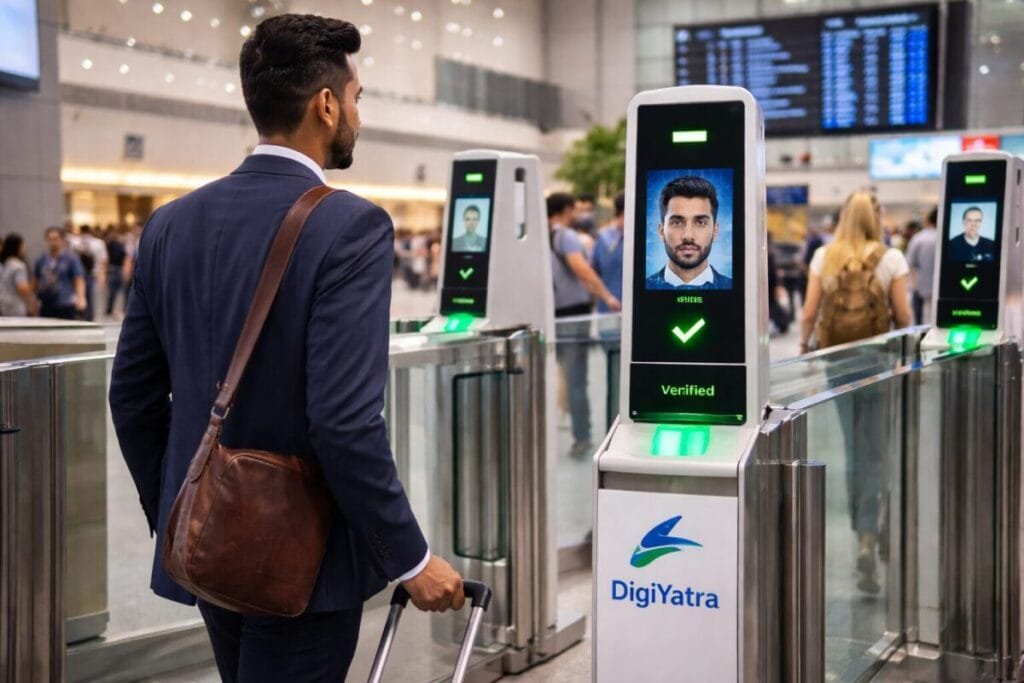
India’s aviation sector prepares for a major transformation with the launch of DigiYatra at Navi Mumbai International Airport. Authorities plan to integrate advanced biometric systems to improve passenger efficiency and reduce congestion.
The new airport will serve as a second major hub for the Mumbai Metropolitan Region. Officials aim to ease pressure on Chhatrapati Shivaji Maharaj International Airport, which currently handles heavy traffic volumes. By embedding DigiYatra from the start, planners want to create a smooth and paperless passenger journey.
Understanding the DigiYatra Biometric Framework
The Ministry of Civil Aviation leads the DigiYatra initiative. The program promotes a digital travel ecosystem built around Facial Recognition Technology.
Passengers register through the DigiYatra mobile application and verify their identity using Aadhaar credentials. Once verified, the system links facial data with the boarding pass. Cameras at airport entry points confirm identity without manual document checks.
This automated process reduces waiting time and streamlines terminal movement. Travelers no longer need to present physical identification at every checkpoint. Instead, biometric gates manage access in seconds.
Officials emphasize data security and privacy. The system encrypts personal information and stores it securely. Airports use data only for travel validation during the journey.
Strategic Importance of Navi Mumbai International Airport
Navi Mumbai International Airport addresses long-standing capacity concerns in the Mumbai region. Rapid passenger growth created pressure on existing infrastructure. Government planners approved the new airport to meet future aviation demand.
The site will eventually handle millions of passengers annually. Designers incorporated advanced logistics, sustainable architecture, and digital systems into the blueprint. DigiYatra aligns with this forward-looking vision.
Authorities aim to position the airport as a benchmark for smart aviation infrastructure in India. Early integration of biometric systems ensures readiness for rising domestic and international travel.
Passenger Benefits and Operational Efficiency
Biometric gates at entry points and security zones will transform the passenger experience. Travelers approach a camera, and the system verifies identity instantly. If credentials match the flight record, access follows immediately.
This efficiency reduces congestion during peak hours. Passengers can move quickly toward retail areas, lounges, or boarding gates. Airports benefit from improved crowd management and optimized terminal flow.
Business travelers, in particular, value time savings. Faster processing supports productivity and encourages corporate travel growth. Leisure passengers also enjoy a more relaxed pre-flight experience.
Digital processing also reduces manual workload for airport staff. Security personnel can focus on surveillance and high-priority tasks rather than routine document checks.
Construction Progress and Digital Readiness
Construction at Navi Mumbai International Airport continues under close supervision from state and central authorities. Developers have completed major milestones in runway and terminal infrastructure.
Officials now conduct system testing and technical calibrations. Teams test landing systems, baggage handling units, and biometric scanners. They aim to ensure full integration before public operations begin.
Careful planning helps prevent operational challenges during launch. Authorities want all digital and physical systems to function seamlessly from day one.
The airport’s design also incorporates sustainable elements. Energy-efficient systems and modern construction standards reflect India’s broader infrastructure goals.
Economic Impact and Regional Connectivity
The new airport will stimulate economic growth in Navi Mumbai and nearby Raigad district. Improved connectivity will attract investment, tourism, and business activity.
Infrastructure projects such as the Mumbai Trans Harbour Link and new metro lines will support passenger access. Efficient transport networks combined with DigiYatra technology create a powerful mobility ecosystem.
Hospitality developments, logistics parks, and commercial zones are likely to expand around the airport corridor. Faster passenger processing enhances the hub’s attractiveness for airlines and travelers alike.
Tourism authorities expect smoother airport operations to encourage both domestic and international visitors. Reliable processing systems strengthen India’s image as a modern aviation destination.
Advancing the Digital India Vision in Aviation
DigiYatra reflects India’s commitment to digital transformation under the broader Digital India initiative. Aviation serves as a key platform for deploying indigenous technology solutions.
Biometric travel enhances transparency, security, and operational efficiency. The system creates a single-token journey, where facial recognition replaces multiple document checks.
As more airports adopt DigiYatra, travelers can expect consistent digital experiences nationwide. Standardization across airports simplifies movement and strengthens network integration.
Collaboration and Future Outlook
The successful rollout of DigiYatra at Navi Mumbai International Airport depends on strong coordination between developers and the DigiYatra Foundation. Technology teams continue refining software compatibility and hardware performance.
Authorities initially plan to focus on domestic operations. However, future phases may expand biometric integration to international departures. This expansion would further simplify cross-border travel procedures.
India’s aviation market continues to grow rapidly, supported by rising middle-class travel demand and airline expansion. Modern infrastructure and digital innovation remain essential to meeting this growth.
With DigiYatra at its core, Navi Mumbai International Airport aims to deliver faster processing, stronger security, and a more efficient passenger journey. The project marks a decisive step toward a fully digital aviation future in India.
For more travel news like this, keep reading Global Travel Wire