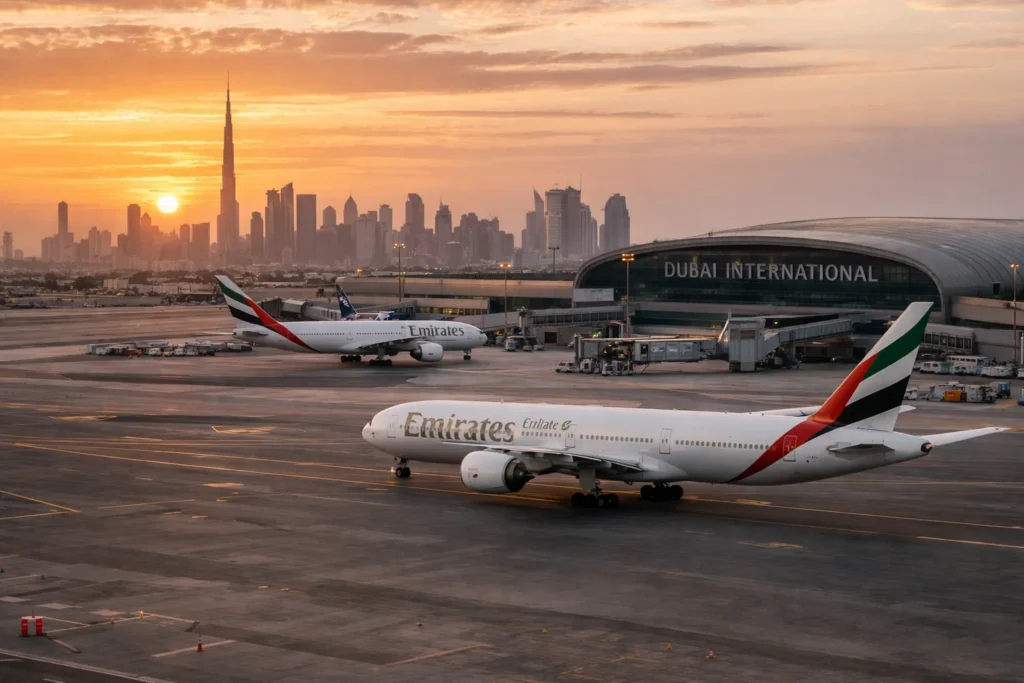
Dubai, a leading global tourism and aviation hub, has introduced a temporary one-flight-per-day limit on foreign airlines operating into its airports, significantly impacting international travel flows and tourism connectivity, particularly between India and the United Arab Emirates. The measure, set to remain in place until 31 May 2026, reflects operational adjustments in response to evolving regional conditions and airport capacity management.
The restriction applies to both Dubai International Airport, widely regarded as the world’s busiest international passenger airport, and Al Maktoum International Airport, which supports Dubai’s long-term aviation expansion plans. Under the new guidelines, each foreign airline is permitted only one round-trip service per day during the summer scheduling period.
Dubai’s aviation infrastructure plays a central role in global tourism, acting as a major transit and destination hub linking continents. The city’s tourism strategy, supported by official government initiatives, has consistently emphasized seamless air connectivity as a key driver of visitor arrivals. However, the current flight cap highlights how external factors can influence travel operations even in highly developed aviation markets.
The impact of the Dubai flight cap is expected to be particularly significant for Indian airlines, given the strong travel demand between India and Dubai. Official aviation data confirms that India remains the largest source market for passengers traveling through Dubai, with millions of travellers contributing to the emirate’s tourism economy each year. This high volume of traffic has traditionally supported frequent flight operations by Indian carriers.
Airlines such as Air India, IndiGo, and SpiceJet had planned extensive flight schedules to Dubai for the April–May period, reflecting strong tourism and business demand. With the implementation of the one-flight-per-day restriction, these carriers are now required to scale back operations significantly, leading to reduced seat capacity and adjustments in travel planning.
From a tourism perspective, the reduced flight availability may affect short-term visitor flows to Dubai, especially from India, which is a key source market for leisure, shopping, and business tourism. Tourism authorities have consistently highlighted the importance of maintaining robust connectivity to sustain visitor numbers, and any limitation on flights can influence travel demand patterns.
The situation also underscores broader challenges within the aviation sector. Indian airlines are currently managing rising operational costs, including increased Aviation Turbine Fuel prices as indicated by official government data. Additionally, ongoing airspace restrictions in certain regions have resulted in longer flight routes for international journeys, increasing fuel consumption and operational complexity.
Industry stakeholders have responded by seeking government intervention. The Federation of Indian Airlines has urged authorities to engage in discussions aimed at restoring balanced aviation access. The organization has expressed concerns that the current restrictions may create an uneven operating environment, particularly if domestic UAE carriers are not subject to similar limitations.
For Dubai’s tourism sector, the temporary flight cap reflects a strategic approach to managing airport capacity during a period of uncertainty. The emirate has demonstrated resilience in the face of global challenges, supported by coordinated efforts between aviation authorities, tourism boards, and government agencies. While the restrictions are temporary, they highlight the importance of flexibility in maintaining operational efficiency.
Despite the limitations, Dubai continues to promote its diverse tourism offerings, including world-class hospitality, retail experiences, cultural attractions, and international events. Official tourism campaigns remain focused on attracting visitors while ensuring that travel experiences meet high standards of safety and service quality.
For travellers, the current situation emphasizes the need for proactive planning. Tourism authorities recommend monitoring official airline schedules and travel advisories, as capacity constraints may lead to changes in flight availability. Early booking and flexible travel plans can help mitigate the impact of reduced flight frequencies.
Looking ahead, the Dubai flight cap is expected to remain in effect until the end of May, after which authorities may review and adjust capacity based on operational conditions. The restoration of flight frequencies will be a key factor in shaping tourism recovery and travel demand during the upcoming peak seasons.
In the broader context of global tourism, the development highlights the interconnected nature of aviation and travel industries. Changes in airline operations can have immediate effects on tourism flows, airline performance, and traveller behavior. Dubai’s response demonstrates how major travel hubs adapt to evolving conditions while maintaining their commitment to global connectivity.
As one of the world’s most visited destinations, Dubai’s ability to navigate these temporary disruptions will be closely observed by the international tourism community. The current measures, while limiting in the short term, represent a strategic effort to balance operational capacity with long-term growth in tourism and aviation.