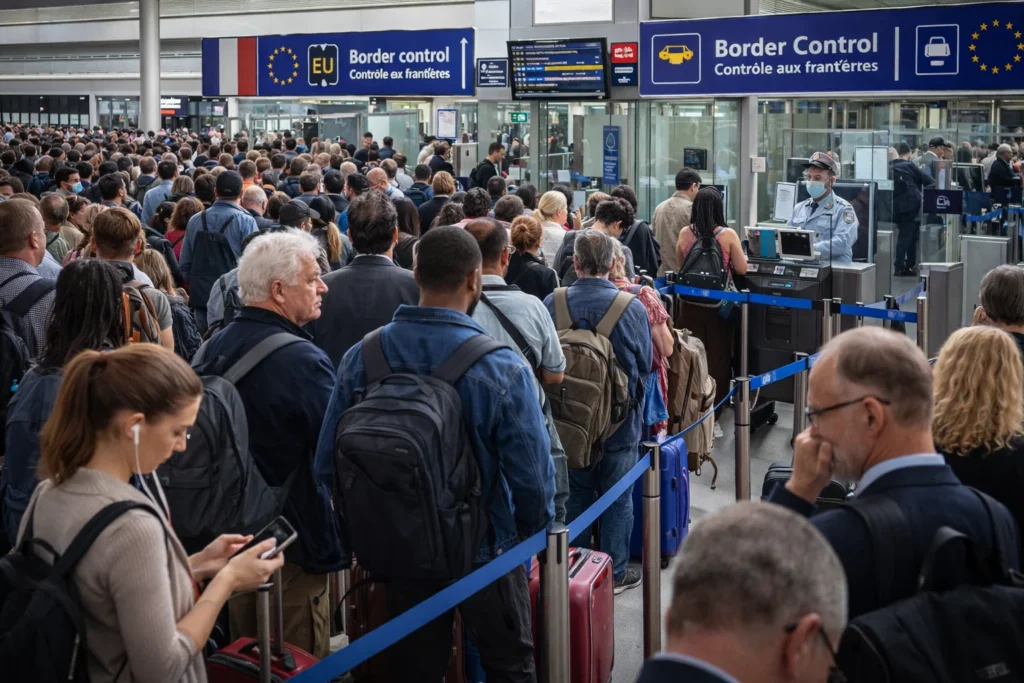
A major shift in Europe’s border control system is creating widespread disruption at some of the continent’s busiest airports, with passengers experiencing longer queues and extended waiting times. The introduction of the new Entry Exit System (EES) is reshaping how travelers are processed across the Schengen region, impacting key aviation hubs such as Paris Charles de Gaulle, London Heathrow, Amsterdam Schiphol, Madrid Barajas, and Lisbon.
The new system, designed to strengthen border security and modernize immigration processes, requires biometric registration for travelers entering and exiting the Schengen area. While the initiative aims to enhance safety and streamline long-term border management, its rollout has led to immediate operational challenges, particularly during peak travel periods.
Biometric Checks Slow Passenger Processing
At the core of the disruption is the introduction of mandatory biometric verification for non-EU travelers, including visitors from countries like the United Kingdom and the United States. Each passenger must now undergo identity verification using facial recognition and fingerprint scanning.
Although the process may take just over a minute per traveler, the cumulative impact at high-traffic airports is significant. With thousands of passengers arriving within short time frames, even small delays quickly build into long queues. Airports that already operate near full capacity are finding it difficult to absorb the additional processing time.
Major European Airports Under Pressure
Airports across Europe are feeling the strain as passenger volumes continue to rise. Paris Charles de Gaulle, one of the busiest international gateways in Europe, has reported noticeable increases in waiting times at immigration checkpoints. Similar situations are unfolding at Amsterdam Schiphol and Madrid Barajas, where congestion has intensified during peak hours.
Even London Heathrow, which operates outside the Schengen zone but connects heavily with European destinations, is experiencing indirect impacts due to increased processing times for passengers traveling onward to EU countries.
Lisbon Airport has also emerged as a hotspot for delays, particularly as Portugal remains one of the early adopters of digital pre-registration tools associated with the system. However, uneven implementation across countries has limited the effectiveness of such solutions.
April Deadline Adds to the Pressure
A key factor intensifying the disruption is the recent policy shift that restricts flexibility in applying the Entry Exit System. Previously, airports had the option to temporarily suspend certain procedures during periods of heavy congestion. This allowed border authorities to manage passenger flow more efficiently.
However, new regulations introduced in April require continuous processing without full suspension options. As a result, airports must now handle all travelers through the system regardless of crowd levels, leading to sustained pressure during busy travel seasons.
With major holidays such as Easter and the upcoming summer travel surge, passenger numbers are expected to increase significantly. Early reports suggest that waiting times at some airports have already exceeded two hours, raising concerns about further delays in the coming months.
Operational Challenges and Staffing Gaps
Beyond the new technology, operational issues are also contributing to the delays. Many airports are currently facing staffing shortages, particularly in border control roles that require specialized training. Recruiting and preparing personnel for the new system takes time, leaving existing staff to manage increased workloads.
Technical challenges are another factor. Some airports have reported issues with biometric equipment, including slow processing speeds and occasional system glitches. In locations where infrastructure is not fully upgraded, bottlenecks are becoming more frequent.
Coordination between airlines, airport authorities, and border agencies also plays a critical role. Inconsistent communication and uneven readiness across different regions have further complicated the transition.
Can Technology Help Reduce Delays?
Authorities have introduced several measures to ease the transition, including a temporary flexibility window allowing partial adjustments to the system. However, these measures are limited in scope and cannot fully eliminate delays.
A digital pre-registration application has also been launched, enabling travelers to submit personal data before arrival. While this has the potential to reduce processing times at airports, adoption remains low and availability is currently limited to select countries.
Fallback procedures are in place in case of technical failures, but these rely on manual processing, which is slower and less efficient. As a result, technology alone may not provide an immediate solution unless supported by wider adoption and improved infrastructure.
What Travelers Should Expect
For passengers planning trips to or within Europe, longer waiting times at airports are likely to become the new normal, at least in the short term. Travelers are advised to arrive earlier than usual, especially during peak travel seasons, and to allow extra time for border formalities.
The changes are particularly relevant for non-EU travelers, who will be directly affected by the biometric requirements. However, the overall impact on airport operations means that even EU passengers may experience indirect delays due to congestion.
A Transitional Phase for European Travel
The introduction of the Entry Exit System marks a significant transformation in how Europe manages its borders. While the long-term goal is to create a more secure and efficient system, the current phase represents a period of adjustment for both airports and travelers.
As infrastructure improves, staffing levels increase, and technology becomes more widely adopted, the situation is expected to stabilize. However, in the near future, passengers should prepare for continued disruption across major European airports.
The evolving travel landscape highlights the growing importance of digital systems in aviation, but also underscores the challenges of implementing large-scale changes in a high-demand environment. For now, patience and preparation will be key for anyone navigating Europe’s busy skies.